
Small bread beetle
Harpalus herbivagus
Description
How to identify
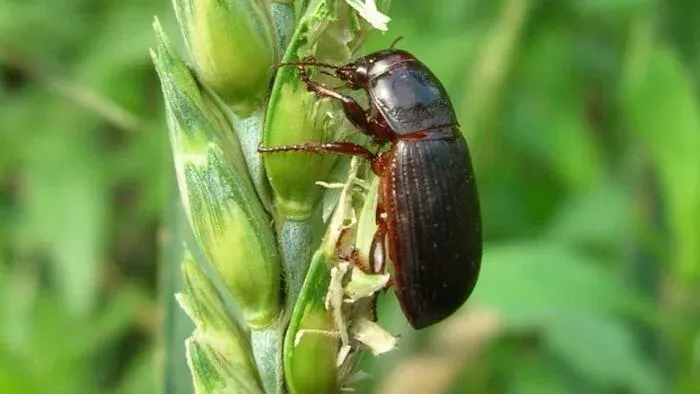
The small bread beetle (Harpalus herbivagus) is a member of the Carabidae family, known as ground beetles, within the order Coleoptera. Adult beetles are small, characterized by a flattened, dark brown or black body with a subtle metallic sheen.
These beetles possess strong mandibles adapted for both predatory behavior and consumption of plant material. Their legs are well-developed, allowing them to scuttle quickly across the soil surface and hide within organic debris.
Larvae are campodeiform, featuring a yellowish-white appearance and distinct thoracic legs. They spend most of their life cycle in the upper soil layers, making them difficult to detect without careful soil sampling.
Morphologically, they are distinguished by specific patterns on the pronotum and elytra. Accurate identification often requires professional entomological assessment to differentiate them from other harmless or beneficial ground beetle species.
Their biology is highly dependent on environmental humidity and the presence of mulch or crop residues, which serve as essential micro-habitats for their daily rest and survival.
What it damages
This beetle primarily affects cereal crops, including winter wheat, rye, and barley. It is considered a pest because it feeds on seeds, germinating embryos, and young plant stems.
The most critical damage occurs during the germination phase. Larvae and adults can consume the seed embryo while it is still in the soil, leading to poor emergence and sparse crop density that often necessitates replanting.
During the grain-filling stage, adult beetles may climb up the stems to feed on ripening kernels. This results in hollow, damaged ears, which significantly reduces the final grain weight and overall yield quality.
Young seedlings can also be damaged at the root level, causing the plants to wither and die prematurely. This type of injury is particularly devastating in fields with high beetle population densities.
Fields with significant crop residues from the previous harvest are more prone to infestation, as the debris provides an ideal environment for the beetles to thrive and reproduce.
When it appears
The life cycle of the small bread beetle is generally univoltine, with one generation per year. Both adults and larvae can overwinter in the soil or under protective plant cover.
In spring, as soil temperatures rise, adults emerge and begin feeding on early vegetation, such as grain volunteers and various weeds, before migrating into newly planted fields.
The egg-laying period typically occurs in late spring and early summer. Females deposit their eggs into the soil, targeting areas with sufficient moisture to ensure the survival of the developing larvae.
Larvae remain active throughout the summer, feeding on organic matter and roots. By late summer or early autumn, they complete their development, pupate, and emerge as a new generation of adults.
These new adults feed intensively during the autumn to build energy reserves for winter, which coincides with the emergence of winter cereal seedlings, making them particularly vulnerable during this period.
Signs of infestation
One of the first signs of infestation is the presence of uneven patches in the field where seedlings have failed to emerge. Digging into these spots often reveals partially consumed or hollowed-out seeds.
Seedlings may show signs of leaf damage, appearing ragged or gnawed along the edges. In severe infestations, the entire seedling may be cut off at the soil surface, leaving only a stub behind.
During the ripening phase, visual inspection of the ears may reveal damaged husks and the absence of kernels, particularly in the lower and middle sections of the grain head.
Nighttime observation with a flashlight is the most effective method for detecting active adults. They are primarily nocturnal and can be found roaming the soil surface after dark.
The presence of larvae in soil samples taken from problematic field areas is a definitive indicator of an active pest population that requires immediate agronomic intervention.
Control measures
Crop rotation is the primary strategy for managing this pest. Avoiding consecutive cereal crops for at least three to four years effectively disrupts the beetle's life cycle and reduces soil populations.
Deep autumn plowing is a highly effective mechanical control measure. It exposes larvae and pupae to the surface, where they become vulnerable to predators like birds and environmental stress.
Proper field maintenance, including the thorough incorporation of post-harvest crop residues, minimizes the shelter available for beetles and forces them to move elsewhere.
Using insecticidal seed treatments is the standard protective measure for susceptible crops. This ensures that the seed and the young seedling are protected during the most critical stage of development.
If population levels exceed economic thresholds, foliar insecticide applications may be necessary. It is crucial to rotate chemical classes to prevent the development of resistance within the beetle population.
Taxonomy
- Latin name
- Harpalus herbivagus
- Order
- Coleoptera (beetles)
- Family
- Carabidae
- EPPO code
- HARPHE
Discussion
No discussions yet — be the first.