
Harpalus distinguendus
Harpalus distinguendus
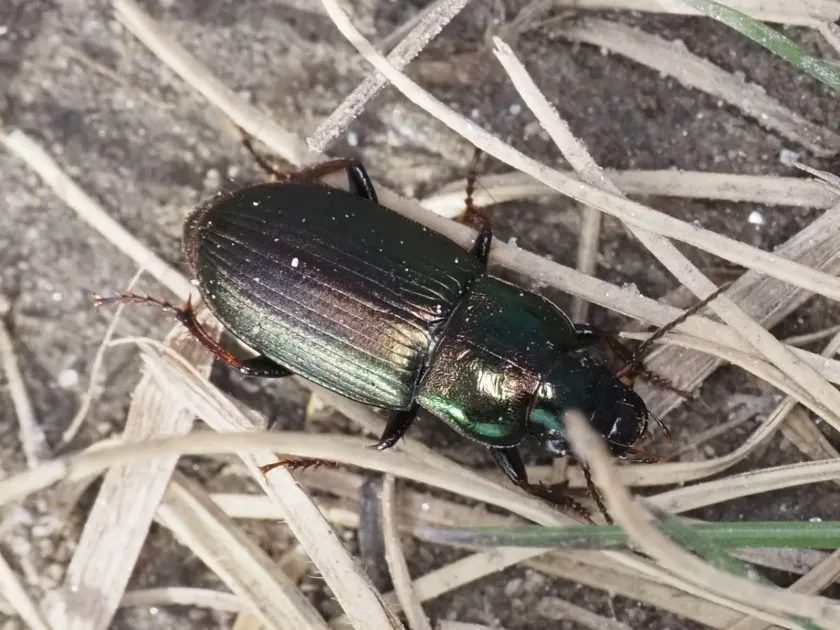
Description
How to identify
Harpalus distinguendus is a species of ground beetle belonging to the family Carabidae. Adult beetles typically measure 9–11 mm in length, possessing a black, metallic-sheened body with reddish-brown legs.
The larvae are approximately 20 mm long, featuring an elongated, dirty-white or greyish body with sclerotized tergites. Their heads are well-developed, equipped with strong mandibles adapted for chewing plant tissues.
These beetles are primarily nocturnal or crepuscular, spending the daylight hours concealed under soil clumps, crop residues, or within soil fissures. During population peaks, they can be observed on the soil surface at dusk.
The life cycle undergoes complete metamorphosis, including egg, larva, pupa, and adult stages. In temperate climates, the species completes one generation per year, with adults typically overwintering in the soil.
They are typical inhabitants of agroecosystems, favoring cereal fields and perennial grasses where conditions for feeding and reproduction are optimal.
What it damages
While polyphagous, this beetle causes significant economic damage to cereal crops such as wheat, rye, barley, and oats. Both the adult beetles and their larvae cause injury to the plants.
Adults feed on grains during the milk and wax ripening stages by gnawing the content, which leads to substantial yield losses and reduced seed quality for subsequent planting.
Larvae, unlike the adults, often feed on emerging seedlings and the basal parts of stems, potentially causing crop thinning and plant mortality during the autumn establishment period.
Beyond cereal crops, the species can feed on the seeds of various weeds, such as Chenopodium album, which allows the population to persist in fields even in the absence of a preferred crop.
The secretive nature of this pest makes early detection challenging, necessitating consistent field monitoring throughout the growing season.
When it appears
Emergence from overwintering sites typically begins in spring when soil temperatures reach 8–10°C. Adult activity continues throughout the spring and summer months.
Egg-laying occurs in the soil during the summer. Optimal conditions for reproduction include warm and moderately humid weather patterns.
Larvae are actively feeding from late summer through the autumn, after which they retreat deeper into the soil for overwintering. Spring larval feeding is less intensive as they rapidly transition toward pupation.
Grain damage by adults coincides with the grain filling and ripening stages, representing the most critical window for protection management.
Climatic factors, including heavy rainfall or severe drought, significantly influence population dynamics and larval survival within the soil profile.
Signs of infestation
A primary indicator of infestation is the presence of gnawed grains within the ear. Upon inspection, one can observe damaged glumes and partially or completely consumed kernels.
Seedlings may exhibit chewed margins or lesions near the base, which are sometimes mistaken for damage caused by other soil-borne pests.
Soil sampling in fields with a history of cereal production may reveal larvae in the top 10 cm of the soil, particularly near crop residue clusters.
Large numbers of beetles captured in light traps or observed during evening soil excavations indicate high population density and the need for immediate intervention.
High weed density often serves as an indirect indicator, as these plants provide a consistent food source for the beetles throughout the growing season.
Control measures
Adhering to strict crop rotation practices is the primary agronomic method to manage populations, as it breaks the developmental cycle by avoiding cereal monocropping.
Deep autumn or spring plowing is an effective cultural practice, as it exposes larvae and pupae to surface predators and adverse environmental conditions.
Seed treatment with systemic insecticides before planting provides essential protection for young seedlings against early-stage larval damage.
During the grain-ripening phase, if population thresholds are exceeded, targeted applications of authorized contact or systemic insecticides may be necessary.
- Timely harvest to prevent grain shattering and residual food sources.
- Destruction of cereal volunteers post-harvest.
- Stubble cultivation immediately following combine operations.
Taxonomy
- Latin name
- Harpalus distinguendus
- Order
- Coleoptera (beetles)
- Family
- Carabidae
- EPPO code
- HARPDI
Discussion
No discussions yet — be the first.