
Harpalus calceatus
Harpalus calceatus
Description
How to identify
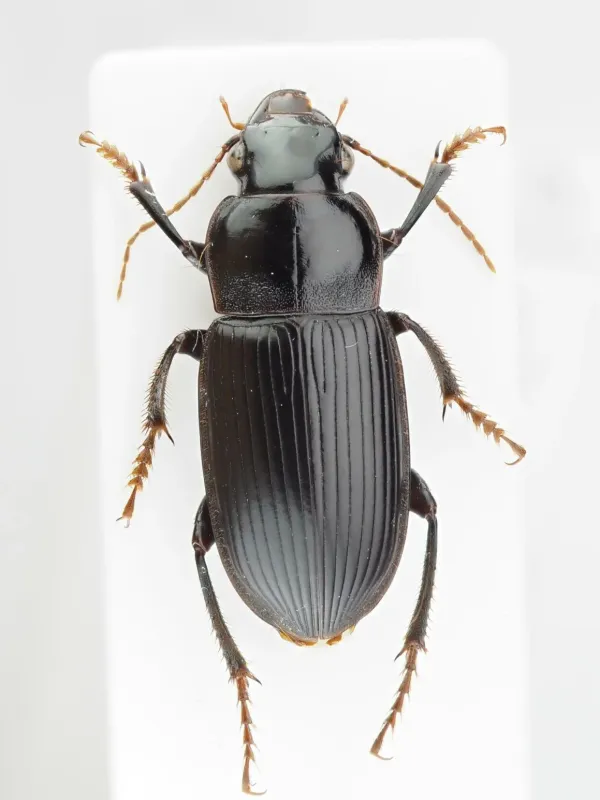
Harpalus calceatus, commonly known as a type of ground beetle (family Carabidae), is a beetle species that can cause damage to cereal crops. Adults typically measure between 12 and 16 mm in length and exhibit a black color with a subtle metallic sheen.
A key distinguishing feature of this species is the dense, fine pubescence (hair) covering the upper surface of its body. The pronotum is broad with blunt posterior angles, and the elytra feature distinct, finely punctured longitudinal striae.
The larvae are elongated, possessing well-developed thoracic legs and strong mandibles for chewing. They are typically gray-white to brown in color, which provides effective camouflage in the soil environment.
As nocturnal insects, these beetles remain hidden during the day in soil cracks, under crop residues, or beneath foliage. This behavior often makes them difficult to detect during standard daytime crop inspections.
They prefer open, warm habitats like steppes and cultivated fields, where the presence of seeds from various grasses and weeds provides an optimal food source for adult beetles.
What it damages
The primary damage is caused by adult beetles that feed on developing grain during the milk and dough stages. They chew into the kernels of wheat, barley, and other cereals, leaving behind empty or partially consumed hulls.
In addition to small grains, Harpalus calceatus may cause significant damage to sunflower crops by feeding on the developing seeds within the flower heads. This impacts both the overall weight of the harvest and the market quality of the seeds.
While larvae are primarily scavengers or predators, they can occasionally feed on the emerging sprouts of crops when alternative food sources are scarce, potentially thinning stands.
Significant infestations are often correlated with warm, extended autumns, which increase the survival rate of the new generation, leading to higher population density in the following season.
Economic damage is most severe on field edges or areas with high weed pressure, where the beetles congregate before moving into the main crop to feed on the maturing grain.
When it appears
The life cycle of Harpalus calceatus involves overwintering either as adult beetles or as late-stage larvae within the soil. Activity commences early in the spring as soil temperatures rise.
The flight and emergence of overwintered adults typically occur in April and May. Following emergence, the beetles mate and lay eggs in the soil near the root zones of host plants.
Peak activity that poses a threat to crop yields occurs during the summer months, specifically when cereal crops are filling their grains. This is when the beetles are most ravenous.
In late summer and autumn, the new generation completes its development. The beetles feed heavily on weed seeds and organic matter to build up fat reserves required to survive the winter dormant period.
In temperate climates, the species generally completes one generation per year, though variations in climate can lead to slightly staggered development phases across different populations.
Signs of infestation
The primary visual sign of infestation is the presence of "empty" or "white" ears in wheat or barley, resulting from the beetle's habit of hollowing out the grains within the spikelets.
Close inspection of the ears reveals mechanical damage to the seed coats, characterized by small, neatly chewed holes or completely consumed grain interiors that are easily distinguishable from fungal rot.
During the early morning or late evening, scouting efforts may reveal the beetles themselves moving along the soil surface or congregating under the protective cover of leaf sheaths.
At harvest time, a reduced grain weight and the presence of significant amounts of shriveled or broken seed fragments in the combine's hopper are strong indicators of larval or adult activity.
On sunflower crops, the damage appears as irregular patterns of seed loss in the head, often accompanied by the remains of the consumed seeds scattered on the head's surface.
Control measures
The most effective strategy for managing Harpalus calceatus is through sound crop rotation, which disrupts the beetle's life cycle and prevents the buildup of stable populations in the field.
Deep autumn plowing (tillage) is essential, as it physically destroys larvae and disturbs the soil conditions necessary for the beetles to successfully overwinter.
Effective weed management on field borders and within the fields themselves reduces the availability of secondary food sources, making the habitat less attractive to the beetles.
Chemical control via insecticides is typically reserved for instances where the economic threshold is exceeded, usually focusing on the period when grain begins to fill.
- Implement precision monitoring using soil traps to determine population density.
- Adjust planting dates to ensure crops pass through their most vulnerable stages quickly.
- Prioritize the use of integrated pest management (IPM) to preserve natural predator populations.
Taxonomy
- Latin name
- Harpalus calceatus
- Order
- Coleoptera (beetles)
- Family
- Carabidae
- EPPO code
- HARPCC
Discussion
No discussions yet — be the first.