
Ground beetle
Harpalus ardosiacus
Description
How to identify
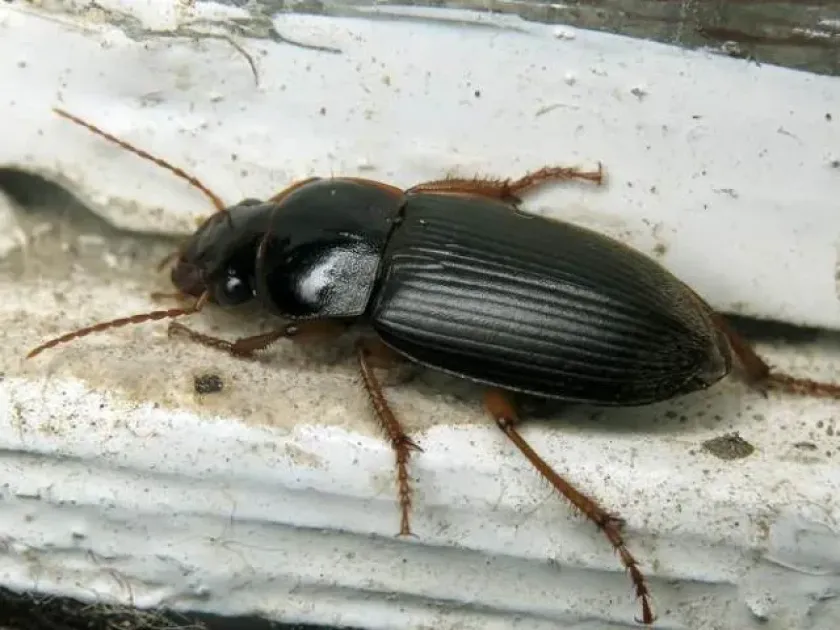
The ground beetle (Harpalus ardosiacus) is a significant agricultural pest belonging to the Carabidae family within the Coleoptera order. Adults typically measure 12–16 mm in length and possess a dark, metallic-black exoskeleton.
Larvae are characterized by an elongated, dirty-white to yellowish body, reaching up to 30 mm at maturity. They have a dark brown head and well-developed thoracic legs, enabling high mobility in soil.
The insect undergoes complete metamorphosis, including egg, larva, pupa, and adult stages. The annual life cycle is closely synchronized with the growth of cereal crops.
Adult beetles are nocturnal, spending the daylight hours in soil cracks or beneath plant residues, which makes them difficult to detect during standard field scouting.
Environmental conditions, particularly soil moisture, play a crucial role in the development and survival rates of the species throughout its annual life cycle.
What it damages
The primary damage is caused by larvae that feed on the shoots of winter cereal crops. They consume leaf tissues, often leaving only vascular bundles, which leads to plant death.
Winter wheat, rye, and barley are the most susceptible crops. High larvae populations can destroy large sections of a field, leading to significant yield losses or total failure.
Adult beetles may damage the developing grain in the head during the milk-to-dough stage, eating the endosperm and reducing both quantity and quality of the harvest.
Plants damaged in the autumn are significantly weakened, reducing their ability to overwinter successfully and increasing susceptibility to secondary fungal infections.
Continuous cropping of cereals creates favorable conditions for population explosions, as the pest finds abundant food sources year after year in the same location.
When it appears
Adult beetles become active in mid-summer, searching for suitable sites for egg-laying, which often coincides with the harvesting period of cereal crops.
Eggs are deposited in the soil, and larval hatching typically occurs by late summer or early autumn, ready to feed on the newly emerged winter grain shoots.
Larvae remain active throughout the autumn and, depending on soil temperatures, can continue feeding during mild winter periods or early spring.
Pupation occurs in the spring within underground cells. The transition from larva to adult is temperature-dependent and marks the start of the new generation.
The emergence of a new generation of adults usually happens in May and June, completing the one-year biological cycle of the beetle.
Signs of infestation
The most distinctive sign is the presence of shredded leaf tips on young seedlings, which look like frayed, fibrous bundles left behind after nocturnal feeding.
Visible patches of thinned or dead seedlings in autumn and early spring are major indicators of ground beetle infestations that require immediate attention.
Digging into the soil near damaged plants often reveals the larvae, especially in areas with high levels of organic matter or crop residues.
During harvest, the presence of adult beetles in the ears of grain or on the soil surface confirms that the pest population is established in the field.
Stunted growth and yellowing of the crop, when other diseases are ruled out, often indicate root zone disturbance caused by beetle larvae activity.
Control measures
Effective management begins with crop rotation, which breaks the pest's cycle by alternating susceptible cereals with non-host crops like legumes or oilseeds.
Deep plowing or mechanical tillage after harvest effectively exposes larvae to predators and desiccation, significantly reducing the pest population for the next season.
Seed treatment with systemic insecticides is the standard and most effective practice to protect young seedlings from early larval feeding damage.
Foliar insecticide applications are recommended if scouting reports indicate that pest populations have exceeded the established economic threshold levels.
- Control of volunteer cereals to prevent off-season feeding.
- Use of high-vigor seed varieties to ensure rapid emergence.
- Removal of weeds along field borders to reduce refugia.
- Monitoring using light traps to track adult flight activity.
Taxonomy
- Latin name
- Harpalus ardosiacus
- Order
- Coleoptera (beetles)
- Family
- Carabidae
- EPPO code
- HARPAR
Discussion
No discussions yet — be the first.