
Halyzia exiguenotata
Halyzia exiguenotata
Description
How to identify
Halyzia exiguenotata is a member of the Coccinellidae family, order Coleoptera. While most ladybirds are predatory, this specific species is primarily mycophagous, meaning it feeds on fungi.
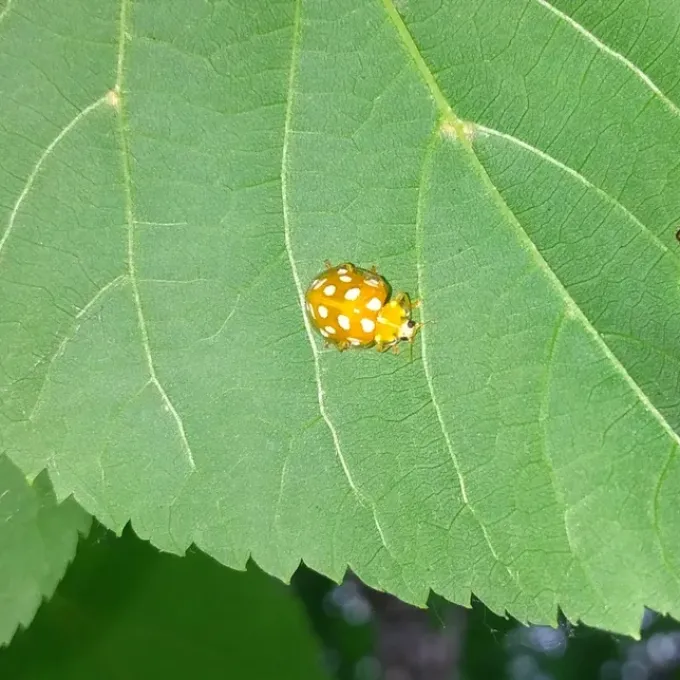
The adult beetle is small and exhibits a characteristic convex, rounded body shape common to the Coccinellidae family. The wing covers are typically yellowish or orange with faint, small spots.
The larvae are spindle-shaped and often covered with small spines or hairs. They undergo several developmental stages while feeding on the surfaces of host plants.
This species is well-adapted to environments where fungal growth is prevalent, as it relies on fungal mycelium and spores for its primary nutrition.
Adults are highly mobile and capable of flight, allowing them to effectively navigate between host plants and spread across large areas during the growing season.
What it damages
The damage caused by Halyzia exiguenotata is mostly associated with ornamental, fruit, and berry crops that are already infested with powdery mildew or similar fungi.
Although they feed on fungal layers, their scraping activity frequently damages the plant epidermis, leading to micro-lesions that stress the plant tissue.
When populations reach high levels, the cumulative effect of their feeding can impair photosynthesis and weaken the plant's overall vitality and growth.
Furthermore, the damaged epidermis serves as an entry point for secondary bacterial and fungal pathogens, which can lead to further infection of the host.
Economic damage is observed in the loss of aesthetic value for ornamentals and reduced yields in fruit crops due to premature leaf drop and systemic weakness.
When it appears
Activity typically begins in the spring when temperatures rise and environmental conditions favor the development of fungal pathogens on plants.
Population peaks usually occur during mid-summer, coinciding with the period of highest fungal growth on leaves and stems of various agricultural crops.
The life cycle involves egg, larval, pupal, and adult stages. The time required for a full generation depends heavily on temperature and food availability.
As autumn approaches and temperatures drop, adults seek overwintering sites, such as bark crevices, dry plant debris, or dense leaf litter.
Successful overwintering ensures that the population can resume its cycle immediately when favorable conditions return in the following spring.
Signs of infestation
Early indicators of infestation include the appearance of light-colored patches on leaves, which eventually turn into necrotic lesions due to epidermal injury.
Detection is often possible by inspecting the underside of leaves, where the beetles and larvae tend to aggregate to feed on fungal mycelium.
- Presence of larval colonies on young shoots and leaves.
- Visible grazing marks on the surface layer of leaves.
- Curling and yellowing of the leaf margins.
- Premature defoliation of the host plant.
In areas where feeding occurs, fungal growth may disappear, but the underlying tissue often shows signs of stress, browning, and necrosis.
Plants affected by significant populations often exhibit stunted growth and decreased vigor, particularly during hot or dry conditions.
Control measures
Managing Halyzia exiguenotata requires an integrated approach that prioritizes habitat modification and the control of the underlying fungal food source.
Regular pruning and the removal of heavily infested plant parts are essential to reduce the population and restrict the spread of fungal pathogens.
Biological control agents, such as microbial fungicides, can be utilized to reduce the food supply, thereby naturally limiting the beetle's population growth.
Improving air circulation and maintaining proper plant density can create conditions that are less favorable for fungal diseases, effectively discouraging the pest.
Chemical intervention should be restricted to cases of severe infestation, utilizing targeted applications that minimize collateral impact on beneficial insects.
Taxonomy
- Latin name
- Halyzia exiguenotata
- Order
- Coleoptera (beetles)
- Family
- Coccinellidae
- EPPO code
- HALZEX
Discussion
No discussions yet — be the first.