
Black grass bug
Halticus apterus
Description
How to identify
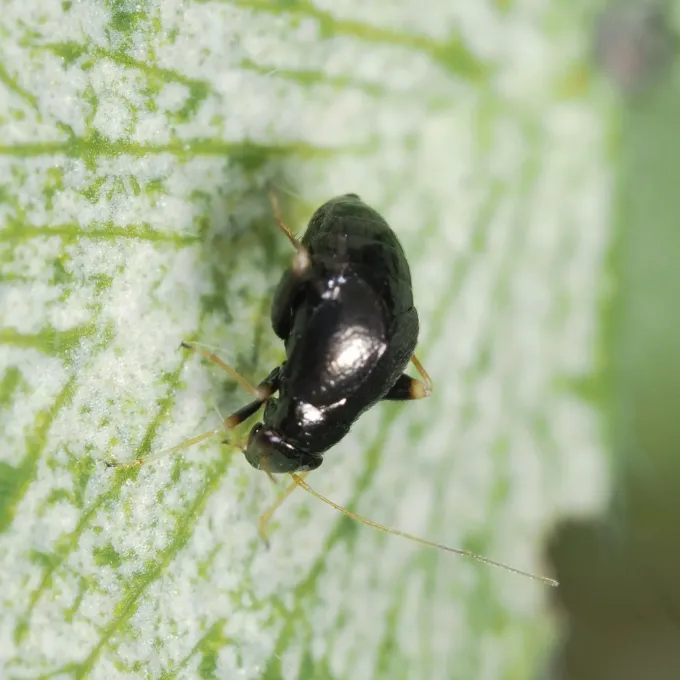
The Black grass bug (Halticus apterus) belongs to the Miridae family within the order Hemiptera. These are small insects, usually 2–3 mm long, characterized by notably thickened hind femora, which grant them a powerful jumping ability similar to that of flea beetles.
The adult is typically black or dark brown with a shiny surface, covered in sparse, fine light hairs. They possess long, thin, thread-like antennae, which is a classic morphological feature for most species of plant bugs (Miridae).
Populations often contain both brachypterous (short-winged) and macropterous (long-winged) forms, allowing for flexible adaptation to different habitats and environmental conditions.
Nymphs are similar in appearance to the adults but smaller, lack fully developed wings, and are sexually immature. Despite their size, they are extremely agile and can leap away when disturbed, making them difficult to spot during inspection.
Entomologists typically use sweep nets to identify the presence of these bugs in a field. When disturbed, their distinctive jumping behavior clearly distinguishes them from other hemipteran pests that primarily walk or fly.
What it damages
This pest is a generalist feeder (polyphage) that attacks a wide variety of agricultural crops. Vegetables such as cucumbers, beans, peas, cabbage, and various leafy greens are particularly susceptible to infestation.
Beyond cultivated fields, Halticus apterus thrives on many wild herbaceous plants, which serve as natural reservoirs. This allows the pest to persist and migrate into crops during the active growing season.
Both adults and nymphs feed by piercing plant tissue and sucking out the sap. This feeding activity disrupts the plant's photosynthesis and overall physiological health, leading to stunted growth.
Massive infestations on young seedlings can cause significant yield loss or even the total destruction of a crop. The damage is particularly severe during dry weather when plants are already under stress.
The commercial quality of the produce is heavily impacted, as the feeding spots turn into necrotic areas. A high percentage of leaf tissue damage can render vegetables unmarketable for commercial purposes.
When it appears
The insects overwinter in the egg stage, with eggs deposited inside plant tissues or near the soil surface under debris. Larval emergence typically occurs in late spring when temperatures are favorable.
The rate of development is highly dependent on ambient temperatures. In warm summer conditions, the lifecycle of a generation can be shortened, allowing for multiple generations within a single season.
Peak populations are usually observed in mid-summer. This coincides with the phase when crops are actively growing, making them vulnerable to migration from surrounding weed host plants.
Multiple generations per year create a continuous pressure on vegetable crops, necessitating long-term monitoring strategies throughout the planting season to prevent economic loss.
As autumn temperatures drop, the bugs prepare for the next winter by laying eggs. Understanding these seasonal milestones helps agronomists time their preventive cultural practices effectively.
Signs of infestation
The earliest signs of infestation appear as tiny, pale, stippling marks on the leaf surface. These are the result of feeding probes where the bug has removed the cellular content.
As the infestation continues, these individual marks coalesce into larger yellow or white chlorotic patches. The foliage loses its healthy green color and takes on a mottled, bleached appearance.
Heavily affected leaves often become deformed, curl, or wither prematurely. This loss of photosynthetic capacity significantly weakens the plant and reduces the overall yield potential of the harvest.
Careful inspection of the underside of the leaves usually reveals the presence of tiny black fecal spots. These excrements are a reliable sign of pest presence, even if the mobile adults have jumped away.
- Jumping insects visible when foliage is disturbed.
- Tiny pale stippling marks and chlorotic patches on leaves.
- Deformation and curling of leaf blades.
- Small black fecal dots on the underside of leaves.
Control measures
The primary control measure is the adoption of sound cultural practices, such as deep autumn plowing, which helps destroy overwintering eggs buried in soil and plant residues.
Managing weed populations in and around the field is essential to eliminate natural reservoirs. Keeping field margins clean helps reduce the pressure of bugs migrating into the crops.
When monitoring data shows that pest numbers exceed the economic threshold, chemical insecticides must be applied. It is recommended to use products effective against Miridae species while alternating active ingredients to prevent resistance.
Integrated Pest Management (IPM) strategies include the use of biological control agents, such as predatory bugs (e.g., Nabidae) or biopesticides based on entomopathogenic fungi, to keep populations under control.
Using yellow sticky traps provides an effective monitoring tool, allowing farmers to detect early colonization and apply corrective measures before the population reaches damaging levels.
Taxonomy
- Latin name
- Halticus apterus
- Order
- Hemiptera (bugs, aphids, leafhoppers)
- Family
- Miridae
- EPPO code
- HALCAP
Discussion
No discussions yet — be the first.