
Pest · Hemiptera (bugs, aphids, leafhoppers) · affects Field pea, Winter wheat, Apple
Especially harmful
Pea aphid
Acyrthosiphon pisum
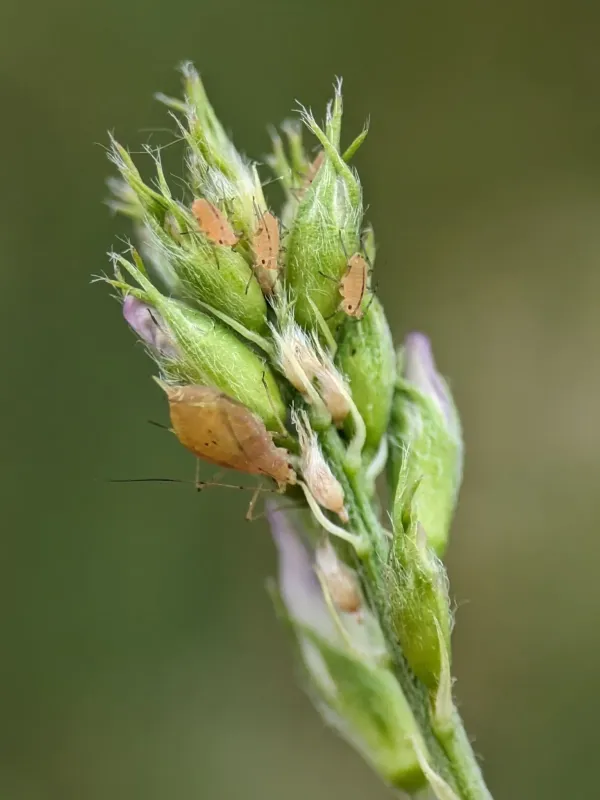
Description
How to identify
The pea aphid is a prominent member of the Aphididae family, known for its distinct pale green to yellowish-green coloration which provides excellent camouflage on leguminous plants.
Adults typically measure between 4 to 5 mm in length and possess long, slender legs, allowing them to navigate quickly across the stems and leaves of host plants.
They are characterized by exceptionally long antennae and prominent siphunculi at the rear end, which are key identification features under a magnifying glass.
The species exhibits polymorphism, with both wingless and winged individuals; winged morphs are produced when the population density reaches a threshold, facilitating migration to new fields.
Reproduction follows a complex cycle, involving overwintering eggs on perennial legumes, followed by a rapid series of asexual generations during the growing season.
What it damages
Pea aphids primarily target legumes such as peas, lentils, and alfalfa, but they are also known to infest onions, beets, oilseed rape, cabbage, hemp, peppers, melons, and sunflowers.
The primary damage results from phloem sap extraction, which directly removes essential nutrients and moisture, weakening the host plant significantly.
Feeding often causes physiological stress, leading to stunted growth, leaf curling, and yellowing of the infested parts, particularly the succulent apical shoots.
Perhaps the most severe economic impact is the damage to flowers and young pods, which can lead to complete floral abortion or the development of thin, deformed seeds.
Furthermore, these aphids act as vectors for various plant viruses, such as pea enation mosaic virus, which can cause devastating outbreaks across entire agricultural regions.
When it appears
Emergence occurs in early spring when overwintered eggs hatch as temperatures consistently stay above 10°C, initiating the first colonizing generations on perennial host plants.
As the season progresses into summer, the life cycle shortens to approximately one week, enabling rapid population spikes that can quickly engulf entire fields.
The critical peak period for damage occurs during the flowering and pod-filling stages of legumes, when the plant's nutrient transport is most vulnerable.
In mid-summer, high temperatures can sometimes limit reproduction, though the presence of lush, irrigated crops can sustain high populations late into the season.
As days shorten in autumn, sexual forms develop and produce eggs, which are then deposited on the stems of perennial legumes to ensure survival through the winter.
Signs of infestation
Early symptoms include localized yellowing and crinkling of leaves, as aphids congregate in high densities on the youngest, most nutritious parts of the plant.
The accumulation of honeydew on the lower foliage, often accompanied by the growth of sooty mold, is a classic indication of an established aphid colony.
Large, visible colonies of green insects can be found clustered on stems, flowers, and the undersides of leaves, often accompanied by ants.
Ant activity on the plants is a strong indicator of aphid presence, as the ants tend the aphids to feed on their sugary excrement, protecting them from predators.
Deformed or withered blossoms and undersized, distorted pods are clear signs that the plant's development has been compromised by prolonged feeding.
Control measures
Cultural strategies are fundamental, including the physical separation of new pea fields from perennial clover or alfalfa stands that host overwintering populations.
Maintaining a weed-free field environment is essential, as many common weeds can serve as bridge hosts for the pea aphid during the early season.
Effective management requires scouting programs to ensure that insecticide applications occur only when the economic threshold is reached, protecting beneficial insects.
Biological control agents, including lady beetles, lacewings, and parasitic wasps, play a vital role in suppressing populations and should be encouraged via reduced pesticide use.
In cases of heavy infestation, systemic insecticides are the preferred tool, providing long-lasting protection against reinvasion during the critical stages of crop growth.
In brief
24
Damages crops
Content graph
Damages crops · 24
Content graph
Connections · Pea aphid
Most often together:
Marketplace
Products · 4


Biology
Taxonomy
- Latin name
- Acyrthosiphon pisum
- Order
- Hemiptera (bugs, aphids, leafhoppers)
- Family
- Aphididae
- EPPO code
- ACYRON
Community
Discussion
No discussions yet — be the first.