
Goniozus legneri
Goniozus legneri
Description
How to identify
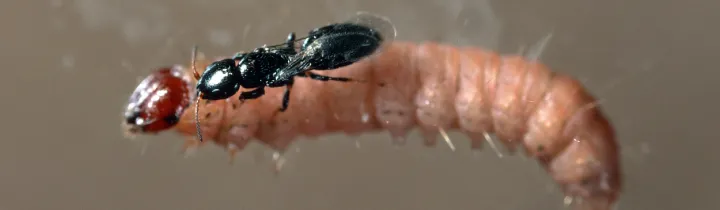
Goniozus legneri is a minute parasitic wasp belonging to the family Bethylidae, order Hymenoptera. It is known as a specialized parasitoid that plays a significant role in ecological pest management.
Adult wasps are characterized by their small size and dark coloration, making them elusive in natural environments. They possess specialized sensory organs to locate their hosts within foliage.
As an ectoparasitoid, the wasp deposits its eggs on the surface of the host's body. This behavior is a critical adaptation for attacking larvae that dwell inside leaf rolls or plant tissue.
Due to their microscopic size, field identification of these wasps is often challenging. Detection typically requires specific entomological expertise and microscopic examination of host larvae.
The insect is widely regarded as a beneficial agent in agricultural systems, providing a natural mechanism to reduce the populations of various detrimental moth species.
What it damages
Goniozus legneri does not damage crops. Instead, it is an essential component of biological control, targeting harmful Lepidoptera larvae that feed on fruits and leaves.
The species primarily parasitizes larvae of leafrollers and other moths that cause significant damage to commercial fruit orchards and ornamental plants.
By effectively locating and paralyzing host larvae within sheltered plant areas, the wasp significantly reduces the severity of damage caused by pests.
The use of this parasitoid is a cornerstone of organic and sustainable farming practices, as it diminishes the need for chemical intervention in orchard management.
Its presence is a positive indicator of ecological health, as the wasp cannot survive in areas subjected to intensive broad-spectrum pesticide treatments.
When it appears
The seasonal activity of Goniozus legneri aligns with the life cycles of its target hosts. Adult wasps typically emerge during the spring when moth populations begin their development.
The species is capable of completing multiple generations during a single growing season, allowing for rapid population growth in response to pest outbreaks.
During peak summer months, their activity is most intense, providing continuous pressure on developing pest populations and preventing major infestations.
As temperatures decline in autumn, the wasps enter a state of dormancy, preparing to overwinter in protected environments until the following spring.
Strategically timed releases of laboratory-reared wasps are often employed to maximize their impact during critical periods of pest vulnerability in the orchard.
Signs of infestation
Identifying the presence of Goniozus legneri involves detecting paralyzed pest larvae on the foliage of fruit trees, which serves as a host for the wasp's progeny.
Parasitized larvae often show signs of being sluggish or immobile and may eventually die as the wasp larvae feed on them externally.
- A noticeable reduction in the number of leaf rolls and active pest feeding sites.
- The discovery of tiny wasp cocoons adjacent to the remnants of a dead host larva.
- Improved crop yields and decreased visible fruit damage within the treated orchard area.
Since both the parasitoid and the host are small, detailed inspections using magnifying tools are usually required to confirm successful parasitism.
The absence of new damage to succulent plant growth is a reliable sign that the beneficial wasp population is successfully managing the pests.
Control measures
Since Goniozus legneri is a beneficial insect, management strategies focus on preserving and augmenting its presence in agricultural fields.
The primary control measure is the adoption of Integrated Pest Management (IPM), which avoids the use of harmful pesticides that could eradicate the wasp population.
Providing nectar-producing plants around orchard borders can significantly enhance the longevity and searching efficiency of adult wasps.
Growers should monitor pest levels carefully and consider biological releases only when host populations exceed economic thresholds, ensuring an optimal balance.
Consulting with local biological supply companies ensures that the introduced wasp strains are well-suited to the specific climate and target pests of the region.
Taxonomy
- Latin name
- Goniozus legneri
- Order
- Hymenoptera
- Family
- Bethylidae
- EPPO code
- GONZLE
Discussion
No discussions yet — be the first.