
Garden Goniozus
Goniozus hortorum
Description
How to identify
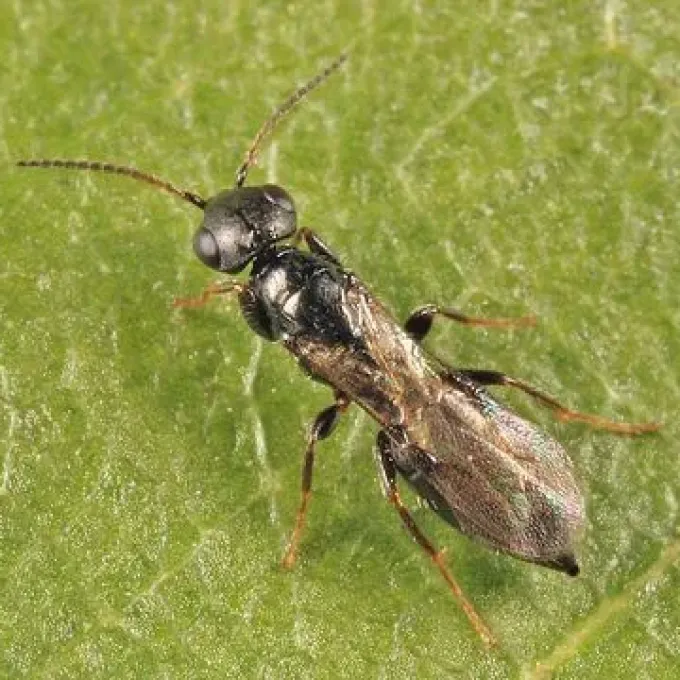
Garden Goniozus (Latin name Goniozus hortorum) is a representative of the Hymenoptera order, specifically the Bethylidae family. These are small, inconspicuous insects often mistaken for small ants or other common garden inhabitants.
Adult insects have a slender, dark, and slightly metallic body. Their heads are relatively large compared to the rest of the body, featuring specialized mouthparts for feeding on the hemolymph of their host larvae.
They exhibit an ectoparasitic lifestyle. Females search for larvae of various Lepidoptera species, paralyze them with venom, and then deposit their eggs directly onto the host's body surface.
Identification is quite challenging due to their tiny size. Often, their presence is only discovered during close inspection of caterpillar colonies on trees and ornamental shrubs.
The life cycle undergoes complete metamorphosis, including egg, larva, pupal, and adult stages. The larvae remain attached to the external surface of the paralyzed host until they reach maturity.
What it damages
Garden Goniozus mainly impacts orchards, including apple, pear, and various berry shrubs, particularly where caterpillar density is high due to natural infestation.
The primary concern regarding this species is its interference with natural pest control. By preying on beneficial larvae or disrupting the natural balance, it can indirectly lead to outbreaks of primary plant pests.
In greenhouses or controlled orchards, the presence of Goniozus can compromise the efficiency of integrated pest management (IPM) programs by competing with or destroying more beneficial parasitoids.
Caterpillars attacked by this insect lose their vitality, stop feeding, and eventually die. While this reduces damage from individual caterpillars, the overall ecological impact may be negative.
Crops in sensitive growth stages are particularly susceptible to secondary pest outbreaks if the natural population of primary biological control agents is reduced by Goniozus activity.
When it appears
The active period for the Garden Goniozus coincides with the warmer months of the year, typically from late spring through the end of the summer season.
Peak activity occurs during periods of moderate humidity and warm temperatures, generally between 22 and 28 degrees Celsius, which are optimal for their larval development.
Multiple generations can occur within a single year, allowing the population to adapt and flourish throughout the entire vegetative season of fruit-bearing crops.
They overwinter as adults, seeking protection in sheltered micro-habitats such as bark crevices on trees, leaf litter, or loose topsoil near the tree roots.
As spring temperatures rise, the surviving adults emerge from hibernation to initiate the search for new hosts, beginning the cycle anew for the upcoming season.
Signs of infestation
Identifying the presence of Garden Goniozus is possible by observing paralyzed, sluggish larvae on the leaves of host plants, which do not respond to external stimuli.
Gardeners should monitor for caterpillars that are motionless and appear somewhat depleted or exhibit distinct small surface lesions where the parasitoid larvae are attached.
- Small, pale larvae attached to the host's external body.
- Clusters of paralyzed caterpillars on branches.
- Noticeable decrease in the success rate of other introduced beneficial insects.
In controlled settings, the presence of Goniozus is identified through visual inspection using a magnifying glass to detect the tiny adults patrolling the leaf surfaces.
Unusual behavioral patterns in caterpillar populations, such as sudden cessation of feeding activity without prior pesticide application, serve as a strong indicator of parasitoid presence.
Control measures
Managing the Garden Goniozus requires a balanced approach, as it is part of the local ecosystem. Total elimination is rarely necessary and often counterproductive.
Maintaining high biodiversity within the garden is the most effective management strategy, as it encourages a variety of natural checks and balances to prevent any one species from dominating.
Chemical intervention should be avoided whenever possible, as broad-spectrum insecticides destroy the delicate balance of beneficial insects, leading to recurring pest issues.
Cultural practices, such as removing loose bark from trees during the winter and cleaning up leaf debris, effectively eliminate the primary overwintering sites for the adults.
When necessary, apply targeted biological controls that are selective and do not harm the diverse array of beneficial insects already present in the orchard environment.
Taxonomy
- Latin name
- Goniozus hortorum
- Order
- Hymenoptera
- Family
- Bethylidae
- EPPO code
- GONZHO
Discussion
No discussions yet — be the first.