
Cephalonomia
Cephalonomia
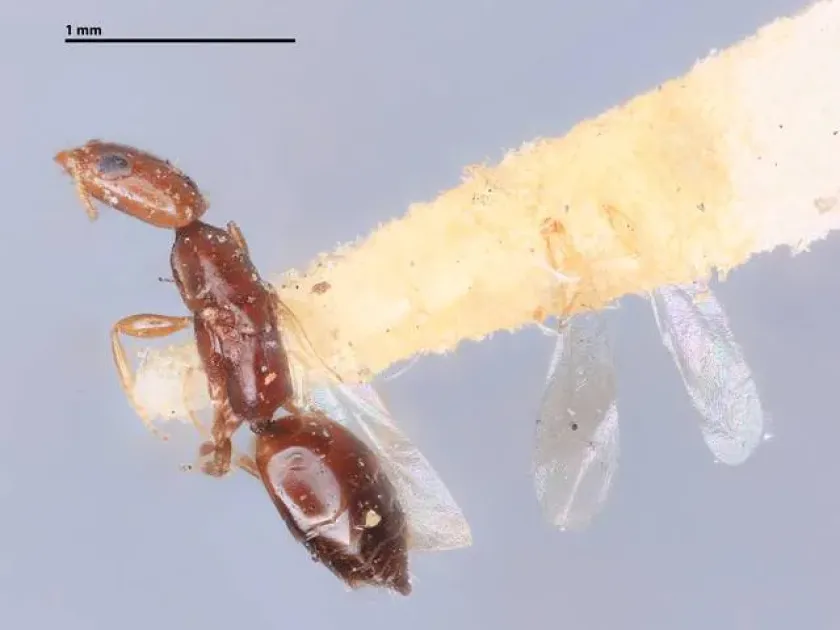
Description
How to identify
The genus Cephalonomia belongs to the family Bethylidae, order Hymenoptera. These are small parasitoid wasps, typically characterized by an elongated, slightly flattened body, often dark brown or black in color.
Adult individuals possess well-developed mouthparts and wings, allowing them to move actively in search of prey within storage environments. Females are significantly different from males, often exhibiting a pronounced parasitic instinct.
The biology of these insects is closely linked to searching for beetle larvae. They are capable of penetrating narrow crevices where their hosts hide, demonstrating high efficiency in locating prey even in dense substrates.
The life cycle includes egg, larval, prepupal, and pupal stages. Depending on environmental temperature and humidity, complete metamorphosis can take anywhere from a few weeks to several months.
It is important to note that Cephalonomia is a beneficial entomophage that limits pest populations, although under certain conditions, it may be considered an undesirable presence in food storage facilities.
What it damages
The primary hosts for larvae of this genus are stored grain pests, particularly larvae of beetles from the families Curculionidae (weevils) and Tenebrionidae (darkling beetles).
Cephalonomia does not feed on grain directly. It acts as an external parasite, laying eggs on the surface of the host beetle's larva or pupa, thereby suppressing its development.
The presence of these insects indicates a serious infestation of the warehouse by pests, as the wasps settle where there is a high density of food sources for their larvae.
In industrial settings, their "damage" is secondary, related to the necessity of sanitary cleaning of products upon detecting entomophages, which can affect the certification of grain lots.
Crops most commonly associated with this genus include wheat, barley, corn, rice, and their processed products (flour, cereals) stored in granaries and warehouses.
When it appears
The occurrence of Cephalonomia in storage facilities is not strictly tied to seasons, as warehouses generally maintain relatively stable microclimatic conditions.
Insect activity increases sharply with rising air temperatures, typically between 20–25 degrees Celsius, and optimal grain moisture levels.
In unheated storage areas, biological processes slow down during winter, though wasps can survive in the pupal stage in hard-to-reach parts of the equipment.
During massive grain pest infestations, the Cephalonomia population peaks in sync with the development of host beetles, which is usually observed in late spring or summer.
Monitoring of population density is conducted year-round using sticky traps or by sifting grain samples to detect adult individuals.
Signs of infestation
The main sign of their presence is the observation of adults on the surface of bags or near the grain bulk, indicating an active parasitism process.
When examining grain samples under a microscope, one can find Cephalonomia larvae tightly attached to the bodies of weevil larvae or other pests.
There are no specific direct damages to the product itself; however, an indirect sign is the presence of numerous empty beetle larval skins that have been drained by the parasite.
Another characteristic is the change in behavior of the pest larvae; they become less mobile or die before pupation due to exhaustion.
Finding adult wasps in traps serves as a warning signal for conducting a phytosanitary inspection of the storage facility for hidden beetle infestations.
Control measures
Specific control measures against Cephalonomia are rarely required, as it is a consequence of infestation by more dangerous pests, such as the granary weevil.
Basic protection measures include preventive disinfection of premises using approved contact insecticides before loading the grain.
Maintaining low grain moisture (less than 14%) is recommended, as it prevents the reproduction of both the pests themselves and their parasites.
- Regular mechanical cleaning of warehouses to remove dust and spilled grain.
- Sealing of facilities to prevent insect migration.
- Fumigation of grain mass when pest population thresholds are exceeded.
The use of biological control methods in warehouses is possible but requires strict coordination to avoid disrupting the balance between entomophages and pests.
Taxonomy
- Latin name
- Cephalonomia
- Order
- Hymenoptera
- Family
- Bethylidae
- EPPO code
- CEPLSP
Discussion
No discussions yet — be the first.