
Goniozus japonicus
Goniozus japonicus
Description
How to identify
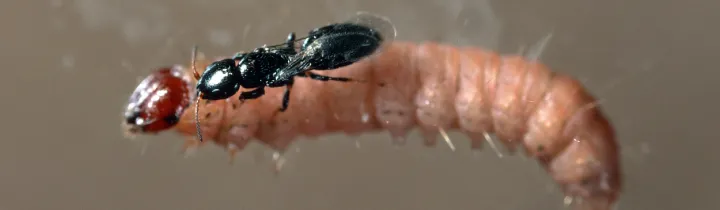
Goniozus japonicus is a small parasitic wasp belonging to the Bethylidae family. These insects are characterized by their dark coloration and diminutive size, making them difficult to detect during standard orchard inspections.
The life cycle involves the female wasp locating lepidopteran larvae, paralyzing them, and laying eggs directly onto the host's body. This specialized behavior makes them effective natural regulators in various agricultural ecosystems.
Anatomically, they possess specialized mouthparts and an ovipositor designed for navigating complex bark structures and penetrating tough tissues to reach their hosts.
Identifying this species requires professional entomological knowledge, as they are often confused with other small parasitic Hymenoptera that share similar habitats.
They are predominantly found in temperate climates, where they utilize the crevices of fruit tree bark as both a shelter and a strategic hunting ground for their larvae.
What it damages
While often considered a beneficial natural enemy, Goniozus japonicus can cause secondary damage by physically interacting with fruit tissues while attempting to reach target larvae hidden inside.
Primary hosts include various larvae of leafrollers and fruit moths that target essential crops like apples, pears, and stone fruits.
The damage to the crop itself is usually indirect, as the wasp's activity leads to the death of the primary pest larvae, which stops the destruction of fruit tissue.
However, in high-density populations, their presence can trigger local ecosystem shifts, potentially affecting the efficacy of other integrated pest management (IPM) programs.
Growers should monitor the presence of these wasps to determine if the benefits of pest suppression outweigh the minor mechanical damage they might cause to fruit surfaces.
When it appears
The activity cycle of Goniozus japonicus is closely synchronized with the emergence of its lepidopteran hosts, beginning in early spring as temperatures rise.
Depending on regional climatic conditions, the insect can produce several overlapping generations throughout the growing season.
Summer months usually see the peak of their population density, driven by the abundance of host larvae feeding on fruit tree leaves and developing fruits.
As autumn approaches, the wasps seek out overwintering sites, often settling in deep cracks of tree bark or within leaf litter at the base of the tree.
Understanding these seasonal dynamics is crucial for orchardists to avoid unnecessary pesticide applications that could harm these natural biological control agents.
Signs of infestation
The most reliable sign of the wasp's presence is the observation of paralyzed or dead larvae under the tree bark, often with external wasp larvae attached to them.
Visual signs on the bark may include tiny exit holes or subtle discoloration caused by the female wasp's search for hosts and oviposition activities.
Stunted growth or wilting of individual plant parts, which were previously infested by moth larvae, can sometimes indicate that a parasitoid is active within the tree.
Field observers may notice an increased presence of tiny, dark-bodied wasps crawling along the branches during late afternoon when the insects are most active.
Diagnostic verification can be achieved by collecting samples of infested bark and monitoring them under laboratory conditions to observe the emergence of adult wasps.
Control measures
Control measures are rarely necessary, as Goniozus japonicus is typically viewed as an ally in biological pest management within orchard environments.
If management is required to limit their population, it is essential to avoid broad-spectrum insecticides that cause significant collateral damage to beneficial insects.
The most effective strategy involves integrating mechanical orchard sanitation, such as bark cleaning and removing debris, which reduces the number of overwintering sites.
Using selective biopesticides that target specific pest species while sparing parasitic wasps is the recommended approach for modern, sustainable fruit production.
Orchardists should focus on monitoring host populations first; if the pest pressure is low, maintaining the current population of parasitoids is a cost-effective management tool.
Taxonomy
- Latin name
- Goniozus japonicus
- Order
- Hymenoptera
- Family
- Bethylidae
- EPPO code
- GONZJA
Discussion
No discussions yet — be the first.