
Common brimstone
Gonepteryx rhamni
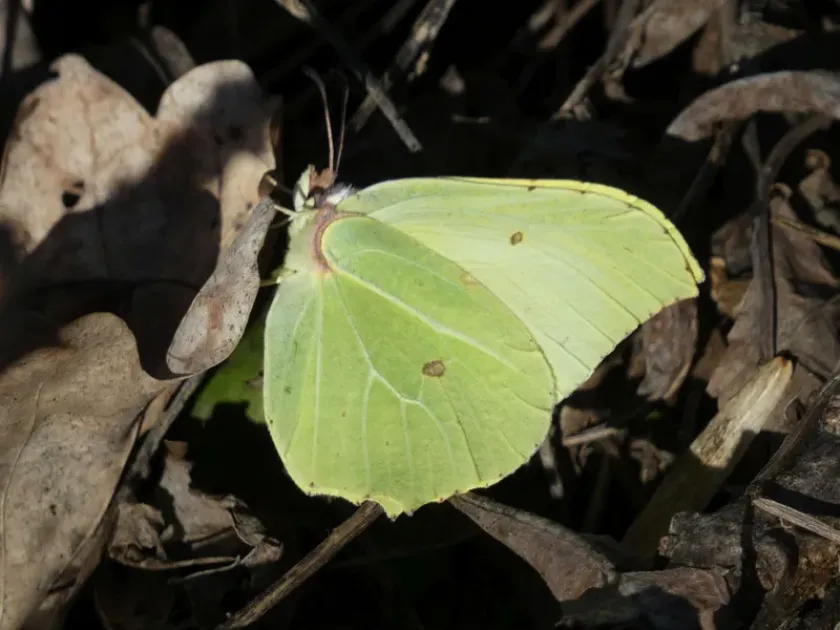
Description
How to identify
The common brimstone (Gonepteryx rhamni) belongs to the Pieridae family within the order Lepidoptera. Adults are large butterflies with distinct angular wings of a bright lemon or greenish-yellow hue.
Males are typically more vibrant, while females display a paler greenish tint, providing them with excellent camouflage against the foliage of their host plants.
The caterpillar of the brimstone is visually distinctive, characterized by a matte green color with a fine white longitudinal stripe running along its flanks.
The body is covered with tiny black dots and fine hairs, which are critical morphological features used for accurate species identification in the field.
The pupa is shaped like a sharp spike and is colored in various shades of green, allowing it to blend seamlessly into the stems and leaves of its host plant.
What it damages
The primary host plants for brimstone larvae are the common buckthorn (Rhamnus cathartica) and the alder buckthorn (Frangula alnus).
For most agricultural crops, the common brimstone is not considered a significant pest, as its life cycle is strictly tied to wild buckthorn shrubs.
In rare instances of high local population density, caterpillars may cause partial defoliation of decorative buckthorn shrubs in gardens or public parks.
The damage caused is generally localized and rarely leads to the death of the shrub, as the species is not considered a major agricultural threat.
Significant economic damage to the agricultural sector is not associated with this insect, so targeted control measures are typically unnecessary.
When it appears
The brimstone is one of the first butterflies to appear in spring, as adults overwinter in the imago stage, hiding in dense foliage or conifers.
The flight season begins as soon as warmer temperatures arrive, often well before the full leaf-out of trees and deciduous shrubs in the spring.
Egg-laying is staggered throughout the spring and summer season, with females depositing eggs singly on the buds or underside of leaves.
Larval development occurs during the summer months, leading to pupation and the emergence of a new generation of butterflies by mid-summer.
The life cycle of the species is perfectly synchronized with the vegetation period of its host shrubs, which provide the essential food source for the larvae.
Signs of infestation
The main sign of infestation is skeletonized or partially consumed leaves on buckthorn bushes, particularly concentrated on the terminal shoots.
The presence of caterpillar frass on the leaves beneath their feeding sites provides a clear indicator of insect activity within the shrub canopy.
Visual detection of larvae is often challenging due to their perfect camouflage, requiring careful inspection of the foliage to locate them.
Occasionally, pupae may be observed attached to twigs by a silken girdle, cleverly disguised to mimic the appearance of dry plant parts.
A mass appearance of adult butterflies in early spring serves as a reliable indicator that the local population has successfully survived the winter.
Control measures
In the vast majority of cases, control measures against the common brimstone are not required, as it does not cause substantial harm to garden crops.
If larval density on ornamental shrubs becomes excessive, manual removal of the caterpillars during the early morning or evening is an effective solution.
Biological control agents, such as those based on Bacillus thuringiensis (e.g., Lepidocide), can be used against young larvae without harming beneficial insects.
Chemical insecticides should be reserved for extreme cases only, as they pose a high risk to non-target insects, including pollinators and natural enemies.
General orchard hygiene, including the sanitary pruning of old or diseased buckthorn branches in autumn, helps prevent excessive pest population build-up.
Taxonomy
- Latin name
- Gonepteryx rhamni
- Order
- Lepidoptera (butterflies)
- Family
- Pieridae
- EPPO code
- GONERH
Discussion
No discussions yet — be the first.