
Cleopatra butterfly
Gonepteryx cleopatra
Description
How to identify
The Cleopatra butterfly (Gonepteryx cleopatra) is a member of the Pieridae family, closely related to the common Brimstone butterfly.
Males are easily identified by their intense yellow wings featuring a large, striking orange patch on the forewings, which distinguishes them from other species.
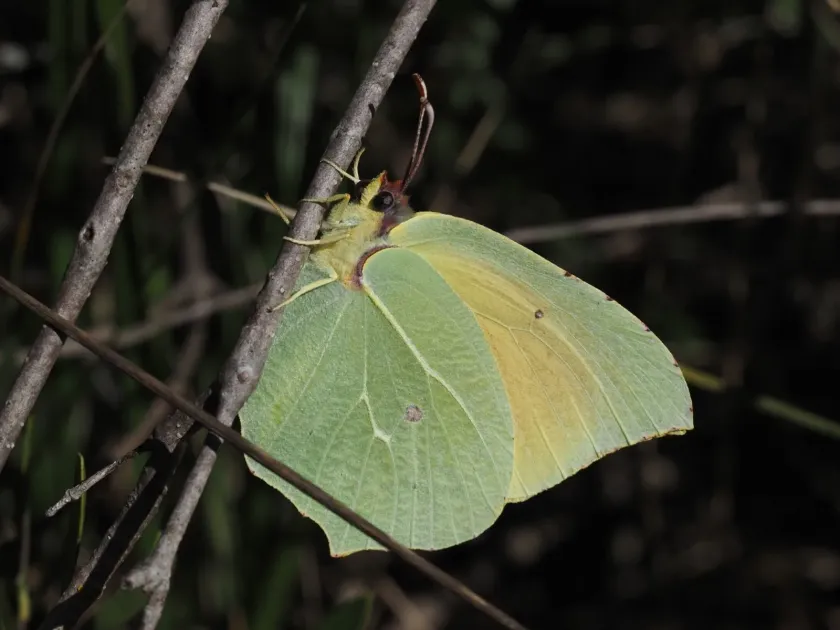
Females are much paler, displaying a greenish-yellow coloration that provides excellent camouflage against foliage when resting or laying eggs.
The wings exhibit a unique, sharply angled shape that mimics a leaf, effectively hiding the insect when it is at rest in trees or shrubs.
Larvae are green with a faint white lateral stripe, allowing them to remain virtually invisible while feeding on the leaves of their host plants.
What it damages
The primary host plants for the larvae are members of the Rhamnaceae family, specifically the Alder Buckthorn (Frangula alnus).
Feeding larvae consume leaf tissue, which can result in ragged leaf margins or partial skeletonization of the foliage on host shrubs.
While aesthetically impacting, the Cleopatra butterfly is rarely considered a major agricultural pest and typically does not threaten the plant's survival.
Damage is usually confined to specific branches and is more of a concern for ornamental gardening than for commercial crop production.
In rare instances of high population density, young shoots may show reduced growth due to the stress caused by larval feeding activity.
When it appears
This species is univoltine, meaning it completes only one generation per year, which is typical for its Mediterranean-influenced habitat.
Adults overwinter in a state of diapause, finding shelter in dense evergreen foliage, ivy, or deep crevices within the bark of trees.
The spring flight period begins very early in the year, often triggered by the first consistent warm temperatures of February or March.
Oviposition occurs on the developing buds and young leaves of host plants shortly after the adults emerge from hibernation.
The pupal stage occurs in early summer, and the new generation of adults typically emerges by July to prepare for the long winter dormancy.
Signs of infestation
The most reliable sign of an infestation is the presence of chewed leaf edges on buckthorn plants, often concentrated near the top of the shrub.
Frass (larval droppings) found on the foliage surface serves as a definitive indicator of current feeding activity by the caterpillars.
Larvae do not create webs or nests, so direct inspection of the foliage is required to locate the pests during the late spring period.
The pupae are exceptionally difficult to spot, as they are attached to stems and perfectly resemble a rolled, green leaf of the host plant.
Visual spotting of the bright orange-colored males flying along hedges during early spring is a clear sign that egg-laying is likely underway.
Control measures
Direct chemical control is generally not recommended, as the Cleopatra butterfly rarely causes economic damage to gardens or landscapes.
For ornamental settings where aesthetics are prioritized, hand-picking the larvae is an effective and non-toxic management solution.
Integrated Pest Management (IPM) practices focus on promoting natural predators, such as insectivorous birds and parasitic wasps, to control numbers.
Regular monitoring of host plants in the spring allows gardeners to manage small populations before they cause any noticeable leaf damage.
Maintaining a healthy, biodiverse garden environment is the best approach to ensuring that this butterfly does not become an issue in your landscape.
Taxonomy
- Latin name
- Gonepteryx cleopatra
- Order
- Lepidoptera (butterflies)
- Family
- Pieridae
- EPPO code
- GONECL
Discussion
No discussions yet — be the first.