
Gonatocerus
Gonatocerus
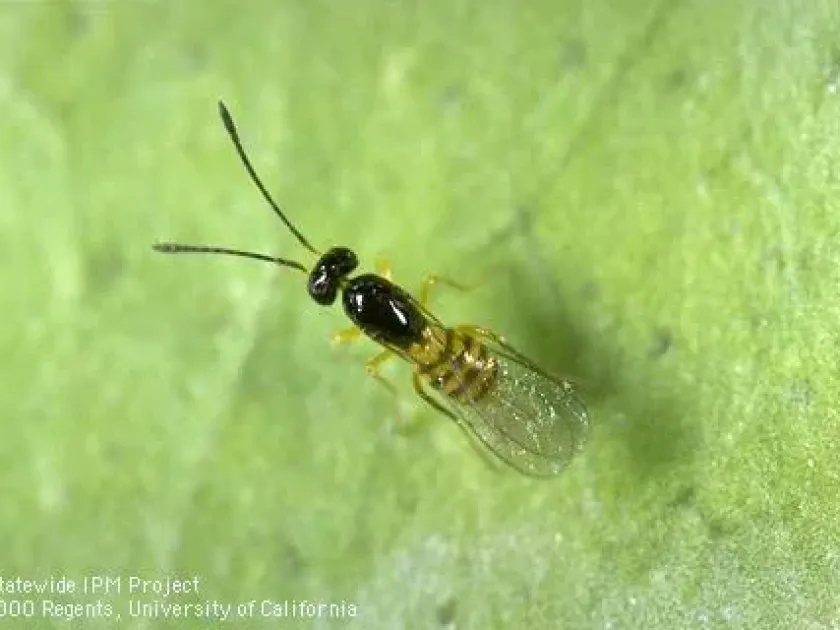
Description
How to identify
Gonatocerus is a genus of minute wasps belonging to the family Mymaridae (fairyflies). These are among the smallest insects in the world, with many species measuring less than one millimeter in length.
Physically, they appear as tiny wasps with characteristic elbowed antennae in females and slender bodies. Their wings are well-developed and fringed with fine hairs, allowing for exceptional flight agility.
Identifying them in the field is difficult due to their microscopic size. Professional identification requires the use of stereomicroscopes and a thorough analysis of wing venation patterns.
It is crucial to distinguish Gonatocerus from actual plant pests, as these insects are highly specialized parasitoids that act as natural enemies rather than threats to agricultural crops.
Systematically, they are classified under the order Hymenoptera. Unlike pests, they provide immense economic value to agriculture by limiting the populations of harmful sap-sucking insects.
What it damages
It is important to clarify for agronomists that Gonatocerus is not a plant pest. Conversely, it is a beneficial entomophage that parasitizes the eggs of leafhoppers, including the glassy-winged sharpshooter.
Since these insects do not feed on plant tissues, they cause no direct damage to crops. Their biological activity is entirely focused on controlling populations of harmful phytophagous insects.
The host targets are the eggs of hemipteran insects laid inside plant tissues. By parasitizing these eggs, Gonatocerus prevents the hatching of damaging leafhopper larvae.
The agronomic significance of this genus lies in the natural reduction of insect vectors responsible for spreading phytoplasma diseases, such as Pierce's disease in grapevines.
Avoiding broad-spectrum chemical sprays allows these beneficial parasitoids to thrive within agroecosystems, providing sustainable and effective biological pest control.
When it appears
The life cycle of Gonatocerus is closely synchronized with the life cycle of its leafhopper hosts. The first generation of wasps typically emerges in spring, coinciding with the start of the egg-laying period for the target pests.
Multiple generations of the parasitoid can develop during the summer season. The speed of the life cycle depends on ambient temperature and relative humidity levels in the region.
Overwintering usually occurs within the host egg, typically at the larval or pupal stage. This ensures the survival of the parasitoid through adverse conditions and allows for immediate activity once the host becomes active.
To maintain the effectiveness of this entomophage, it is essential to have a stable sequence of host availability and to preserve natural vegetation buffers near crop fields.
The peak activity of the wasps usually occurs in the latter half of summer, aligning with the population explosion of target leafhopper species.
Signs of infestation
A primary indicator of this parasitoid's activity is the discoloration of the host eggs. Once a Gonatocerus female oviposits inside a leafhopper egg, the egg eventually turns a darker, opaque shade.
Upon close inspection of the infested plant tissues, one can detect tiny, circular exit holes. These are the physical traces left by the adult Gonatocerus after emerging from the egg.
The absence of hatched leafhopper larvae within egg clusters, combined with the presence of darkened or empty eggs, is clear evidence of successful parasitism.
A decrease in the general level of foliage damage usually caused by leafhopper nymphs serves as a reliable indirect sign of parasitoid activity.
- Darkening of pest eggs within clusters.
- Presence of microscopic exit holes in the egg shell.
- Lack of active leafhopper nymphs in the colony.
Control measures
Since Gonatocerus is a beneficial organism, protection measures focus on conservation and enhancing their populations within orchards and vineyards.
Broad-spectrum insecticides should be avoided during periods of high wasp activity, as these chemicals are highly detrimental to their survival.
Preference should be given to selective biological products or narrow-range pest management strategies that do not harm native parasitoid populations.
The implementation of wildflower strips and the conservation of nectar-producing plants near crops provide these wasps with essential energy, increasing their lifespan and fecundity.
An Integrated Pest Management (IPM) program should acknowledge the role of Gonatocerus as a natural regulator, minimizing unnecessary chemical intervention.
Taxonomy
- Latin name
- Gonatocerus
- Order
- Hymenoptera
- Family
- Mymaridae
- EPPO code
- GONTSP
Discussion
No discussions yet — be the first.