
Cooley spruce gall adelgid
Gilletteella cooleyi
Description
How to identify
The Cooley spruce gall adelgid (Gilletteella cooleyi) is a member of the Adelgidae family within the order Hemiptera. These specialized insects often migrate between different conifer hosts as part of their complex life cycle.
Visually, the pest is difficult to spot without close inspection, as females are covered in white waxy filaments that resemble cotton. Nymphs are dark in color and attach themselves to the bark or the base of needles to feed on plant sap.
Adults exhibit both sexual and parthenogenetic reproduction. Depending on the generation and life stage, insects may be winged or wingless, allowing for rapid dispersal within a garden or plantation.
The life cycle is complex and typically requires both spruce (the primary host) and Douglas-fir (the secondary host). On spruce, the insect induces the formation of characteristic elongated galls where the larvae develop.
The life cycle involves several generations that differ in morphology and ecological requirements. Understanding this cycle is essential for timing the application of pest control products effectively.
What it damages
The primary hosts of this pest are various spruce species, particularly Sitka and Colorado blue spruce, as well as Douglas-fir. The insect causes significant aesthetic damage to ornamental plantings.
On Douglas-fir, the adelgid causes needle discoloration, often turning them yellow. Heavy infestations can lead to premature needle drop, weakening the tree and reducing its overall growth rate.
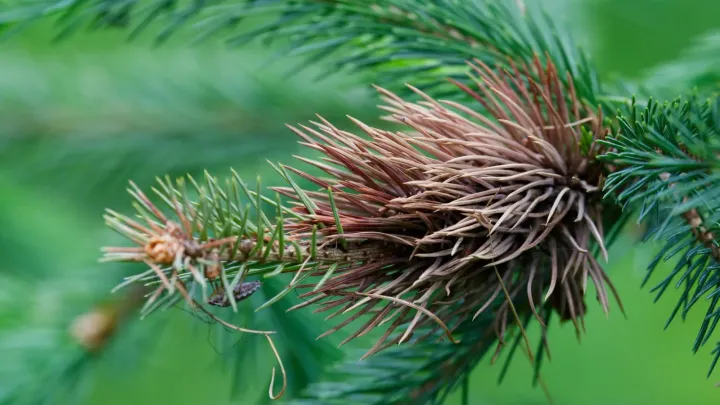
On spruce trees, the pest induces the formation of galls — abnormal tissue growths that develop on young shoots. These deformations restrict normal branch development and create unsightly, distorted growth patterns.
Persistent sap-sucking stresses the tree, making it susceptible to secondary pathogens such as fungal infections or wood-boring insects. In severe cases, extensive shoot dieback and even tree death may occur.
Economic damage is particularly evident in nurseries, where infested planting stock loses its commercial value. Maintaining and treating weakened trees requires substantial time and financial investment.
When it appears
The development of the Cooley spruce gall adelgid is tightly synchronized with the host tree's phenology. In early spring, as sap flow begins, overwintering nymphs become active and start feeding on developing needles.
During the bud-break period on spruce, galls begin to form. At this stage, females lay eggs, which hatch into the next generation, continuing the life cycle.
The summer period is characterized by the migration of winged forms to secondary hosts (Douglas-fir). During this time, colonies become more visible due to the white, waxy secretion covering the branches.
In autumn, a portion of the population migrates back to spruce to lay overwintering eggs. These insects settle in protected areas such as bark crevices or near the base of buds.
Overwintering occurs at the nymphal stage. While harsh winters may reduce the population, their high reproductive potential allows them to recover quickly when favorable conditions return in spring.
Signs of infestation
The most prominent sign of infestation on spruce is the presence of cone-like galls on new shoots. Initially green, these galls turn brown and open as the larvae mature and exit.
On Douglas-fir, the clearest indicator is the presence of small, white, fluffy patches that look like cotton wool. These clusters are primarily found on the undersides of needles and near the needle bases.
Yellowing of the needles and subsequent needle drop are clear indicators of chronic infestation. If sticky honeydew is observed on the needles, it confirms the presence of sap-sucking insects like adelgids.
An increased presence of ants on spruce branches can be a secondary sign, as ants are often attracted to the sugary honeydew excreted by the adelgids.
Distorted or bent terminal shoots are clear signs of structural damage to the tree crown. If these symptoms are detected, nearby conifers should be inspected immediately.
Control measures
Good cultural practices are the first line of defense: regular watering, proper fertilization, and spacing out plants help maintain tree vigor. Avoid planting spruce and Douglas-fir in close proximity to each other.
Chemical control involves the use of systemic insecticides, such as those containing imidacloprid or acetamiprid. Treatments are most effective when applied in early spring before gall formation begins.
Applying horticultural oil in early spring while the trees are still dormant can be highly effective, as it suffocates overwintering nymphs before they become active.
For localized infestations on ornamental trees, hand-picking and destroying infested shoots containing galls before the larvae emerge can significantly reduce the pest population.
Biological control encourages natural predators such as lady beetles, lacewings, and syrphid fly larvae. Maintaining a balanced ecosystem in the garden helps naturally suppress the adelgid population.
Taxonomy
- Latin name
- Gilletteella cooleyi
- Order
- Hemiptera (bugs, aphids, leafhoppers)
- Family
- Adelgidae
- EPPO code
- ADLGCO
Discussion
No discussions yet — be the first.