
Spruce adelgid
Gilletteella
Description
How to identify
The spruce adelgid (Gilletteella cooleyi) belongs to the Adelgidae family, order Hemiptera. These specialized sap-sucking insects are known for their complex life cycles and specific host preferences among coniferous trees, particularly spruce and Douglas-fir.
Adult insects are microscopic and rarely seen. Their presence is primarily identified by the white, woolly, or fluffy wax secretions they produce, which protect the colonies from predators and environmental stressors during their feeding stages.
The nymphs are small and dark brown, typically found fixed to the needles or bark. Due to their ability to blend in and remain stationary, they often go unnoticed until the characteristic white wax patches become dense enough to spot.
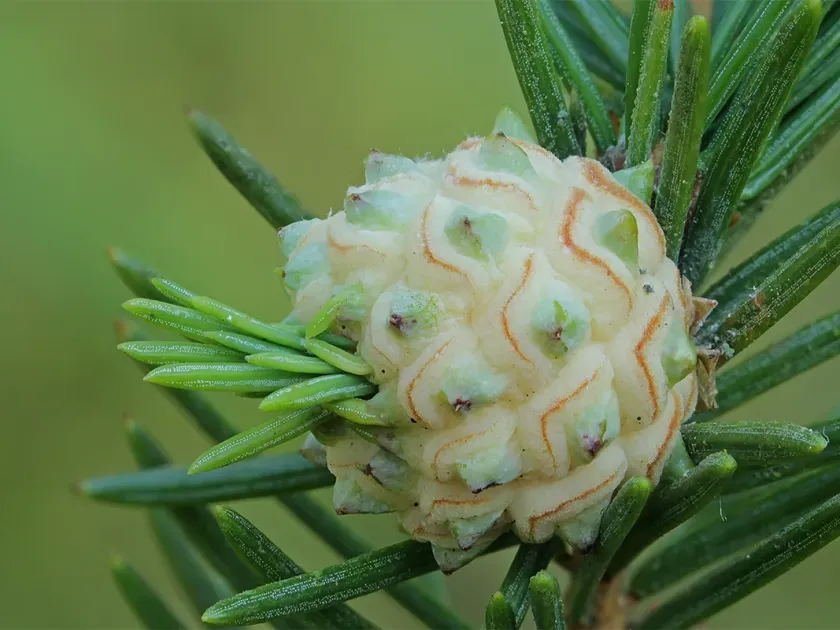
A distinctive biological feature of this pest is the formation of galls, which are woody, cone-like growths on the branches. Inside these galls, the next generation of adelgids develops safely, protected from many contact insecticides.
Being close relatives of aphids, adelgids are highly adapted to coniferous environments. Their systematic position reflects their long-term evolutionary relationship with spruce trees, making them a persistent challenge for arborists and foresters.
What it damages
The spruce adelgid primarily targets spruce species (especially Colorado and Norway spruce) and Douglas-fir. By feeding on the sap of young shoots and buds, they deprive the tree of vital nutrients, leading to physiological stress.
The most noticeable damage is the development of galls at the base of new shoots. These growths disrupt the normal vascular development of the branch, causing it to curl or twist, which ruins the natural aesthetic shape of the tree.
Heavy infestations lead to needle yellowing, premature needle drop, and general decline. A tree suffering from a chronic adelgid population often appears thin and sparse, losing the dense foliage that makes spruces desirable for landscaping.
The wounds left by the insects' feeding stylets can act as entry points for secondary pathogens, including fungi that cause needle cast or bark necrosis, further complicating the tree's recovery process.
In nurseries, this pest is a significant economic threat. Young saplings are particularly sensitive, and significant adelgid damage can render them unsellable or lead to the death of the entire plant if left unmanaged.
When it appears
The life cycle begins in early spring when overwintering nymphs emerge from dormancy. They feed on the succulent tissues of developing buds, which coincides with the onset of the tree’s active growth phase.
Summer is a peak period for reproduction and migration. During this time, wingless and winged forms are produced, allowing the pest to spread to other branches or neighboring host trees while the galls mature.
As autumn approaches, the insects prepare for winter. Nymphs seek refuge in bark crevices or at the base of buds, where they remain stationary throughout the cold season, waiting for the return of favorable spring conditions.
Effective monitoring should start in late March or early April. Regular inspections during the spring allow for early detection, which is crucial for preventing the rapid population buildup that occurs later in the season.
Weather conditions significantly impact the speed of the life cycle. Warm, early springs can accelerate development, potentially resulting in multiple overlapping generations, which makes timing for control treatments more complex.
Signs of infestation
The presence of galls is the most prominent indicator. These look like small, cone-like swellings on the branches that should not be mistaken for the tree's actual reproductive cones; they are structurally distinct and abnormal.
White, cottony patches on needles and twigs are a hallmark sign of an active infestation. This waxy substance is a defense mechanism for the insects and is easily recognizable once you know what to look for.
Curled, stunted, or distorted new shoots are a strong diagnostic sign. If a branch tip looks twisted or fails to grow in length, it indicates that the adelgids are interfering with the plant's hormonal and nutrient flow.
Discoloration of needles, which may turn yellow or brown, followed by needle fall. This indicates severe stress on the branch and is often visible in the middle or lower parts of the tree crown.
High ant activity on the tree can be an indirect sign. Ants are often attracted to the honeydew-like secretions produced by sap-sucking insects, so swarms of ants on a spruce tree warrant a closer inspection of the foliage.
Control measures
The primary mechanical control method is the removal and destruction of galls. This must be done in early summer before the galls open, preventing the exit of the next generation of winged insects.
Chemical control focuses on the use of systemic insecticides. Because adelgids are protected by wax, contact sprays are often less effective than systemic products that move through the plant's vascular system to kill the pests from within.
- Apply horticultural oils in early spring to smother overwintering nymphs before they start feeding.
- Utilize systemic neonicotinoids or similar chemistries during the active growing season to ensure the pest ingests the toxin.
- Conduct sanitation pruning to remove and destroy heavily infested branches, thereby reducing the localized pest pressure.
- Encourage biological control by preserving natural enemies like lady beetles and lacewings, which feed on adelgid colonies.
Rotation of insecticide groups is vital to prevent the development of resistance. Adding a high-quality spreader-sticker to your spray solution can help penetrate the waxy protective layer of the adelgids, improving the efficacy of the treatment.
Ongoing monitoring is essential throughout the season. Even after a successful spring application, secondary migrations can occur, necessitating follow-up treatments if new white wax colonies are detected on the tree.
Taxonomy
- Latin name
- Gilletteella
- Order
- Hemiptera (bugs, aphids, leafhoppers)
- Family
- Adelgidae
- EPPO code
- GILLSP
Discussion
No discussions yet — be the first.