
Big-eyed bug
Geocoris punctipes
Description
How to identify
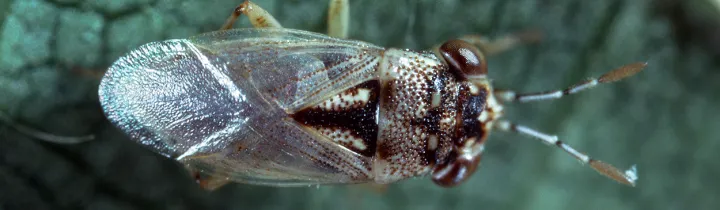
Geocoris punctipes, commonly known as the big-eyed bug, belongs to the family Geocoridae. The most distinctive feature of this insect is its oversized, bulging eyes that provide a wide field of vision, helping it locate prey or hosts.
Adults are small, typically measuring between 3 to 4 mm in length. Their body shape is oval, and their coloration ranges from light gray to dark brown or black, often with subtle pitting or spots on the pronotum.
Nymphs resemble smaller, wingless versions of the adults. They progress through several nymphal stages, growing progressively larger and developing wing pads before reaching the adult stage.
These bugs are predominantly ground-dwelling and are often found in the soil surface or the lower foliage of plants. Despite their terrestrial nature, adults are capable of flight, allowing them to disperse rapidly to new host fields.
While often recognized as beneficial predators of aphids and spider mites, they can act as minor pests by feeding on plant sap when their preferred prey sources become scarce in the ecosystem.
What it damages
Geocoris punctipes can feed on a wide variety of crops including cotton, soybeans, peanuts, and various vegetable species. They are particularly prone to plant-feeding behavior during periods of environmental stress or drought.
The damage is caused by the insect using its piercing-sucking mouthparts to penetrate plant tissues. By extracting cell contents, they induce localized tissue damage that can impair the overall health of the plant.
Signs of damage include chlorotic spots on leaves where the cell contents were removed. In high-density populations, these spots can merge, causing the leaves to wither or show signs of premature senescence.
When feeding on reproductive structures or developing seeds, the bugs can cause significant quality loss. This is especially problematic in seed production fields, as it reduces both the viability and the vigor of the seeds.
Persistent feeding on young fruit or pods can lead to deformation, internal tissue necrosis, and in severe cases, the abscission of the developing fruit, directly impacting yield quantity.
When it appears
The life cycle of the big-eyed bug is highly dependent on temperature. Activity typically begins in the early spring as soon as soil temperatures reach a threshold that supports insect metabolism.
Multiple generations can occur throughout the growing season, with the number of generations heavily influenced by the regional climate and the length of the warm season. Peak populations are often reached during mid-summer.
Adults overwinter in protected areas, such as leaf litter, soil crevices, or under dense weeds. They emerge once conditions are suitable to begin their search for food and oviposition sites.
Environmental conditions like extreme rain or drought can fluctuate population levels. Excessive moisture may limit nymph survival, whereas moderate humidity often supports consistent growth of the population.
Migration typically occurs post-harvest. As host plants begin to dry out or are harvested, the bugs move to adjacent green fields, which can lead to sudden population spikes in late-season crops.
Signs of infestation
Visible chlorosis, or yellowing of the leaves, is the most common early indicator of feeding activity. These symptoms are often concentrated on the underside or the younger, more succulent parts of the plant.
Close inspection of the plants can reveal the presence of the bugs. They are quite shy and often drop to the ground or move to the opposite side of the stem when disturbed, making them difficult to spot.
Small dark specks of excrement on the underside of leaves near the feeding sites serve as a secondary sign of infestation. These spots can sometimes be mistaken for fungal growth or debris.
Deformed or pitted fruit is a hallmark sign of advanced feeding damage. When such symptoms appear without other obvious causes, like larvae or aphids, bug feeding should be suspected.
Using a drop cloth or sweep net is the standard method for detection. If these bugs are found in high numbers, it is critical to confirm whether they are causing economic damage or acting as predators.
Control measures
Integrated Pest Management (IPM) is essential for managing Geocoris punctipes. Since they are often beneficial predators, chemical interventions should be reserved for cases where damage exceeds economic thresholds.
Cultural control measures include effective weed management. Removing weeds around field margins reduces the habitat available for overwintering and early-season development of the bug population.
Biopesticides and biological agents can be utilized to regulate numbers. Encouraging natural enemies, such as parasitic wasps, can keep populations in check without resorting to broad-spectrum insecticides.
When chemical control is absolutely necessary, choose selective insecticides that have low toxicity to beneficial insects. Always follow label directions to ensure that the chemical impact is focused on the target pest.
Strategic planting dates can help the crop avoid peak population cycles. Ensuring that the most sensitive stages of crop development do not coincide with the highest population density of the bug is highly effective.
Taxonomy
- Latin name
- Geocoris punctipes
- Order
- Hemiptera (bugs, aphids, leafhoppers)
- Family
- Geocoridae
- EPPO code
- GEOCPU
Discussion
No discussions yet — be the first.