
Gampsocleis glabra
Gampsocleis glabra
Description
How to identify
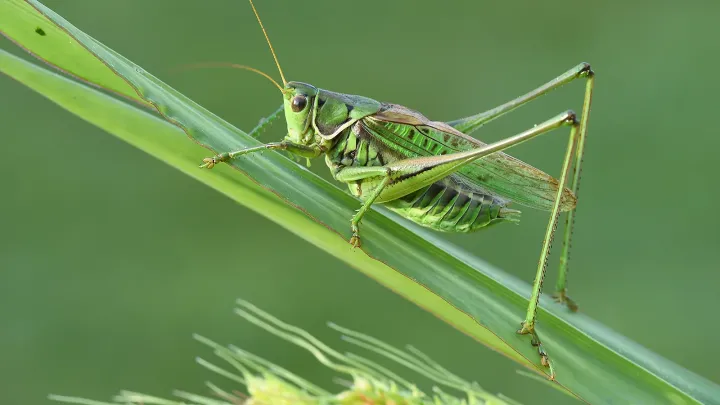
Gampsocleis glabra belongs to the Tettigoniidae family within the order Orthoptera, commonly known as a type of shield-backed katydid.
These insects are characterized by a robust body, long antennae, and powerful hind legs adapted for jumping across fields.
The coloration of the adult stage is typically green or yellowish-brown, providing excellent camouflage within dense crop foliage and weeds.
Unlike some other grasshoppers, this species has a relatively smooth appearance on the pronotum, which is a key identification feature for agronomists.
The female possesses a long, sword-shaped ovipositor, which is used to deposit eggs deep into the soil or plant tissues for protection.
What it damages
Gampsocleis glabra is recognized as a polyphagous insect capable of causing significant damage to various agricultural crops during periods of high population.
Cereal crops like wheat, barley, and rye are particularly vulnerable, as the insects consume leaves and damage the developing ears during grain filling.
Beyond cereals, they can attack industrial crops such as sunflowers and various types of legumes, leading to reduced overall agricultural yield.
The damage is caused by both late-instar nymphs and adults, which possess strong mandibles capable of tearing through tough plant tissues.
Severe infestations can result in total destruction of edge zones in fields, forcing farmers to take immediate action to prevent the spread into the core area.
When it appears
The life cycle of Gampsocleis glabra is univoltine, meaning there is only one generation per year, driven by the seasonal climate of the region.
The species survives the winter exclusively in the egg stage, with eggs buried safely within the soil profile until the following spring.
Nymphs typically emerge in late spring or early summer, following the first consistent warm temperatures that trigger the hatching process.
Throughout the summer, the insects pass through five nymphal stages, growing steadily and consuming increasing amounts of vegetation each week.
The adult stage is reached mid-summer, and these individuals remain active until the first autumn frosts bring an end to the active feeding season.
Signs of infestation
One of the first signs of Gampsocleis glabra presence is the appearance of jagged, irregular holes in the leaves of crops at the field margins.
Visible damage to the ears of cereals, often manifesting as chewed grains or damaged glumes, serves as a clear indicator of the pest's activity.
The sudden sound of jumping insects when walking through the field is a behavioral sign that a population of katydids is present in the canopy.
Accumulation of insect frass (droppings) on the leaves or the ground beneath the plants is a secondary sign of intense localized feeding.
Increased activity of avian predators or small mammals in specific parts of the field can sometimes signal a localized spike in pest numbers.
Control measures
Effective management starts with cultural practices, such as deep tillage after harvest to bury or destroy the overwintering eggs in the soil.
Maintaining clean field borders and eliminating weeds reduces the primary habitat where these insects congregate and reproduce before moving to crops.
Chemical control using insecticides should be considered only when scouting reveals that the population density exceeds the economic threshold.
Whenever possible, select selective pesticides that target orthopteran pests while minimizing harm to beneficial predatory insects and pollinators.
Continuous monitoring and early detection in border strips allow for localized treatments, significantly reducing the need for field-wide chemical applications.
Taxonomy
- Latin name
- Gampsocleis glabra
- Order
- Orthoptera (locusts)
- Family
- Tettigoniidae
- EPPO code
- GAMCGL
Discussion
No discussions yet — be the first.