
Crested lark
Galerida cristata
Description
How to identify
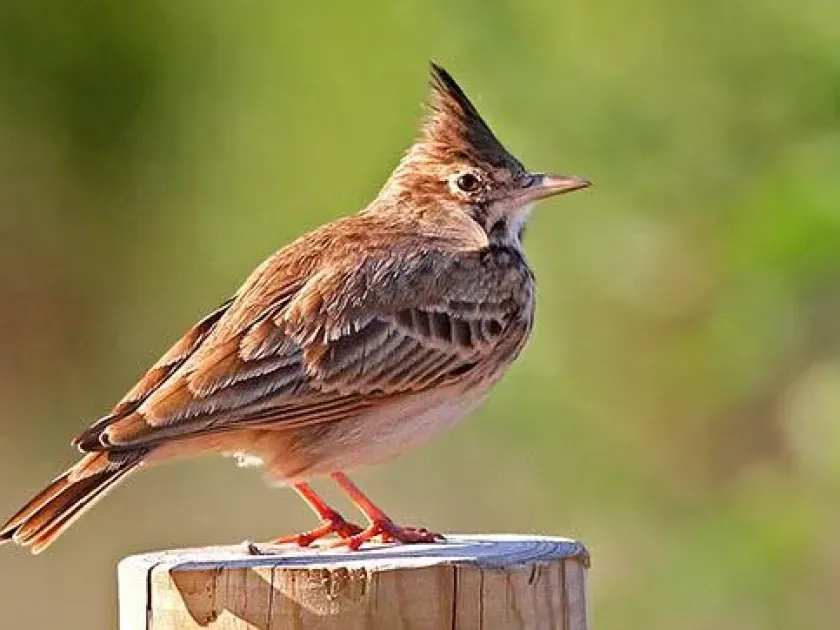
The crested lark (Galerida cristata) is a small bird of the family Alaudidae, easily recognized by the prominent crest of feathers on its head.
Its plumage is dull, streaked brown and grey, providing excellent camouflage against the soil and sparse vegetation of open habitats.
Typically measuring 17 to 19 centimeters in length, the bird has a short tail and a robust beak, well-suited for digging and seed consumption.
Unlike many other larks, the crested lark prefers to move on the ground, walking rather than flying when foraging for food in agricultural landscapes.
This species is highly adaptable and frequently resides near arable land, where it finds both nesting sites and accessible food sources.
What it damages
The crested lark causes significant agricultural damage by consuming seeds sown in fields and pulling up young seedlings during the spring season.
Grain crops such as wheat, barley, and oats are the most common victims, especially when seed coverage is shallow or unevenly distributed.
Excessive feeding by these birds can lead to patchy crop density, forcing farmers to perform costly reseeding of the affected field areas.
Beyond cereals, they may damage vegetable seedlings and sunflower crops, affecting the plant's growth point and leading to total seedling failure.
While the birds consume harmful insects during the summer, their impact on spring sowing operations remains a major concern for commercial growers.
When it appears
The most critical period for crop damage occurs during the spring, coinciding with the sowing and germination of major agricultural crops.
From March through May, these birds are highly active in fields, targeting exposed seeds that have not been adequately covered by soil.
In autumn, they may also target winter crops, particularly if the seeds are left near the soil surface due to improper drilling techniques.
Throughout the summer, the larks' dietary habits shift, with a greater reliance on insects and weed seeds, reducing their pressure on cultivated crops.
Winter months see a decline in field activity, though flocks may still congregate on harvested fields or near grain storage areas if food is scarce.
Signs of infestation
Signs of infestation include small, distinct holes in the soil along seed rows, where birds have systematically excavated and removed the seeds.
Irregular gaps in seedling emergence, often appearing as distinct patches or empty strips within the field, are primary indicators of bird damage.
Visual observation of crested larks foraging on the ground within the fields confirms their presence and active feeding on crop inputs.
Remnants of damaged seedlings, including pulled-up stems with evidence of pecking, are commonly found near the sites of activity.
Bird droppings and track marks on recently tilled soil surfaces provide secondary evidence of their persistent foraging behavior.
Control measures
Proper agricultural practices, particularly ensuring the correct planting depth for all seeds, are the most effective deterrent against these birds.
- Deploying visual deterrents such as raptor decoys or holographic reflective tape.
- Utilizing sonic devices that emit distress calls to scare birds away from sowing zones.
- Applying professional seed coatings or chemical deterrents to the grain before planting.
- Installing mechanical netting for small, high-value agricultural experimental plots.
Field monitoring during the first weeks after sowing is essential for early detection and mitigation of potential losses before damage scales up.
Maintaining clean field borders can help reduce the attractiveness of the area to these birds, discouraging them from nesting nearby.
Taxonomy
- Latin name
- Galerida cristata
- Family
- Alaudidae
- EPPO code
- GALRCR
Discussion
No discussions yet — be the first.