
Japanese skylark
Alauda japonica
Description
How to identify
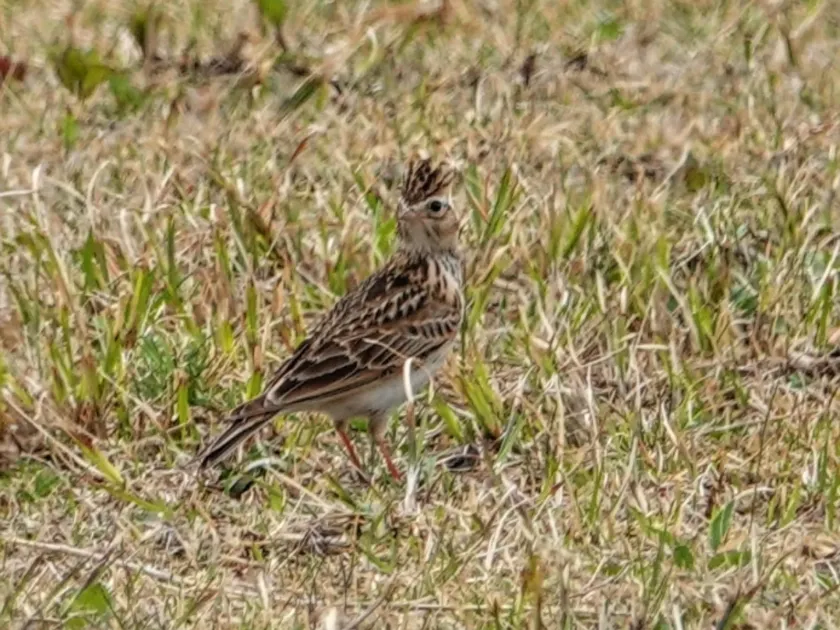
The Japanese skylark (Alauda japonica) is a small passerine bird species belonging to the Alaudidae family. It is physically characterized by its compact, ground-dwelling body, a short crest, and a strong, conical beak adapted for foraging on the ground.
The plumage is primarily earthy, with streaked brown, ochre, and black patterns. This coloration serves as effective camouflage against the bare soil and crop vegetation, making the birds difficult to detect in their natural agricultural habitat.
Japanese skylarks are native to East Asia, including Japan, Korea, and parts of the Russian Far East. They are known for their distinct song and a specific flight pattern involving a vertical ascent followed by hovering over their territory.
As ground-nesting birds, they build their nests directly on the soil within crops or meadows. This close association with cultivated land often leads to conflicts with agricultural practices, as they frequently select field edges for nesting sites.
They are highly adaptable to human-altered landscapes. Their ability to integrate into farming environments allows them to thrive in areas where traditional agriculture provides consistent access to food and shelter throughout the year.
What it damages
The primary agricultural damage caused by the Japanese skylark occurs during the sowing period. The birds actively feed on freshly sown seeds of grains such as wheat, barley, and oats, which are often easily accessible in the upper soil layers.
In the early stages of growth, the skylarks damage young seedlings. By plucking the tender parts of the plants, they cause significant thinning of the crops, which may eventually require farmers to perform a costly re-seeding process.
Damage is particularly pronounced during the spring sowing campaign. Large flocks can consume a significant percentage of seeds on exposed fields, leading to uneven crop density and reduced yields at harvest time.
Mechanical damage is also a factor, as the birds stomp on developing shoots while foraging in groups. This activity creates small, sparse patches across the field that hinder proper crop establishment and growth.
While the birds consume insects later in the season, which can be beneficial, the initial damage during the planting phase is economically significant. Their habit of congregating in flocks exacerbates the damage to specific field sections.
When it appears
The peak risk period is the spring sowing season, usually in April and May, when seeds and young sprouts are most vulnerable. The lack of dense vegetation at this time makes the fields highly attractive to foraging flocks.
Another high-risk period is during the sowing of winter crops in the autumn. The birds aggregate in flocks before migration or wintering, increasing their foraging intensity on agricultural land.
Daily activity is most intense during the early morning and late afternoon. These periods are critical for monitoring, as the birds congregate on the fields to feed, taking advantage of the relatively undisturbed conditions.
The severity of the damage is heavily influenced by the weather. Cold and delayed springs can leave the skylarks with fewer natural food sources, forcing them to rely more heavily on agricultural seeds and young plants.
Seasonal patterns are predictable based on local farming schedules. Agronomists must align their field monitoring programs with the sowing dates to ensure that deterrent measures are active exactly when the threat is highest.
Signs of infestation
The most common sign of infestation is the presence of small, cone-shaped holes in the soil surface. These holes are created when the skylarks use their beaks to probe for seeds or pull out sprouting seedlings.
Patches of sparse or missing crops indicate areas where birds have been feeding intensely. These patches often align with field edges or tramlines where seeds were left less deeply buried.
The presence of bird droppings and small, characteristic footprints in the field soil are clear indicators of avian activity. These signs are often concentrated near the areas where the most damage to the crops is observed.
Scattered seed husks and remnants of green shoots left on the soil surface provide definitive proof of the bird's feeding activities. These remain as visual evidence after the birds have moved to other areas.
Auditory signs, such as the skylark’s distinctive song and alarm calls, are reliable indicators for experienced agronomists. Frequent flight activity across the field in response to human presence confirms the field is being used as a primary feeding ground.
Control measures
Effective management of the Japanese skylark involves a combination of mechanical deterrence and proper agricultural practices. The most essential step is ensuring optimal seed depth and compaction during sowing to minimize surface availability.
Recommended crop protection strategies include:
- Deploying bio-acoustic systems that play predator alarm calls.
- Using visual deterrents like reflective tapes, motion-activated scarecrows, or holographic spinners.
- Applying seed treatments with repellent properties (bittering agents) to deter feeding.
- Rotating the locations of deterrent devices to prevent the birds from habituating.
- Keeping field borders clean of weeds to make the site less attractive for nesting.
Habituation is a major challenge, so rotating the deterrent types and locations is crucial. A multimodal approach—combining sound and visual stimuli—is significantly more effective than relying on a single method alone.
Preventative monitoring is key. If deterrence starts early, it is easier to discourage the formation of established feeding habits within the crop field, which is much harder to break once a flock has settled.
Integrated bird management not only reduces economic damage but also aligns with sustainable farming by minimizing the need for more aggressive or disruptive control methods in the agricultural ecosystem.
Taxonomy
- Latin name
- Alauda japonica
- Family
- Alaudidae
- EPPO code
- ALADAJ
Discussion
No discussions yet — be the first.