
Crested Lark
Galerida
Description
How to identify
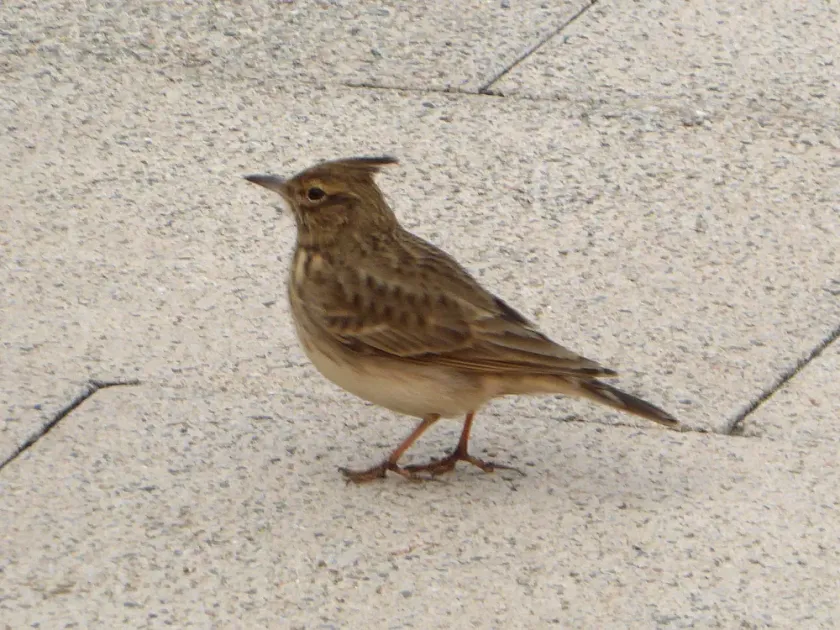
The Crested Lark (Galerida cristata) is a bird species belonging to the Alaudidae family within the order Passeriformes. It is easily identified by the distinct, pointed crest on its head, which it raises when alert.
These birds are small, measuring approximately 17–19 cm in length, with a grayish-brown plumage that provides excellent camouflage against soil backgrounds, making them difficult to spot on cultivated fields.
Unlike many other lark species, the Crested Lark is highly adaptive to human-altered landscapes, frequently inhabiting roadside areas and the peripheries of agricultural fields.
They are largely sedentary birds, meaning they remain in their habitat year-round, which makes them a constant presence during different stages of crop development.
Though they are often seen as part of the local ecosystem, their dietary habits change seasonally, which can lead to significant interaction with agricultural crops during specific periods.
What it damages
The main agricultural damage occurs during the sowing period when the birds feed on seeds buried in the shallow layers of the topsoil, leading to reduced germination density.
Young seedlings are also at risk; larks frequently pluck the cotyledons and early shoots of wheat, barley, maize, and sunflower, causing physical damage that stunts growth or kills the plant.
The damage is particularly severe during the emergence phase when the plants are delicate and lack the root system necessary to recover from mechanical tearing.
High concentrations of these birds on a single plot can lead to significant thinning of the crop row, resulting in uneven fields and potential yield loss.
While they consume insects for most of the year, the spring transition to a plant-based diet makes them a specialized pest for farmers during the critical window of crop establishment.
When it appears
The highest level of damage occurs in early spring, following the thaw and the start of the sowing season, when natural food sources for larks are relatively scarce.
This period of high vulnerability correlates with the emergence of field crops, lasting from late March through April, depending on the climatic zone and spring temperatures.
In autumn, there is a secondary peak of activity when larks may target newly sown winter cereal crops if other food supplies become limited due to harvesting or early frosts.
During the peak of the summer, the birds rely heavily on insect populations, significantly reducing their impact on the crop canopy during the vegetative growth stage.
Winter months represent the lowest threat to agriculture, as the birds forage on weed seeds, stubble remnants, and general organic waste found in non-cropped areas.
Signs of infestation
One of the primary indicators of Crested Lark activity is the presence of small, conical depressions in the soil surface, left behind as the birds use their beaks to search for seeds.
Gaps in the rows of emerging crops are a visual signal of seed predation or seedling destruction occurring shortly after the germination process.
Examination of damaged plants reveals clean, torn edges on the leaves and stems, which differs from the jagged or irregular chewing marks left by insect larvae or rodents.
Droppings found along the edges of fields or near the damaged clusters confirm the presence of the birds as the causal agent for the observed crop issues.
Bird flushes, where small groups of larks fly up with a characteristic short alarm call as one approaches the field, are definitive signs of their active foraging behavior on the plot.
Control measures
Acoustic deterrents, such as automated gas cannons or speakers playing distress calls of raptors, are highly effective in driving bird flocks away from open fields.
Visual aids, including predator silhouettes, metallic reflective tapes, and kites, can create an environment that discourages the larks from settling on the crop area.
Agronomic practices, such as increasing the depth of seed placement during sowing, help protect the seeds from being easily unearthed by the birds.
Treating seeds with avian-specific repellent coatings or applying protective substances can reduce the palatability of the grain, protecting it from consumption.
In smaller or high-value experimental plots, using protective agricultural netting or fleece covering during the emergence period acts as a physical barrier against all avian pests.
Taxonomy
- Latin name
- Galerida
- Family
- Alaudidae
- EPPO code
- GALRSP
Discussion
No discussions yet — be the first.