
Northern palm squirrel
Funambulus pennanti
Description
How to identify
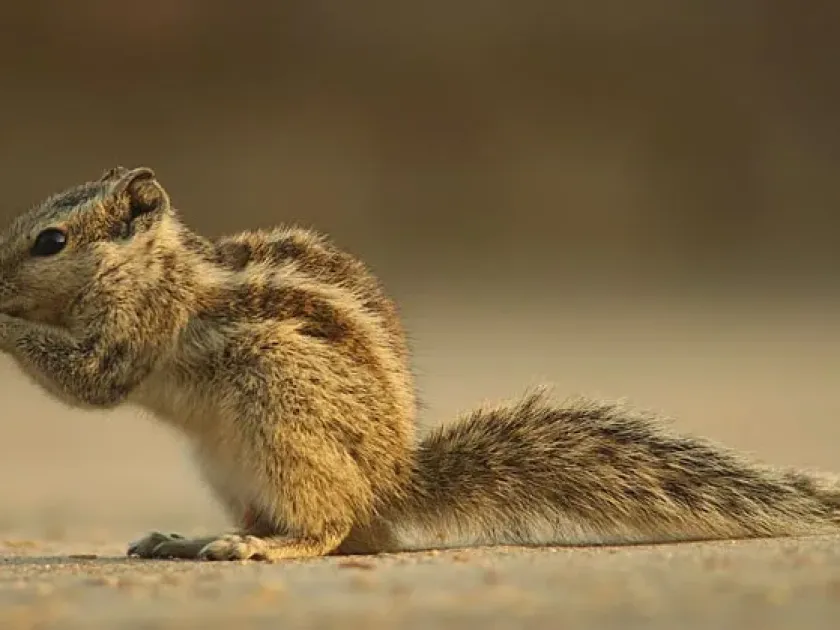
The Northern palm squirrel, scientifically known as Funambulus pennanti, is a rodent species belonging to the Sciuridae family, often recognized as a significant agricultural pest.
It is a small, agile creature characterized by a greyish-brown coat with three distinctive longitudinal pale stripes on its back, which act as a key identifying feature.
Active primarily during daylight hours, these squirrels are highly adaptable and thrive in both natural habitats and man-made agricultural landscapes.
The species exhibits a semi-arboreal lifestyle, demonstrating remarkable speed and jumping ability, which allows them to easily navigate through orchards and crop fields.
High reproductive rates and the ability to maintain dense populations near food sources make them a persistent challenge for farmers and orchard managers worldwide.
What it damages
The squirrel causes substantial damage to fruit-bearing trees by consuming ripening fruits and nuts directly from the branches during the harvesting season.
Primary crops affected include mangos, guavas, various citrus fruits, and nuts, where the animals frequently leave fruits damaged or partially consumed.
In field crops like maize and other cereals, these rodents can cause severe losses by gnawing on cobs and stems, which often leads to reduced yields.
Beyond feeding, they damage young bark and tender shoots, which puts the plant's health at risk and leaves wounds prone to secondary fungal infections.
The cumulative impact of their activity leads to a significant decrease in the commercial value of produce and increased maintenance costs for the grower.
Signs of infestation
Typical signs of infestation include partially eaten fruits scattered under the trees or found hanging with visible tooth marks from the squirrel's incisors.
Nests constructed from dry vegetation, leaves, and twigs located within tree crotches serve as an obvious indicator of their presence on the property.
Fresh grazing marks on the bark of young saplings or branches are clear evidence that squirrels are using the wood as a dietary supplement or for tooth maintenance.
Constant, rhythmic chirping or clicking sounds made by the animals during the day are common signs that a colony is active nearby.
Observed movement trails through vegetation and high activity levels in orchards during ripening periods confirm the presence of this pest.
Control measures
Implementing mechanical barriers, such as installing smooth metal sleeves around tree trunks, is a highly effective way to prevent squirrels from climbing.
Utilizing protective netting over the entire canopy of fruit trees can safeguard the harvest, especially for high-value crops in small-scale farming.
Good orchard sanitation, including the prompt removal of fallen fruits and crop residues, is essential to minimize the attractiveness of the site to rodents.
Ultrasonic deterrent devices can be utilized, though their success often depends on regular maintenance and the use of variable frequency settings.
Promoting biological control by providing nesting boxes for raptors and other natural predators can help keep the squirrel population under natural pressure.
Taxonomy
- Latin name
- Funambulus pennanti
- Order
- Rodents
- Family
- Sciuridae
- EPPO code
- FUNAPE
Discussion
No discussions yet — be the first.