
Indian palm squirrel
Funambulus palmarum
Description
How to identify
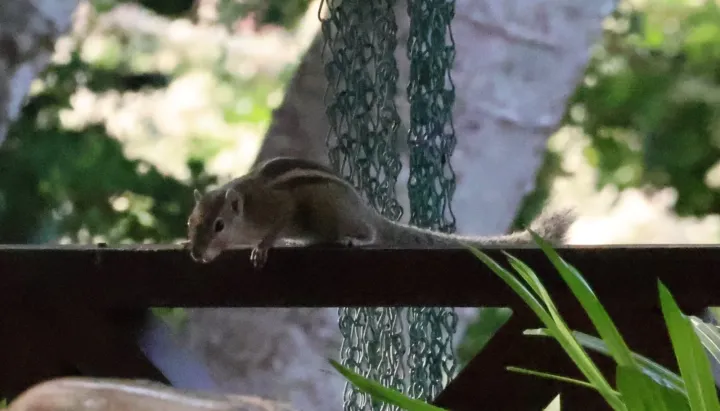
The Indian palm squirrel (Funambulus palmarum) is a small rodent belonging to the Sciuridae family. It is easily identified by three distinctive longitudinal stripes running along its back against a grayish-brown fur.
Measuring about 15–20 cm in body length with a tail of equal size, this squirrel is incredibly agile. Its anatomical features allow it to navigate through dense plantation canopy with ease and speed.
This species is primarily diurnal, which makes it highly visible during the day. Despite their small size, their constant movement and rapid foraging patterns make them difficult to track for pest control efforts.
The reproduction cycle is highly efficient, often allowing the species to breed throughout the year in stable tropical environments. This rapid population growth can quickly turn a few individuals into a major infestation.
Palm squirrels are social animals that often operate in groups, especially in productive agricultural zones. This communal foraging behavior significantly accelerates the rate of damage in commercial orchards.
What it damages
The primary agricultural impact is the destruction of palm crops, particularly coconuts. Squirrels gnaw on young, immature nuts, causing them to fall prematurely and leading to substantial harvest losses.
Other fruit crops such as mango, guava, and papaya are also frequently targeted. By biting into the skin and flesh, squirrels introduce airborne pathogens and insects, which cause the fruit to rot rapidly on the tree.
In young plantations, squirrels can cause severe damage by stripping the bark from saplings. This girdling effect hinders nutrient transport and frequently results in the death of the tree.
Cereal crops like corn are vulnerable during the milk stage. Squirrels damage the ears of corn to access the soft grains, effectively destroying the economic value of the produce before it can be harvested.
Beyond direct consumption, the damage caused by squirrels facilitates secondary infections such as fungal outbreaks, which force farmers to increase their use of chemical pesticides across the plantation.
Signs of infestation
A primary indicator of a squirrel infestation is the presence of prematurely dropped fruit on the ground, clearly marked with gnaw marks from sharp incisors. This debris is often the first sign of an active threat.
The squirrels' presence is also signaled by their characteristic high-pitched chirping sounds, especially during peak morning and late afternoon activity hours in the canopy.
Nests constructed from leaves, twigs, and synthetic materials found in the forks of trees are clear indicators of a established population within the vicinity of the orchard.
Stripped bark or fresh gouges on the trunks of younger trees indicate that squirrels have moved beyond fruit consumption and are actively feeding on the tree tissue itself.
Finding leftover fruit remains, shells, or discarded pieces in the branches is a definitive sign that a group of squirrels is currently using that specific tree as a feeding station.
Control measures
Physical barriers are the most reliable method for individual tree protection. Wrapping the lower trunk with smooth metal bands or plastic guards prevents squirrels from climbing the tree to reach the fruit.
Orchard management techniques, such as pruning branches to ensure they do not touch neighboring trees, can effectively isolate trees and prevent the spread of squirrels across the entire plantation.
Ultrasonic deterrents are a non-lethal option, though their success relies heavily on the frequency settings being rotated regularly to prevent the rodents from becoming habituated to the sound.
Live trapping is a highly recommended method for population management in commercial settings, allowing for the relocation of squirrels away from vulnerable agricultural areas.
- Prompt harvesting of fruit
- Removing debris from the orchard floor
- Installing tree trunk guards
- Encouraging local avian predators
Taxonomy
- Latin name
- Funambulus palmarum
- Order
- Rodents
- Family
- Sciuridae
- EPPO code
- FUNAPA
Discussion
No discussions yet — be the first.