
Lesne's earwig
Forficula lesnei
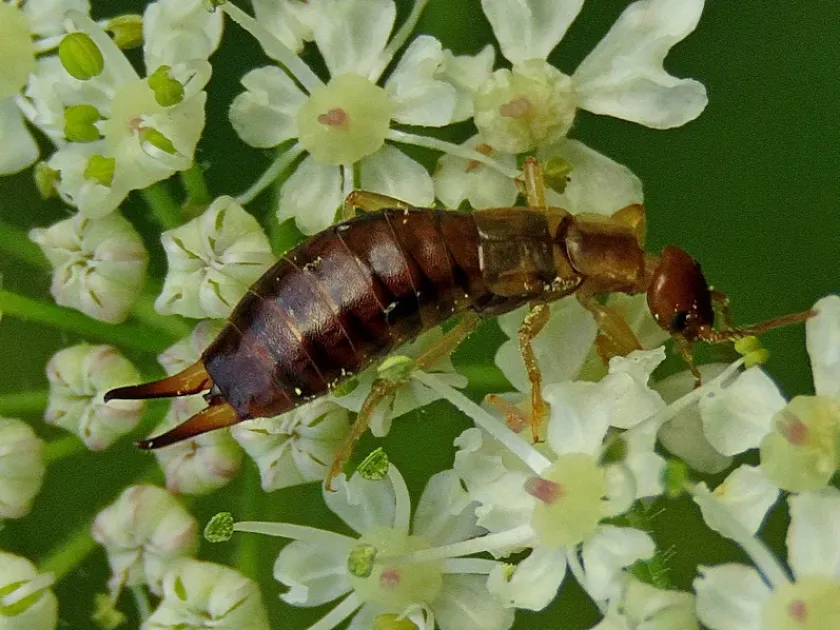
Description
How to identify
Lesne's earwig (Forficula lesnei) is an insect belonging to the order Dermaptera and the family Forficulidae. It is characterized by an elongated, slightly flattened body, typically ranging from reddish-brown to yellowish-brown in color.
The key morphological identifier of this species is the shape of the cerci (appendages on the abdomen). In males, these are distinctively long and curved, allowing for visual differentiation from other common earwig species.
Adult specimens usually measure between 10 and 15 mm in length. Unlike some other dermapterans, Lesne's earwig lacks fully functional wings, meaning it is restricted to terrestrial movement and rarely flies.
These insects prefer humid and sheltered environments. They are nocturnal by nature, spending their daylight hours hidden in cracks, under bark, or within dense vegetation where moisture levels remain consistent.
The life cycle involves incomplete metamorphosis. Nymphs closely resemble adults but are smaller in size and lack fully developed reproductive structures until they reach the final molt stage.
What it damages
Lesne's earwig is a polyphagous pest, capable of feeding on a wide range of plant species. They tend to target succulent tissues, young shoots, and developing flower buds.
In ornamental gardens, they are known to cause significant aesthetic damage to popular flowers such as dahlias, chrysanthemums, and roses. They feed on petals, resulting in tattered and unattractive blooms.
Vegetable and fruit crops are also susceptible. Earwigs often excavate holes in ripening strawberries, raspberries, and tomatoes, which significantly reduces the quality and marketability of the harvest.
Beyond direct consumption of plant matter, earwigs contribute to the spread of plant diseases. Their feeding sites often become entry points for various fungal and bacterial pathogens, leading to secondary decay.
During dry spells, these insects seek moisture within plants, which leads to increased damage on young seedlings that may be unable to recover from the loss of stem or leaf tissue.
When it appears
The annual cycle of Lesne's earwig begins with adults overwintering in protected sites, such as deep within the soil, beneath piles of debris, or inside rotting wood where temperatures stay relatively stable.
Activity resumes in early spring as ground temperatures rise. Females establish nesting burrows in the upper layers of the soil to lay their eggs, providing protection for the next generation.
The peak population and the period of greatest damage occur from mid-summer through early autumn. This is when the new generation of adults and older nymphs are at their most active and hungry stage.
Being strictly nocturnal, they retreat during the day to avoid desiccation and predators. They seek dark, narrow crevices where they aggregate in groups until sunset.
As the weather cools down in late autumn, the population density decreases as individuals search for suitable overwintering locations to survive the winter months, often moving into greenhouses or sheds.
Signs of infestation
The most prominent sign of an infestation is the presence of irregular, ragged holes in leaves. These are often produced during the night, so the damage is typically discovered the following morning.
Flower buds that fail to open or appear stunted and chewed from the inside are strong indicators of earwig presence, as they often congregate inside the folded petals of developing flowers.
The accumulation of small, black fecal pellets on leaf surfaces and near fruit stems serves as an unmistakable sign of earwig activity in the immediate area.
Visual confirmation can be achieved by using a flashlight to inspect plants at night. This is the most reliable way to assess the current population density on your plants.
If you suspect an infestation, you may find the insects hiding in moist spots near the base of the plant, especially under organic mulches or inverted flower pots placed on the ground.
Control measures
The first line of defense is rigorous sanitation. Removing organic litter, weeds, and debris from the garden eliminates the daytime shelters that earwigs rely on for survival.
Trapping is highly effective for localized control. Placing damp, rolled-up newspapers or short segments of cardboard tubes around the base of affected plants creates attractive daytime shelters that can be collected and discarded daily.
Encouraging natural predators such as ground beetles, toads, and various birds is a sustainable way to manage earwig populations without relying on synthetic chemicals.
In cases of severe infestation, targeted insecticide applications may be necessary. These should be applied to the soil surface or the base of the plants where the insects congregate during the day.
Always time your insecticide applications for the evening. Since this is when the insects emerge to feed, direct contact with the product is maximized, increasing the efficacy of the treatment.
Taxonomy
- Latin name
- Forficula lesnei
- Family
- Forficulidae
- EPPO code
- FORFLE
Discussion
No discussions yet — be the first.