
Longleaf (Falcaria vulgaris)
Falcaria
Description
How to identify
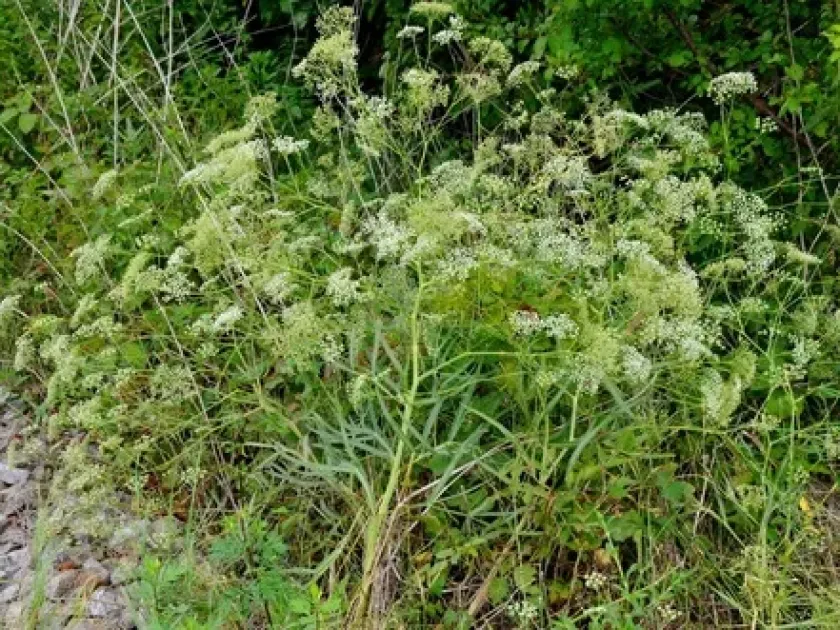
Falcaria vulgaris, commonly known as sickleweed or longleaf, belongs to the Apiaceae family. It is a hardy perennial herbaceous plant characterized by a deep, branched taproot system.
The plant grows to a height of 50 to 90 centimeters and features highly branched stems. Its leaves are distinctively leathery and pinnate, with narrow, sharp-toothed segments that give the plant its characteristic appearance.
White flowers are arranged in complex umbels, which bloom throughout the summer months. After pollination, the plant produces dry, fruit-like seeds that are easily dispersed.
This weed is highly resilient, capable of regenerating from fragments of its roots, which makes it particularly difficult to eliminate through simple mechanical tillage.
It thrives in various soil types and is often found in pastures, roadsides, and cultivated fields, displaying high adaptability to different environments.
What it damages
Falcaria vulgaris acts as a serious weed, competing aggressively with grain, legume, and forage crops for limited water and nutrient resources.
Due to its deep root system, the weed survives droughts better than many agricultural crops, allowing it to dominate the field and reduce overall yields significantly.
In pastures, it reduces the nutritional value of hay, as it is often avoided by livestock and replaces more palatable forage grasses.
The presence of this weed complicates mechanical harvesting and leads to increased impurity levels in harvested grain, necessitating additional cleaning costs.
Furthermore, it acts as a host for various agricultural pests and viral diseases that can spread to nearby susceptible crop species.
When it appears
Growth initiates in early spring, as the plant emerges from its overwintering root system to form new vegetative rosettes.
The vegetative and reproductive phases peak during the summer months, with flowering and seed production occurring from June through August.
Seeds are dispersed in late summer and autumn, often utilizing wind or farm equipment to travel across fields and establish new patches.
Throughout the autumn, the plant focuses on accumulating energy reserves in its underground organs to survive winter temperatures.
The plant remains active until severe frosts, maintaining its competitive advantage well into the late stages of the growing season.
Control measures
Managing Falcaria vulgaris requires a strategic combination of cultivation techniques and herbicide applications to disrupt its robust root system.
Deep plowing that turns the soil is essential, as it exposes the roots to environmental stress and inhibits their capacity for rapid regeneration.
Implementing a crop rotation that includes competitive, shade-producing crops can effectively suppress the growth of sickleweed patches.
Systemic herbicides, particularly those labeled for broadleaf perennial weed control, are most effective when applied during the active rosette stage.
- Regular cultivation and tillage to deplete root reserves.
- Strategic use of herbicide fallow cycles.
- Strict monitoring of seed purity to prevent introduction to new areas.
Taxonomy
- Latin name
- Falcaria
- Order
- Lepidoptera (butterflies)
- Family
- Drepanidae
- EPPO code
- FLCRSP
Discussion
No discussions yet — be the first.