
Townsend's chipmunk
Eutamias townsendii
Description
How to identify
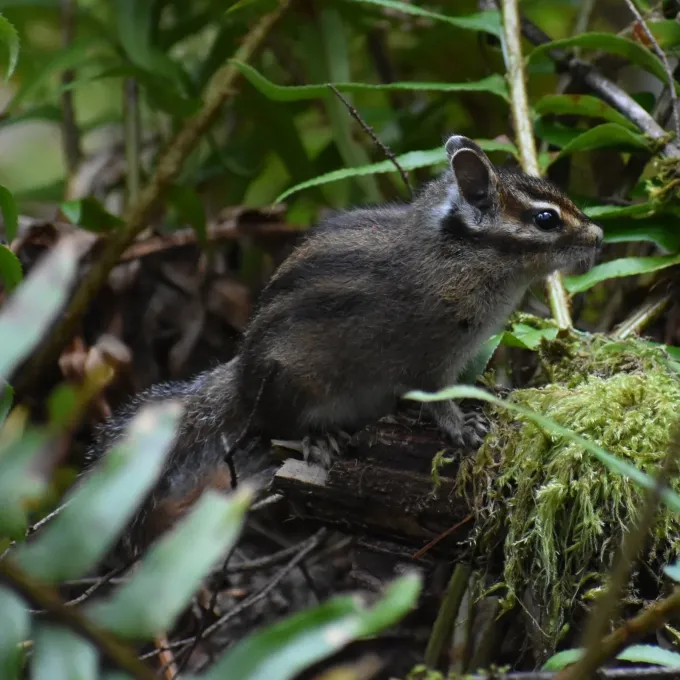
Townsend's chipmunk (Neotamias townsendii, formerly Eutamias townsendii) belongs to the order Rodentia and the family Sciuridae. It is one of the largest chipmunk species, reaching lengths of 25–30 cm including the tail.
The animal is characterized by a brownish-gray back with five dark stripes separated by lighter areas. The belly is pale or whitish, and the tail is covered with dense fur, distinguishing it from smaller ground squirrels.
These rodents are primarily terrestrial but are capable of climbing trees and shrubs with agility. They prefer to live in dense forests, edges, and adjacent agricultural lands, where they establish complex burrow systems.
Systematically, this species is closely related to other members of its genus but is defined by its specific range along the Pacific Northwest of North America. Chipmunks are highly territorial animals.
It is important to distinguish them from small squirrels, as chipmunks possess characteristic cheek pouches for carrying food. This unique adaptation allows them to rapidly harvest and store large quantities of seeds and grains.
What it damages
This rodent species causes significant damage to orchards, vegetable gardens, and field crops. They actively consume the seeds of cereals, corn, and various vegetables, digging them out of the soil immediately after planting.
In orchards, Townsend's chipmunks feed on small fruits, including raspberries, blackberries, and strawberries. They also damage tree fruits by gnawing into the flesh to reach the nutrient-rich seeds.
Substantial damage occurs in forest nurseries, where the rodents consume the seeds of coniferous and deciduous trees, hindering natural regeneration and reducing the efficiency of reforestation efforts.
In addition to consuming crops, these animals gnaw on the bark of young saplings, which can lead to the weakening or death of the trees. During population peaks, the damage becomes a major economic burden.
- Destruction of corn and wheat seedlings.
- Feeding on fruits and berries in large quantities.
- Loss of seed stocks in storage facilities.
- Bark gnawing on young woody plants.
When it appears
Chipmunk activity begins in early spring, as soon as snow melts and temperatures remain above freezing. This is when they emerge from their winter torpor in search of food.
The peak of damage occurs during summer months, when fruits, berries, and grains ripen. The rodents feed intensively to build up fat reserves needed to survive the winter season.
Autumn is the period of most intensive gathering and transport of supplies to burrows. During this time, high levels of movement across fields lead to visible damage to crops and storage sites.
In winter, Townsend's chipmunks enter a state of torpor rather than deep hibernation. During mid-winter thaws, they may emerge from their burrows to forage if their internal supplies run low.
The life cycle is closely linked to plant phenology. Reproduction occurs once a year, in the spring, which determines population density throughout the following growing season.
Signs of infestation
The first sign of an infestation is the presence of characteristic small burrows, often hidden under tree roots, fallen logs, or thick grass. Fresh soil mounds and shell remnants near entries are typical.
Damaged seedlings that appear neatly gnawed or unearthed in rows are clear indicators of rodent activity. Footprints similar to those of squirrels, but smaller, can be found on loose soil.
Leftover pieces of fruit and discarded seeds indicate the presence of a chipmunk that was either disturbed or is caching extra food. They often use stumps or rocks as feeding platforms.
A distinctive sharp chirping or rapid chattering sound acts as an alarm call, which the animals emit when sensing a threat. Hearing these calls can help locate their presence within the garden.
Damage to fruits appears as small, precise holes or cavities with seeds remaining inside, which helps distinguish their work from that of birds or insects that typically consume the entire pulp.
Control measures
For garden protection, mechanical barriers such as fine-mesh metal hardware cloth around beds and saplings are highly effective. The mesh must be buried to prevent burrowing underneath.
Biological control methods include attracting natural predators like owls and hawks to the property. Installing nesting boxes and perches helps maintain a healthy balance in the local ecosystem.
Ultrasonic repellers can be effective on a small scale, though chipmunks often habituate to these sounds quickly, making them a temporary solution best used with other strategies.
Sanitation of the property is essential for prevention. Removing woodpiles, brush, and debris eliminates the ideal cover chipmunks need for nesting and raising their young near food sources.
Chemical control (rodenticides) should be a last resort and used with extreme caution to avoid secondary poisoning of pets and beneficial wildlife. Use only tamper-resistant bait stations.
Taxonomy
- Latin name
- Eutamias townsendii
- Order
- Rodents
- Family
- Sciuridae
- EPPO code
- EUTATO
Discussion
No discussions yet — be the first.