
Least chipmunk
Eutamias minimus
Description
How to identify
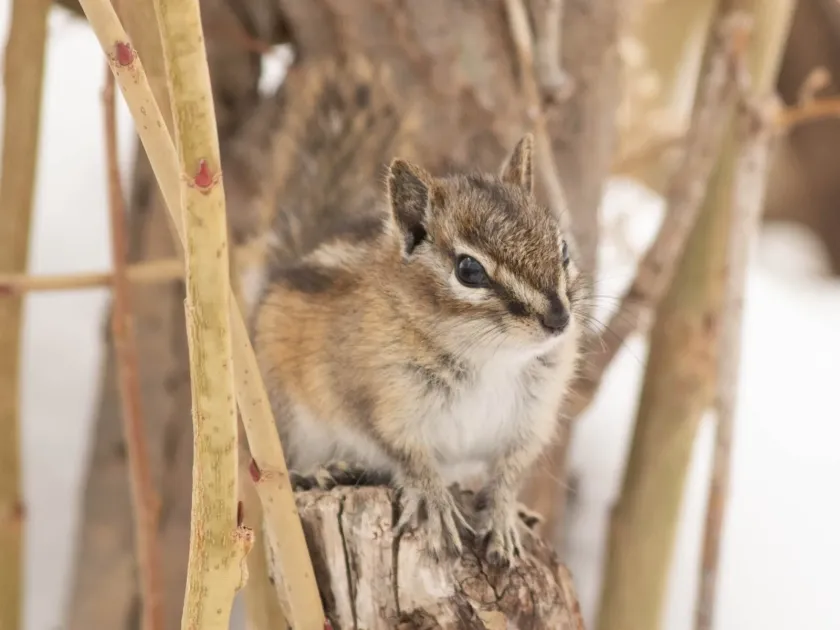
The least chipmunk (Neotamias minimus, formerly Eutamias minimus) is the smallest member of the squirrel family (Sciuridae). It is distinguished by its small size and a pattern of five dark stripes separated by white or gray bands along its back.
Adult individuals reach a total length of 18–22 cm, with the tail accounting for almost half of that length. These rodents are highly agile, capable of quickly navigating both across the ground and within dense vegetation or tree branches.
They are strictly diurnal, meaning they are most active during daylight hours. They construct elaborate burrow systems that include storage chambers for winter supplies and nesting areas, often located in well-drained, sheltered spots.
Taxonomically, they belong to the order Rodentia. Widely distributed across North America, they have successfully adapted to diverse environments, including grasslands, shrublands, and suburban landscapes near agricultural zones.
Their high level of environmental plasticity allows them to thrive in human-altered landscapes, making them frequent visitors to garden plots and cereal fields where food sources are consistently available.
What it damages
The least chipmunk causes significant damage to cereal crops by excavating seeds immediately after planting. Fields of wheat, barley, and oats are particularly vulnerable to these rodents as they consume seeds before germination occurs.
In vegetable gardens, they are known to damage a variety of crops, including peas, beans, corn, and sunflowers. They often nip off young shoots and seedlings, potentially destroying entire rows of plantings early in the season.
Orchards and berry patches also suffer from their presence. Chipmunks consume fruits such as strawberries and raspberries, and in some instances, they may strip the bark from young fruit trees, leading to stress or death of the saplings.
A major economic impact arises from their hoarding behavior. They transport large quantities of grain and seeds to their underground caches, resulting in significant yield losses that extend beyond their immediate daily consumption.
The physical disturbance caused by digging tunnels and burrows disrupts the root systems of garden plants, leading to weakened growth, decreased yields, and potential collapse of the soil structure around the crops.
When it appears
Activity begins in early spring as the animals emerge from their winter dormancy. This period is critical as the rodents search for food and are highly attracted to newly sown agricultural fields and garden plantings.
Summer is the peak period for crop damage, coinciding with the maturation of various fruits and seeds. During this time, chipmunks are at their most mobile, intensively gathering and storing food for the upcoming winter.
In autumn, chipmunks are extremely busy harvesting leftover grain and wild seeds. Their presence in harvested fields or near storage areas increases significantly as they finalize their food stockpiles before the cold weather sets in.
Winter dormancy involves long periods of inactivity within burrows, where they rely on previously collected food caches. While they are less active outdoors during this time, they remain a potential threat if storage bins are not properly secured.
The length of the active season depends heavily on local climate, with populations in milder regions remaining active for a longer portion of the year, necessitating prolonged pest management efforts.
Signs of infestation
The most reliable sign of a least chipmunk infestation is the discovery of burrow entrances. These are typically small, circular holes found near logs, rock piles, tree roots, or thick brush at the edges of cultivated areas.
Evidence of digging, such as small craters on seed rows or disturbed soil around vegetable plants, indicates where chipmunks have been excavating to reach seeds or young tubers.
Auditory signs include sharp, rhythmic "chip-chip" or trilling calls, often used to warn other chipmunks of danger. Hearing these sounds during the day is a strong indicator of their presence in the immediate vicinity.
Specific bite marks on crops are another diagnostic sign. These appear as clean-cut or gnawed edges on fruits, vegetable stems, and seed pods, often accompanied by seed husks left behind at their feeding stations.
Well-worn trails through vegetation, leading from burrow entrances to food sources, are often visible. These represent repetitive travel paths used by the rodents to move between their nesting sites and the garden beds.
Control measures
Physical exclusion is the most effective approach for garden protection. Using wire mesh or hardware cloth fences around vegetable beds and protecting individual young tree trunks can prevent access by chipmunks.
Ultrasonic or vibration-based repellents can be used to deter chipmunks from specific areas. For these to be effective, devices should be rotated or moved periodically to prevent the animals from habituating to the stimuli.
Good agricultural hygiene is essential. Keeping fields free of weed debris, securing harvest storage in airtight containers, and removing wood or rock piles near growing areas reduces the available cover and food storage sites.
Chemical control with rodenticides may be considered in severe infestations, but it requires extreme caution to protect non-target species, including domestic pets and local wildlife, by using tamper-resistant bait stations.
Biological management, such as encouraging local raptors (hawks or owls) by providing nesting or perching opportunities, can serve as a natural deterrent, effectively maintaining chipmunk population levels within manageable limits.
Taxonomy
- Latin name
- Eutamias minimus
- Order
- Rodents
- Family
- Sciuridae
- EPPO code
- EUTAMP
Discussion
No discussions yet — be the first.