
Shore ground beetle
Eurynebria complanata
Description
How to identify
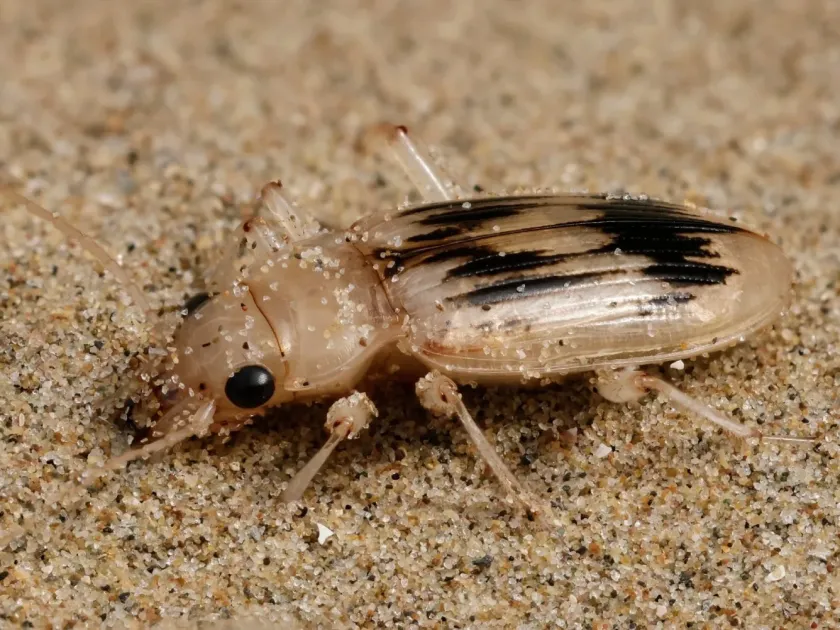
The shore ground beetle (Eurynebria complanata) is a large insect belonging to the family Carabidae within the order Coleoptera. Adult beetles typically reach 20–25 mm in length.
They possess a flattened body, which is a physical adaptation for moving through sandy environments such as dunes or coastal riverbanks.
The coloration is usually light brown to ocher with dark markings on the elytra (wing covers), providing excellent camouflage against sandy soil.
The head is large, equipped with strong mandibles adapted for a predatory lifestyle, although this species can occasionally feed on plant tissues.
The larvae are elongated with well-developed legs, making them capable of rapid movement through the soil profile when searching for food or shelter.
What it damages
While primarily predatory, the shore ground beetle can become an opportunistic pest in agricultural fields, especially those near its natural habitat.
Both adults and larvae have been observed feeding on the shoots and seeds of emerging cereal crops such as wheat, barley, and maize.
The damage occurs when the beetles gnaw on the young stems or seeds, often resulting in weakened seedlings that may fail to establish properly.
Crop losses are most significant in fields that have been recently reclaimed or are situated immediately adjacent to sandy wetlands or coastal zones.
In addition to direct feeding, the mechanical disturbance of the soil around the plant roots can indirectly stress the seedlings, making them more susceptible to disease.
When it appears
Adult beetles become active in the spring when soil temperatures reach a threshold that stimulates their emergence from overwintering sites.
Peak activity and mating typically occur during the late spring and early summer, which coincides with the germination phase of many spring-sown crops.
They are primarily nocturnal, remaining hidden under debris, stones, or inside soil crevices during the daylight hours to avoid heat and predation.
The life cycle involves multiple larval stages, with development progressing throughout the summer months depending on humidity and food availability.
As autumn approaches, activity declines significantly as the beetles migrate to deeper layers of the soil to survive the winter season.
Signs of infestation
The presence of this pest is indicated by jagged, irregular feeding marks on the stems and bases of newly emerged plant seedlings.
Observing adult beetles under plant debris at the field edge during evening inspections can confirm the identity of the pest.
The presence of shallow tunnels or disturbed soil around the base of the plants can also indicate active larvae in the root zone.
Stunted growth or wilting in specific patches of the field, especially near water sources, often suggests an infestation of soil-dwelling carabids.
Soil sampling by digging small pits in the root zone is an effective way to detect the presence of larvae before significant damage occurs.
Control measures
Integrated pest management (IPM) is the most effective approach, starting with mechanical soil preparation to disrupt the beetle's resting sites.
Treating seeds with appropriate systemic insecticides is a standard agricultural practice to protect seedlings from soil-dwelling insects during the vulnerable early growth stage.
Crop rotation should be implemented to prevent the population from establishing itself permanently in a specific field.
If population densities exceed economic thresholds, foliar or soil-applied insecticides can be used during the peak activity of the beetles.
- Maintaining field hygiene to reduce harborages for adults.
- Using light traps near field borders for population monitoring.
- Monitoring the proximity of sandy environments to high-risk fields.
Taxonomy
- Latin name
- Eurynebria complanata
- Order
- Coleoptera (beetles)
- Family
- Carabidae
- EPPO code
- ENEBCO
Discussion
No discussions yet — be the first.