
Broad-banded hoverfly
Eupeodes latifasciatus
Description
How to identify
The broad-banded hoverfly, Eupeodes latifasciatus, is a member of the Syrphidae family, commonly known as hoverflies or flower flies due to their flight behavior.
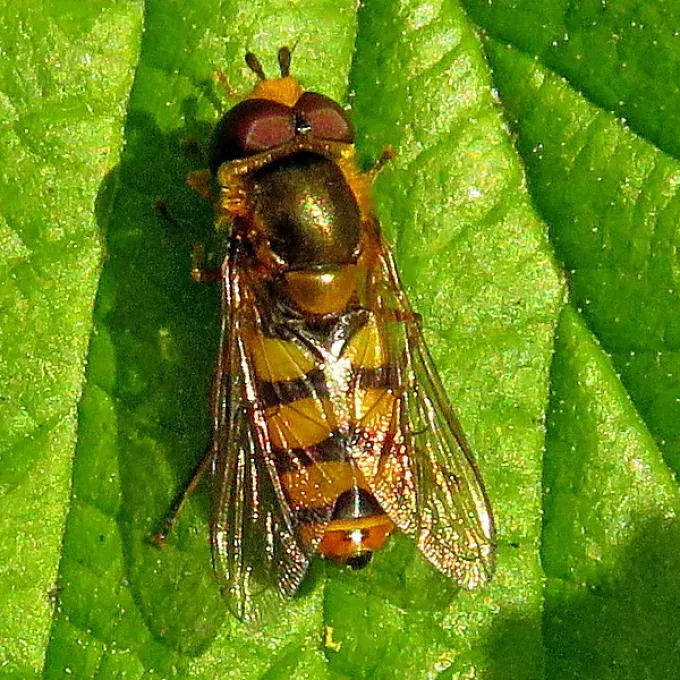
Adults typically exhibit yellow and black bands across the abdomen, mimicking the appearance of wasps or bees to deter potential predators through mimicry.
The larvae are typically legless, slug-like, and range in color from pale green to yellowish-brown, allowing them to blend into the foliage where aphids congregate.
While often grouped with pests in general surveys, this species is highly valued in agriculture as a beneficial predatory insect.
Proper identification is crucial for farmers to distinguish this beneficial ally from actual plant-damaging larvae that might appear in similar environments.
What it damages
The larvae are active predators of aphids, which are significant pests on various agricultural, horticultural, and ornamental plant species.
They consume large numbers of aphids, directly reducing the population density of these sucking pests and preventing damage to the host plants.
There is no evidence of the larvae causing direct damage to plant tissues, as their mouthparts are evolved exclusively for a predatory lifestyle.
In rare instances of extremely high populations, the only potential concern is the presence of larval waste on crop surfaces, though this is negligible compared to the benefits provided.
Farmers should view the broad-banded hoverfly as a natural biological control agent rather than a damaging pest.
When it appears
Adults emerge in late spring when temperatures rise sufficiently to support flight and the availability of early-season nectar sources increases.
Peak activity occurs throughout the summer months, coinciding with the rapid population growth of aphid colonies on susceptible crops.
The life cycle involves multiple generations per year, allowing the species to quickly track and respond to changes in aphid abundance.
Overwintering occurs in the pupal stage, typically within the soil or deep within organic mulch, providing protection from cold winter temperatures.
Monitoring the flight period helps agronomists time the application of biological treatments to avoid harming these beneficial populations.
Signs of infestation
The most prominent sign is the sighting of adult flies hovering around flowers or aphid-infested stems, exhibiting their characteristic stationary flight.
Larval activity can be observed by inspecting the underside of leaves, where legless larvae will be found moving amongst aphid colonies.
Evidence of successful predation includes shriveled, empty aphid exoskeletons left behind after the hoverfly larvae have finished feeding.
A reduction in the rapid spread of aphid outbreaks often indicates that hoverfly larvae are effectively controlling the pest population in that area.
The presence of these insects is an indicator of a healthy, functioning agro-ecosystem that does not require drastic intervention.
Control measures
Control measures are unnecessary and counter-productive, as the broad-banded hoverfly acts as a natural guardian of crop health.
To support and increase their populations, farmers should plant nectar-rich flowers nearby, which serve as essential food sources for the adult flies.
If aphid pressure is extreme, use selective insecticides that have low toxicity to beneficial predators, avoiding broad-spectrum chemicals.
Integrated Pest Management (IPM) practices should prioritize the preservation of these hoverflies as a primary defense against aphid infestations.
- Maintain diverse planting zones;
- Use selective bio-pesticides;
- Minimize pesticide spraying during peak activity;
- Promote natural habitats.
Taxonomy
- Latin name
- Eupeodes latifasciatus
- Order
- Diptera (flies)
- Family
- Syrphidae
- EPPO code
- METYLT
Discussion
No discussions yet — be the first.