
Hoverfly
Eupeodes confertus
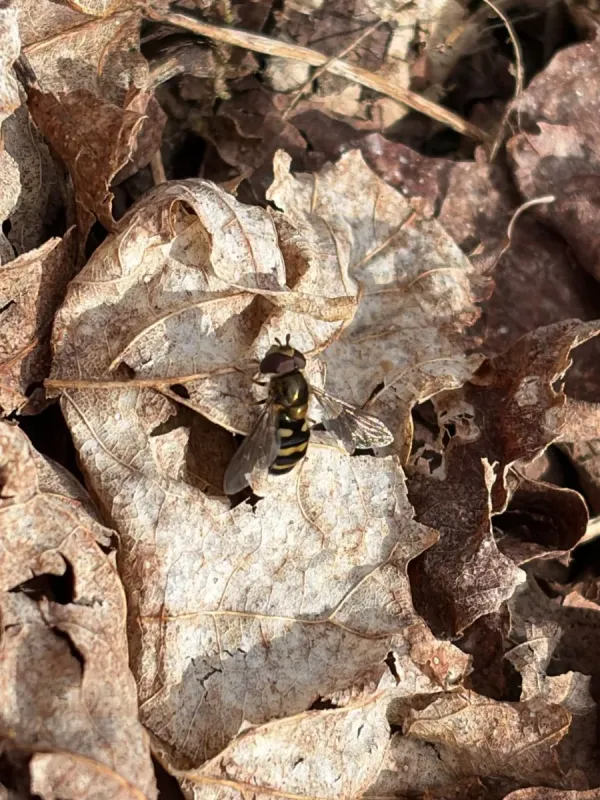
Description
How to identify
The hoverfly (Latin: Eupeodes confertus) belongs to the Syrphidae family, order Diptera. Adult flies are famous for their mimicry, resembling wasps or bees with yellow and black patterns, but they are harmless and do not possess stings.
Adults typically measure between 8 and 12 mm in length. They are recognized by their unique flight pattern, characterized by the ability to hover stationary in mid-air before darting rapidly between flowers.
Larvae are elongated, legless, and lack a distinct head. Their color often ranges from pale green to yellowish-grey, which provides excellent camouflage while feeding on surfaces of host plants.
The life cycle encompasses four distinct stages: egg, larva, pupa, and imago. Females prefer to lay eggs near food sources, ensuring that larvae can immediately start consuming resources upon hatching.
While many syrphid flies are beneficial predators, certain species like Eupeodes confertus may cause localized damage in agricultural settings when population densities become excessively high.
What it damages
Damage occurs when larvae, particularly during periods of food scarcity, feed on the tender epidermis of young shoots and leaves, leading to tissue necrosis and stunted growth.
The host range includes various vegetable and fruit crops, such as cabbage, apple, and plum, as well as several ornamental flowers that are highly susceptible during their active growth phase.
Feeding activity leaves visible bite marks and scars, which often serve as entry points for secondary fungal or bacterial infections, further compromising the health of the entire plant.
Significant infestations lead to leaf curling and discoloration, ultimately reducing the plant's photosynthetic capacity and causing substantial yield losses in commercial production.
The economic impact of this species is assessed based on the density of the larvae, as scattered individuals usually cause negligible harm compared to mass outbreaks.
When it appears
The activity period for adults begins in early spring and persists until the first autumn frosts, depending heavily on temperature and the availability of nectar-producing plants.
Peak larval abundance is typically observed in mid-summer, correlating with the highest density of prey species or the specific phenological stage of the agricultural crop.
Pupation generally occurs within the topsoil or amongst debris, allowing the insect to survive winter dormancy successfully until environmental conditions become favorable again.
Multiple generations may occur within a single growing season, provided that environmental conditions and food resources remain optimal for rapid development.
Monitoring for adults can be effectively conducted using yellow sticky traps, which attract hoverflies and provide data for timing potential pest management interventions.
Signs of infestation
The most immediate sign of presence is the characteristic hovering flight of the adults around blossoms and lush foliage during sunny, calm weather conditions.
Inspection of leaves often reveals irregular feeding patterns, where larvae have grazed on the surface, leaving behind brownish, oxidized marks or slight tissue thinning.
Leaves may appear distorted or curled, providing shelter for the larvae; unfolding these leaves frequently reveals the larvae or their characteristic slimy excrement.
Stunted growth of new terminal shoots and a general lack of vigor in young seedlings are indicators that the plants are under stress from larval grazing.
Presence of pupae in the soil or under organic mulch near the base of the plant can be detected during routine garden maintenance or agricultural soil assessments.
Control measures
Management strategies emphasize cultural practices, such as clearing crop residues in the autumn to eliminate overwintering sites for the pupal stage.
Biological control methods are preferred to maintain ecological balance, utilizing natural predators and parasitoids that effectively keep hoverfly populations under control.
Chemical intervention should be reserved as a last resort, using selective pesticides that minimize the impact on beneficial insects and non-target organisms.
Creating sustainable landscapes with diverse plant species can help regulate the population of these insects by providing habitat for their natural enemies.
- Utilizing yellow sticky traps for population monitoring.
- Autumn soil cultivation to destroy pupae overwintering in the ground.
- Applying insecticides only when infestation thresholds are exceeded.
Taxonomy
- Latin name
- Eupeodes confertus
- Order
- Diptera (flies)
- Family
- Syrphidae
- EPPO code
- EPDSCO
Discussion
No discussions yet — be the first.