
American hoverfly
Eupeodes americanus
Description
How to identify
The American hoverfly (Eupeodes americanus) is a member of the Syrphidae family, order Diptera. These insects are well-known for their resemblance to wasps or bees, exhibiting bright yellow and black abdominal markings.
Hoverflies are famous for their ability to hover motionless in the air before darting away. Adults have large compound eyes and are highly agile, making them efficient pollinators in various landscapes.
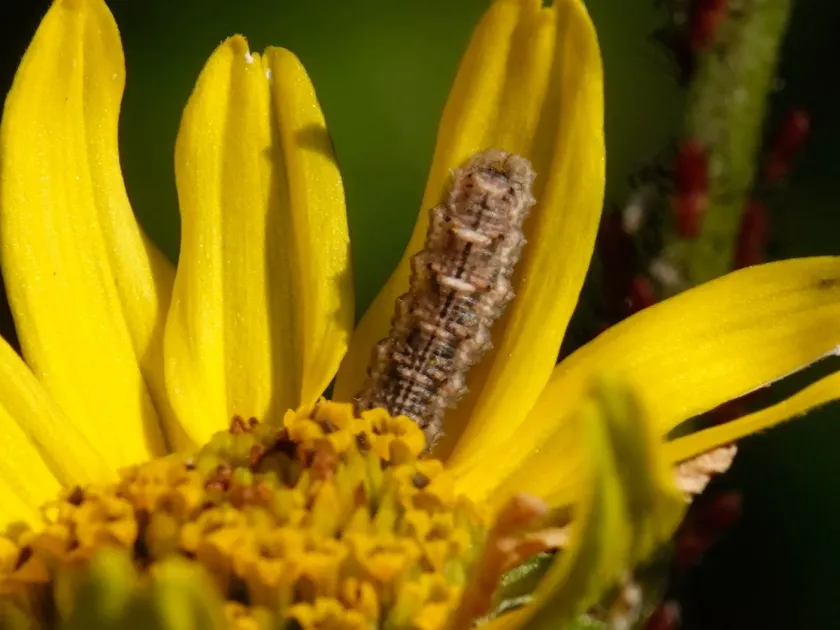
Larvae are typically slug-like, legless, and may range in color from green to brownish-grey, often with faint longitudinal stripes. They possess specialized mouthparts used to pierce and drain their aphid prey.
The life cycle encompasses four distinct stages: egg, three larval instars, puparium, and adult. The development rate is highly dependent on ambient temperatures and the availability of aphid colonies for the larvae.
As a non-pest species, the American hoverfly is a critical component of healthy agricultural ecosystems, providing essential services such as pollination and biological pest suppression.
What it damages
The American hoverfly does not cause any damage to plants. It is not a herbivore; therefore, it does not feed on leaves, stems, roots, or fruit, and it poses no threat to crop health.
In fact, this species is a highly effective predator of various aphid species. A single larva can consume hundreds of aphids during its growth phase, significantly reducing pest pressure on crops.
Adult hoverflies feed on nectar and pollen, which makes them excellent pollinators for many horticultural and agricultural crops. Their presence enhances both the quality and quantity of plant production.
Because they act as natural enemies to pests, these insects are considered allies in integrated pest management (IPM). They help reduce the reliance on synthetic chemicals in commercial farming.
Farmers should recognize Eupeodes americanus as a beneficial agent rather than a pest. Protecting their habitats helps maintain a biological balance that naturally limits aphid outbreaks.
When it appears
Adults emerge in early spring, synchronized with the blooming of early floral resources. They require pollen and nectar to survive and prepare for the breeding season.
During the summer months, as aphid populations rise, the predatory activity of the larvae reaches its peak. This synchronization is crucial for the natural suppression of aphid outbreaks in fields.
The number of generations per year depends largely on local climate and resource availability. Warmer climates allow for faster developmental rates and multiple successive generations throughout the season.
As autumn approaches, hoverflies seek sheltered locations to overwinter. They may hibernate as pupae or adults in leaf litter, bark crevices, or protected areas near agricultural fields.
Effective monitoring involves observing adult flight activity around blooming plants, which serves as a biological indicator of the potential for natural aphid control in the area.
Control measures
Control measures for Eupeodes americanus should focus entirely on conservation and habitat enhancement. Do not apply insecticides to target these insects as they are beneficial.
To encourage their presence, integrate flowering companion plants like dill, coriander, or buckwheat into your crop rotation. These provide the necessary nectar for the adult stage.
Avoid broad-spectrum pesticide applications, especially during the active flight periods of hoverflies. If spraying is necessary, utilize selective or biopesticides that have minimal impact on predators.
Maintain semi-natural habitats such as hedgerows or field margins to provide refuge for the larvae and overwintering sites for the adults, ensuring the population persists year after year.
By promoting a diverse ecosystem, growers can maximize the efficacy of these natural predators, leading to more sustainable farming practices and a reduced need for chemical interventions.
Taxonomy
- Latin name
- Eupeodes americanus
- Order
- Diptera (flies)
- Family
- Syrphidae
- EPPO code
- SYRPAM
Discussion
No discussions yet — be the first.