
Euchloe simplonia
Euchloe simplonia
Description
How to identify
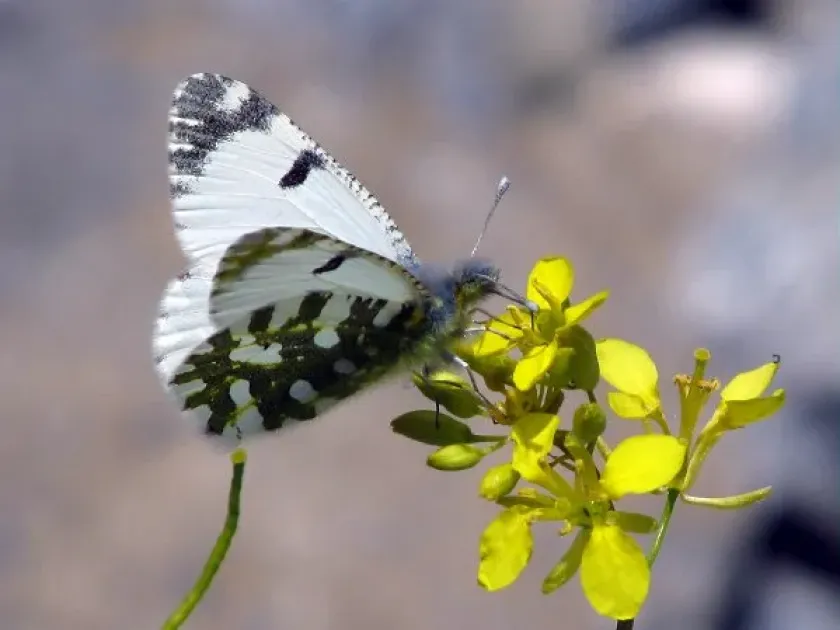
Euchloe simplonia is a butterfly species belonging to the family Pieridae, within the order Lepidoptera. Adults are easily recognized by their white wings featuring a distinctive marbled green pattern on the underside of the hindwings, providing effective camouflage against vegetation.
The larvae, or caterpillars, typically exhibit a green coloration with lighter lateral stripes, allowing them to blend seamlessly with the foliage of their host plants. As they mature, they undergo several molting stages, significantly increasing in size before entering the pupal stage.
The life cycle of this insect is closely adapted to temperate and alpine environments. Adult butterflies are diurnal, showing high activity during sunny periods, which is when they mate and oviposit on their specific host plants.
This species is a typical member of the local entomofauna in its distribution range. Proper identification is crucial for farmers, as morphological similarities to other Pieridae species can complicate field assessment during the early stages of a population outbreak.
While often considered a secondary pest, environmental factors can occasionally lead to population surges, making it a potential threat to sensitive vegetable crops if left unmonitored during the growing season.
What it damages
The caterpillars feed primarily on plants within the Brassicaceae family. While they favor wild host species, they readily migrate to agricultural crops such as cabbage, broccoli, and radishes if host availability is high in the vicinity.
The primary damage consists of intensive defoliation. Larvae begin by feeding on the edges of the leaves, creating irregular notches, and progressively move toward the center, often skeletonizing the entire leaf and leaving only the main veins intact.
When infestation occurs at the seedling stage, the growth point of the plant may be destroyed, leading to stunted development or total mortality. Such damage is particularly costly in large-scale vegetable production, where plant uniformity is essential.
Damage to the reproductive structures of the plant, such as flower buds, can drastically reduce seed yield, posing a significant risk to seed-producing farms. The resulting stress makes the plants more susceptible to secondary pathogenic infections.
The extent of the damage varies greatly depending on the geographical location and local agricultural practices. In regions with dense wild cruciferous vegetation, the risk of cross-infestation from natural habitats into crop fields is significantly higher.
When it appears
The active flight period for adult Euchloe simplonia occurs in the late spring and early summer. Once temperatures stabilize, adults emerge to begin their reproductive phase, targeting suitable host plants for egg-laying.
Embryonic development is relatively fast, leading to the emergence of larvae by early summer. This timeframe is critical for agricultural protection, as it is the period when most cruciferous vegetables are in their active growth phase.
The species typically undergoes a single generation per year, which is a key biological factor for management planning. This limited window of vulnerability makes it easier for farmers to concentrate their scouting efforts.
Pupation occurs in mid-summer, and the insect enters a diapause state. The pupae overwinter in protected areas, usually attached to stalks or debris near the host environment, remaining dormant until the following spring.
Understanding the phenology of this pest allows for precise timing of preventive measures. By monitoring flight patterns, growers can determine the optimal timing for interventions before larvae hatch and begin significant feeding.
Signs of infestation
The most evident sign of infestation is the appearance of irregular holes and notches along the leaf margins of cruciferous crops. As feeding progresses, the degree of leaf area loss becomes more pronounced and visible from a distance.
The presence of frass (larval excrement) on the leaves or the base of the plant is a reliable indicator of infestation. The accumulation of these droppings often points to the current location of the feeding larvae.
Visual inspection often reveals the caterpillars themselves, though their cryptic green coloring makes them difficult to spot. Searching during early morning or evening hours, when the larvae are more exposed, improves the probability of detection.
Damaged tissues often exhibit color changes, such as yellowing or desiccation, as the leaf loses its photosynthetic capacity. This decline in plant health is often a sign of significant leaf mass removal or damage to the plant's vascular system.
Scouting protocols should involve a systematic check of crop edges, especially those bordering wild habitats. Early detection of eggs on the underside of leaves can prevent the development of a large larval population that would be harder to control later.
Control measures
Effective management begins with agronomic practices, including thorough autumn plowing to destroy overwintering pupae in the soil. Removing cruciferous weeds from field margins is also vital, as these plants serve as alternative hosts for the pest.
Biological control agents, particularly formulations based on Bacillus thuringiensis, offer a high level of efficacy against lepidopteran larvae while remaining safe for beneficial insects like bees and predators.
Chemical intervention should be reserved for instances where the population density exceeds economic damage thresholds. Using selective insecticides that target larvae while preserving natural enemies is recommended to maintain biological balance.
Physical barriers, such as agricultural fleece or fine-mesh netting, are highly effective for small plots and garden settings. This method physically prevents the adult butterflies from accessing the crops to lay their eggs.
- Implement crop rotation patterns to break the life cycle of the pest.
- Regular monitoring of crop fields for egg masses during late spring.
- Manual removal of larvae in small-scale vegetable gardens.
- Use of trap crops to divert the population away from the main production fields.
Taxonomy
- Latin name
- Euchloe simplonia
- Order
- Lepidoptera (butterflies)
- Family
- Pieridae
- EPPO code
- EUOESI
Discussion
No discussions yet — be the first.