
Drone fly
Eristalis tenax
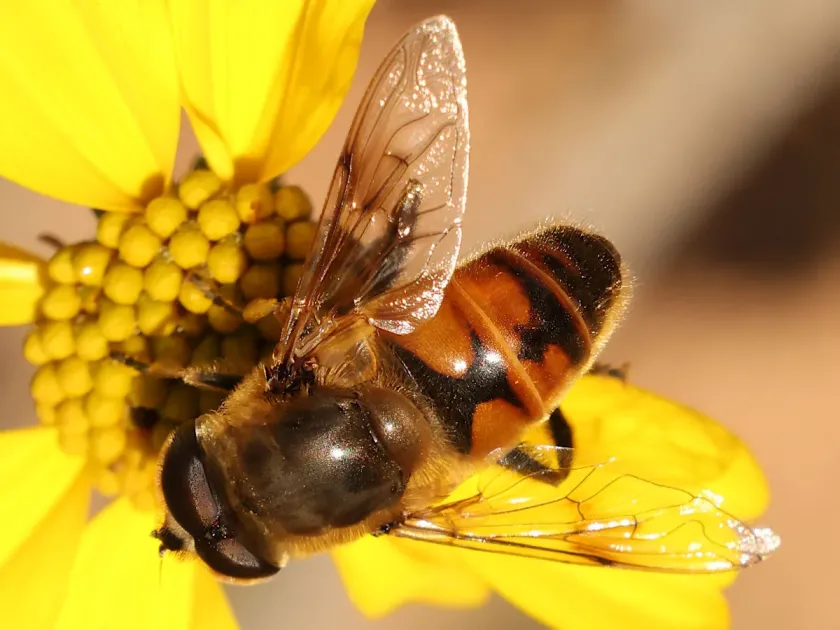
Description
How to identify
The Drone fly (Eristalis tenax) is a member of the Syrphidae family, widely known for its striking resemblance to a honey bee, which serves as a defense mechanism.
These flies have a robust, hairy body with specific markings that allow them to mimic the appearance of Hymenoptera effectively.
The larva, commonly referred to as the "rat-tailed maggot," possesses an exceptionally long telescopic respiratory siphon used to breathe air while submerged.
This unique respiratory organ allows the larvae to thrive in deoxygenated environments such as sewage, manure pits, and stagnant water bodies.
The life cycle encompasses eggs, aquatic larvae, pupae, and winged adults, with each stage uniquely adapted to its specific ecological niche.
What it damages
In an agricultural context, the Drone fly is generally considered a beneficial insect rather than a crop pest.
Adult flies are important pollinators for various flowering plants, contributing to increased yields in orchards and vegetable farms.
The larvae do not feed on live plant tissues, so they do not cause direct damage to cultivated crops or harvest quality.
However, the presence of these larvae in food supplies or drinking water can pose sanitary risks to livestock and humans.
While they don't consume crops, they indicate high levels of organic decay, which may necessitate better sanitation practices on the farm.
When it appears
Drone flies are highly active from early spring through late autumn, often congregating around flowers on warm, sunny days.
They typically complete several generations per year, with activity peaking during mid-to-late summer in nutrient-rich environments.
Larval development is closely tied to the presence of liquid organic waste, where they feed on bacteria and decaying plant matter.
When the larvae are ready to pupate, they migrate from the water source to drier ground to undergo metamorphosis.
Adults often hibernate in sheltered areas, such as hollow trees or buildings, to survive the cold winter months until spring returns.
Control measures
Controlling the Drone fly is usually unnecessary since they provide significant pollination services that outweigh any minor nuisances.
If their presence becomes a concern for sanitation, the primary strategy should be the removal of stagnant, organic-rich water sources.
Proper management of manure pits and timely composting of crop residues are effective ways to minimize suitable breeding sites.
Screening water containers and preventing the accumulation of waste are simple, non-chemical ways to reduce larval populations.
Because they are efficient pollinators, farmers are encouraged to protect these flies rather than using insecticides against them.
Taxonomy
- Latin name
- Eristalis tenax
- Order
- Diptera (flies)
- Family
- Syrphidae
- EPPO code
- ERITTE
Discussion
No discussions yet — be the first.