
Eristalis cerealis
Eristalis cerealis
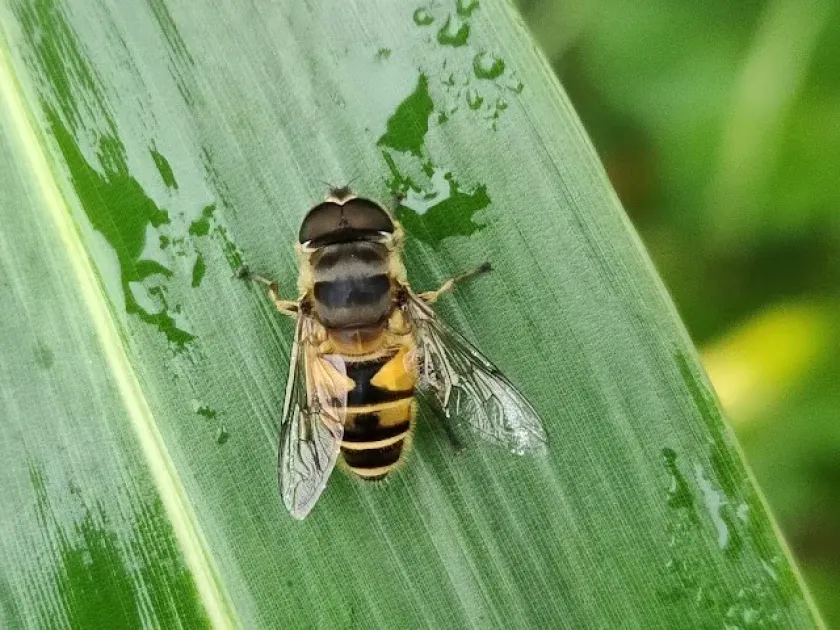
Description
How to identify
Eristalis cerealis is a species of hoverfly belonging to the family Syrphidae, order Diptera. Adults mimic bees, exhibiting a yellow and black striped abdomen that serves as a protective mechanism against predators.
The adult fly features a robust thorax covered in dense hairs and a distinctive facial stripe. Its eyes are large, often meeting in the center in males, which is a key identifying morphological trait.
The larvae are commonly known as "rat-tailed maggots." They possess a long, telescopic respiratory tube at the posterior end of their body, allowing them to breathe air while submerged in water or mud.
Adult flies are typically 12–15 mm in length. Their wings are transparent and feature complex venation typical of the genus, which distinguishes them from other bee-mimicking insects.
In the field, distinguishing Eristalis cerealis from related species requires detailed examination of the leg coloration and the precise structure of the male genitalia under magnification.
What it damages
While adult Eristalis cerealis are beneficial pollinators that frequent many flowering crops, the larvae can be problematic in specific agricultural and greenhouse environments.
The primary damage occurs when larvae populate the rhizosphere of crops planted in waterlogged soils rich in decaying organic matter, leading to mechanical stress on roots.
Direct damage involves the feeding activity of high densities of larvae on the root systems of weakened plants, which can disrupt water and nutrient uptake during critical growth stages.
The larvae create localized areas of rot. This environment encourages the growth of secondary bacterial and fungal pathogens, which can lead to seedling damping-off or root system decay.
This pest is more prevalent in low-lying fields with poor drainage or in areas where improper waste management leads to stagnant, nutrient-rich water pools near crop zones.
When it appears
Adult flies are most active from late spring through late summer. Their population peaks during warm, sunny periods, which are conducive to their flight and pollination activities.
The life cycle of the species is highly dependent on environmental temperature and moisture availability in the breeding substrate, with rapid development occurring in warm conditions.
Overwintering usually takes place in the larval stage, buried deep within moist soil or organic debris that provides insulation against freezing temperatures during the dormant season.
The emergence of adults is triggered by the warming of the soil in spring, which initiates the pupal development phase in the soil layers or protected cavities.
Successive generations can occur throughout the growing season, provided that sufficient organic matter and moisture remain available for larval survival and development.
Signs of infestation
Identifying the presence of Eristalis cerealis starts with observing the health of the plants in damp areas. Affected crops often appear stunted or suffer from premature yellowing of lower leaves.
A foul, putrid odor emanating from the soil around the root zone is a common indicator of high larval activity, caused by the breakdown of organic matter in the substrate.
Direct inspection of the soil near the root collars, especially in muddy patches, will reveal the characteristic rat-tailed larvae moving through the sludge.
Plants affected by larval feeding often show signs of wilt even when moisture levels are adequate, as the integrity of the root system has been compromised by rot.
- Stunted plant growth in wet soil areas.
- Yellowing and premature wilting of lower leaves.
- Visible rat-tailed larvae in the root zone.
- Foul smell from the soil surface.
Control measures
Effective management begins with improving soil drainage. Proper land grading and the installation of drainage systems are the most effective ways to discourage larval colonization.
Sanitation practices are critical; removing decaying organic waste and crop residues from the vicinity of fields prevents the buildup of larval breeding habitats.
The proper management of organic fertilizers, such as manure, is essential. Avoid leaving piles of organic matter exposed or in conditions that promote waterlogging.
Deep plowing or mechanical tillage can disrupt the larval environment, exposing them to desiccation and natural predators, which significantly reduces local populations.
Biological and chemical control measures are rarely necessary if appropriate cultural practices are maintained, as the environment is the primary driver of this species' success.
Taxonomy
- Latin name
- Eristalis cerealis
- Order
- Diptera (flies)
- Family
- Syrphidae
- EPPO code
- ERITCE
Discussion
No discussions yet — be the first.