
Macadamia felted coccid
Eriococcus ironsidei
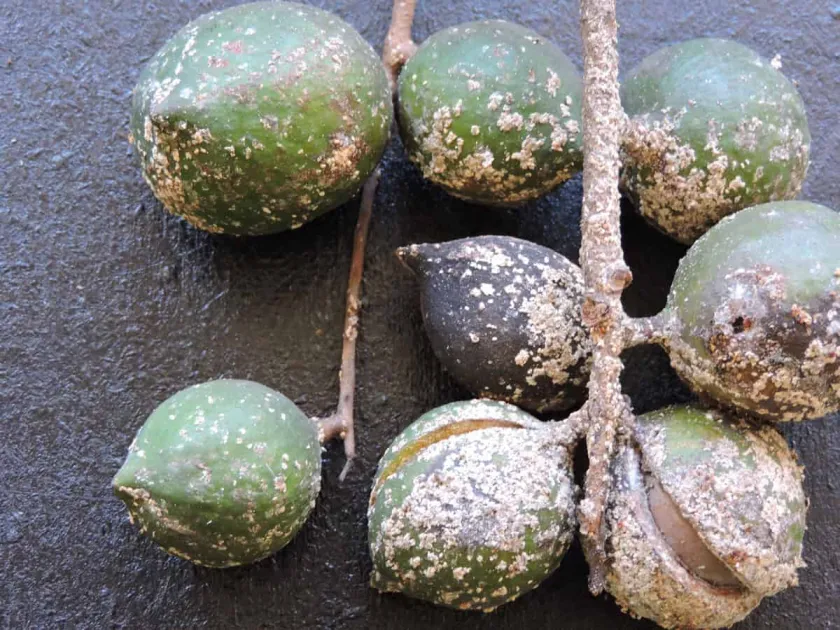
Description
How to identify
The Macadamia felted coccid (Eriococcus ironsidei) is a small insect belonging to the family Eriococcidae within the order Hemiptera. Adult females are typically sessile, remaining attached to the bark of trees throughout their entire reproductive stage.
The name "felted coccid" comes from the dense, white or yellowish felt-like sac that the female secretes around her body. This protective layer acts as a shield against predators, environmental stressors, and certain types of chemical treatments.
In contrast to the females, the male Macadamia felted coccids are tiny, winged insects. Their life cycle is brief, focusing entirely on locating and fertilizing the females, which makes them difficult to observe in the field compared to the stationary females.
The species primarily inhabits the bark and stems of its host plants. Their identification is best achieved during the crawler stage, when the newly hatched nymphs are mobile and seek out optimal feeding sites on the tree's surface.
Taxonomically, this insect is well-studied for its specific host relationship with the Macadamia tree. Understanding its morphology and microscopic features is essential for accurate diagnosis in large-scale orchards where infestations can go unnoticed until they become severe.
What it damages
The Macadamia felted coccid is a major pest of macadamia orchards. It feeds by inserting its specialized mouthparts into the phloem of young twigs, leaf petioles, and developing nuts, extracting vital plant sap.
The feeding activity results in the withdrawal of nutrients, which significantly weakens the tree's health. Severe infestations can lead to shoot dieback, loss of foliage, and a general decline in the tree's vitality over several growing seasons.
Economic damage is largely caused by the reduction in nut quality and yield. The distorted growth of fruit and the loss of energy reserves affect the size and oil content of the macadamia kernels, directly impacting marketability.
Furthermore, the pest's presence creates an environment conducive to the growth of sooty mold. This fungus develops on the honeydew excreted by the coccids, covering the leaves and reducing the tree's photosynthetic capacity.
In cases of extremely high pest density, the overall vigor of the orchard decreases, making the trees more susceptible to other secondary pests and pathogens, thus complicating the entire orchard management process.
When it appears
The lifecycle of the Macadamia felted coccid is largely driven by seasonal temperature variations. In many growing regions, activity begins in early spring as the macadamia tree initiates its new growth flush.
The most active period for the movement of crawlers is typically during the warmer months. As temperatures rise, multiple overlapping generations may occur, leading to a rapid buildup of the pest population on previously uninfested parts of the tree.
Development slows down significantly during the cooler winter months, with the population often persisting in the adult or nymphal stages within the crevices of the bark. This dormancy period is a critical time for certain dormant oil applications.
Monitoring efforts should be intensified during the peak of the growing season, specifically when crawler emergence is expected. This synchronization is crucial for the timing of any management intervention.
Weather patterns, particularly humidity and excessive rainfall, can influence the mortality rates of the crawlers, making it important for growers to maintain site-specific records of pest pressure across the year.
Signs of infestation
The primary visual sign of an infestation is the appearance of white, felt-like sacs on the bark of twigs and branches. These sacs can appear in clusters, sometimes creating a patchy or dense white appearance on the host wood.
Trees infested with the Macadamia felted coccid often exhibit stunted growth and yellowing leaves. Because the insects target the vascular tissue of the petioles, the transport of water and nutrients to the leaves is frequently impaired.
Honeydew secretion is another characteristic indicator. If the surface of the leaves looks shiny and sticky, or if it is covered by a black, dusty layer of sooty mold, a scale infestation is likely present nearby.
Branch dieback is a serious sign of a long-term, established colony. When the insects have been feeding on a specific twig for an extended period, the branch becomes brittle, loses its leaves, and eventually dies.
Increased ant activity around the tree canopy is a strong indicator of scale presence. Ants are often attracted to the honeydew and may actively protect the coccids from natural predators, further exacerbating the infestation.
Control measures
Integrated Pest Management (IPM) is the most effective approach for controlling the Macadamia felted coccid. This includes cultural, biological, and chemical interventions to maintain pest populations below economic thresholds.
Cultural methods focus on the removal of heavily infested wood during regular pruning. This mechanical reduction of the population helps to prevent the spread of the insect to cleaner parts of the orchard.
Chemical control is most effective when targeted at the crawler stage, as the adult females are protected by their felted sacs. Systemic insecticides can be used, provided they are applied in accordance with regional regulations and safety guidelines.
Biological control plays a significant role in maintaining balance. Encouraging populations of natural predators, such as ladybird beetles and parasitic wasps, can help keep the scale insect numbers in check without the need for intensive chemical spraying.
- Monitor for crawler emergence using double-sided sticky tapes.
- Utilize petroleum or horticultural oils to smother nymphs.
- Maintain orchard sanitation to eliminate overwintering sites.
- Use selective, narrow-spectrum insecticides to preserve beneficial predator populations.
Taxonomy
- Latin name
- Eriococcus ironsidei
- Order
- Hemiptera (bugs, aphids, leafhoppers)
- Family
- Eriococcidae
- EPPO code
- ERIOIR
Discussion
No discussions yet — be the first.