
Acanthococcus lagerstroemiae
Acanthococcus lagerstroemiae
Description
How to identify
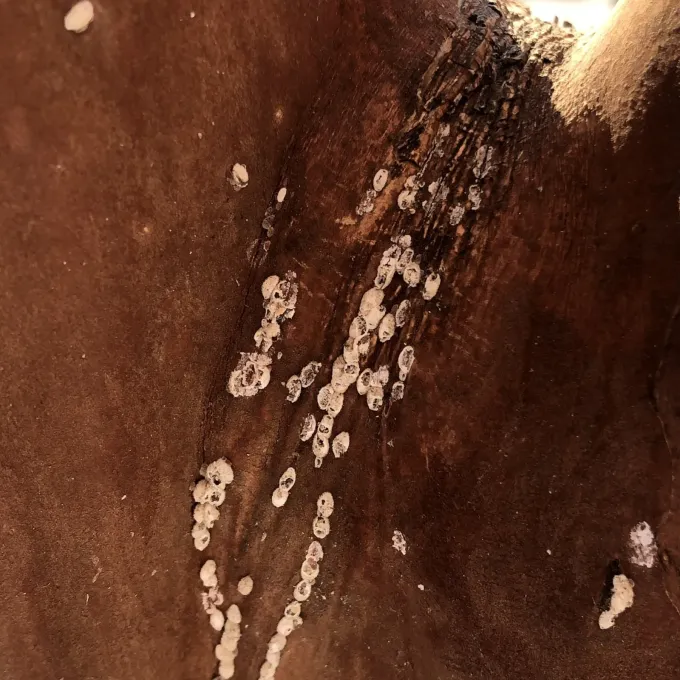
Acanthococcus lagerstroemiae, commonly known as the crepe myrtle bark scale (CMBS), belongs to the family Eriococcidae, order Hemiptera. This tiny sucking insect is distinguished by the dense, white, felt-like waxy covering that protects the adult females.
Adult females are oval-shaped and remain stationary once they have attached themselves to the plant bark, forming white or cream-colored mats that resemble fuzzy white mold or cotton.
While the adult females are easily spotted due to their white protective coatings, the male insects are winged and small, making them much less noticeable in a garden environment.
The insect is well-adapted to surviving on woody hosts, using its specialized piercing-sucking mouthparts to feed directly on the sap within the plant's vascular system.
Identifying this pest early is crucial because its ability to hide in bark crevices and branch crotches allows it to go unnoticed until a significant population has developed.
What it damages
The primary host of this pest is the crepe myrtle (Lagerstroemia), though it has also been documented on pomegranate, persimmon, and certain maple species.
Feeding by these insects significantly drains the host plant's vital energy, leading to stunted shoot growth, weakened overall health, and a reduction in the abundance of flower blooms.
As the insects feed, they excrete a sugary substance known as honeydew, which drops onto leaves and branches below, providing a food source for sooty mold.
This black, velvety fungal growth covers the affected parts of the plant, further inhibiting photosynthesis and reducing the aesthetic quality of the shrub or tree.
In cases of severe infestation, the plant may experience dieback of branches, severe stress, and in extreme circumstances, the death of the entire ornamental specimen.
When it appears
Acanthococcus lagerstroemiae is multivoltine, meaning it produces multiple generations per year, which allows the population to expand rapidly during the growing season.
During the spring, overwintered eggs hatch into mobile nymphs, often called "crawlers," which move across the bark to find suitable feeding sites.
Summer is characterized by peak activity, with all life stages—eggs, nymphs, and adults—often present simultaneously on the same branch.
As temperatures begin to drop in the autumn, the insects begin to settle into overwintering sites, often choosing protected areas like bark fissures or buds to survive the winter.
Monitoring should be continuous, but special attention is needed during the spring emergence phase to prevent the establishment of new colonies on healthy branches.
Signs of infestation
The most diagnostic sign of an infestation is the presence of white, felt-like masses attached to the trunk and limbs, which are the protective sacs of the female scale insects.
The buildup of black sooty mold on the foliage is a secondary indicator that the tree is currently supporting a large population of sap-sucking insects.
Plants often exhibit signs of general stress, such as yellowing leaves, lack of terminal shoot growth, and premature leaf drop during the summer months.
Small, sticky droplets of honeydew on the leaves are another common sign, which often attracts ants and wasps to the infested tree.
- white, fuzzy waxy patches on bark;
- black sooty mold on leaves and twigs;
- sticky honeydew residue;
- diminished growth and branch dieback;
- premature leaf yellowing.
Control measures
Managing this pest requires an integrated approach, as the waxy protective coating makes the adults highly resistant to standard contact insecticides.
Physical control methods, such as scrubbing the bark with a soft brush and water, can help reduce the initial population and remove honeydew buildup.
Systemic insecticides, particularly those containing neonicotinoids or insect growth regulators, applied to the soil or trunk, are highly effective as they are absorbed by the plant and target the pests during feeding.
Timing is critical: applications should be synced with the crawler emergence phase in the spring, as these young nymphs lack the thick waxy armor of the adults.
Dormant oils applied during the late winter can help suppress overwintering stages by suffocating the insects, providing a cleaner start to the spring growing season.
Taxonomy
- Latin name
- Acanthococcus lagerstroemiae
- Order
- Hemiptera (bugs, aphids, leafhoppers)
- Family
- Eriococcidae
- EPPO code
- ERIOLA
Discussion
No discussions yet — be the first.