
Hoverfly
Episyrphus
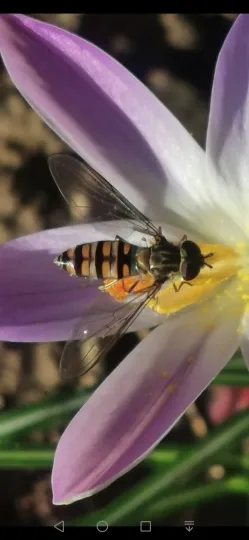
Description
How to identify
Hoverflies, belonging to the family Syrphidae, are fascinating insects often mistaken for bees or wasps due to their vibrant yellow and black patterns, which serve as Batesian mimicry.
The name hoverfly comes from their unique ability to hover mid-air, remaining perfectly still before darting away at high speed. This behavior is easily observed around flowers.
Their larvae are legless, slug-like creatures, often found in pale green or yellowish colors. They are secretive and dwell primarily within aphid colonies, making them difficult to spot without close inspection.
Within the order Diptera, the genus Episyrphus is widely recognized as a key group of hoverflies. They are found across various habitats, ranging from private gardens to large commercial orchards.
Identifying these insects is crucial for integrated pest management, as they are not pests but rather highly effective biological control agents for horticultural crops.
What it damages
Adult hoverflies do not cause any damage to crops. They are nectar and pollen feeders, playing a vital role in pollination, similar to bees and other pollinators.
The larvae are voracious predators. Their primary food source consists of aphids, scale insects, and other small, soft-bodied pests that frequently damage vegetable and fruit crops.
A single hoverfly larva can consume several hundred aphids during its development, making it one of the most efficient natural controls against common garden infestations.
They do not pose a threat to plant health; in fact, their presence is an indicator of a healthy, balanced ecosystem that is capable of self-regulating pest populations.
Misidentifying them as pests is a common error, but it is important to remember that Episyrphus provides significant economic value to growers by reducing the need for chemical interventions.
When it appears
Adult hoverflies emerge in early spring as soon as floral resources become available. They require nectar to fuel their flight and reproductive activities throughout the season.
The highest levels of activity occur during the summer months when aphid populations peak. This synchronicity ensures that hoverfly larvae have a constant food supply for their development.
Multiple generations can occur within a single year, allowing the hoverfly population to respond quickly to sudden spikes in aphid numbers in the field.
As autumn approaches, activity declines as insects seek suitable overwintering sites, often in debris or sheltered areas near hedgerows and field margins.
Developmental rates are temperature-dependent, meaning warmer springs often lead to earlier emergence and a more rapid establishment of the first generation of larvae.
Control measures
There are no control measures against hoverflies, as they are considered beneficial insects. The focus should always be on conservation rather than eradication.
To encourage hoverflies, maintain a diverse range of flowering plants, especially those in the Apiaceae family like dill, fennel, and parsley, which are highly attractive to adults.
Reducing the use of broad-spectrum pesticides is essential, as these chemicals often prove fatal to beneficial predators, leading to subsequent outbreaks of target pests.
- Incorporate flowering margins into crop rotations
- Avoid preventative insecticide applications
- Leave patches of wild vegetation to serve as habitat and overwintering sites
When chemical management is absolutely necessary, choose selective products that have low impact on beneficial insects, ensuring that the natural balance remains protected.
Taxonomy
- Latin name
- Episyrphus
- Order
- Diptera (flies)
- Family
- Syrphidae
- EPPO code
- EPIYSP
Discussion
No discussions yet — be the first.