
Epistrophe nitidicollis
Epistrophe nitidicollis
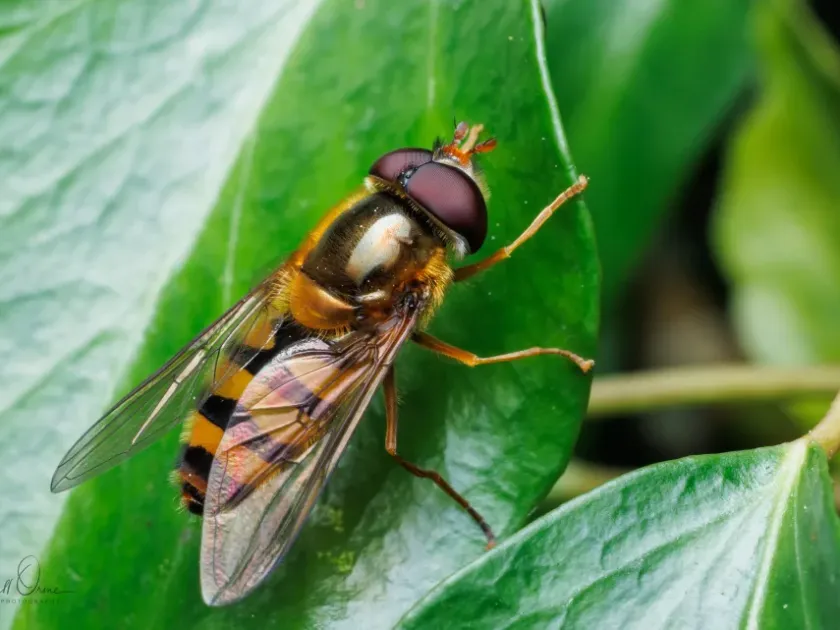
Description
How to identify
Epistrophe nitidicollis belongs to the order Diptera and the family Syrphidae. Known as hoverflies, these insects are famous for their ability to hover in the air and their mimicry of wasps and bees.
Adult flies are medium-sized with a shiny black body and distinctive yellow abdominal bands. Their heads are dominated by large compound eyes, which are essential for their agile flight patterns.
The larvae of this species are slug-like, apodous (legless), and exhibit a range of colors from pale yellow to greenish-gray. They are highly specialized predators often found within aphid colonies.
The life cycle encompasses four stages: egg, larva, pupa, and adult. Females lay eggs directly near aphid aggregations, ensuring that the emerging larvae have an immediate food source.
While often viewed through the lens of biological control, their presence is a clear indicator of a functional ecosystem capable of natural pest suppression.
What it damages
The primary role of Epistrophe nitidicollis in an agricultural context is that of a predator. Their larvae feed voraciously on various aphid species, which are notorious pests of orchard and vegetable crops.
They do not pose a direct threat to the plant tissues. Any perceived damage is usually collateral during the cleaning process of a dense aphid colony on leaves or tender shoots.
Orchards including apple, pear, and plum trees benefit significantly from the presence of these larvae, as they can decimate aphid populations before significant plant damage occurs.
Vegetable gardens also see a reduction in pest pressure on crops like beans, lettuce, and cabbage when these hoverflies are present in sufficient numbers.
Managing the population of this hoverfly is crucial for sustainable agriculture, as they perform a service that chemical alternatives often disrupt by killing beneficial predators.
When it appears
Adult flies emerge during the spring, coinciding with the flowering of early nectar-producing plants. They rely on pollen and nectar for energy to sustain flight and egg production.
The flight season extends throughout the summer months. Depending on temperature and food availability, multiple generations can occur, ensuring sustained protection against pests.
Larval activity is most intense during the peak colonization period of aphids, typically late spring and early summer. The speed of their development is tightly linked to ambient temperatures.
As autumn approaches, the development cycle slows down. Pupation usually occurs in sheltered areas such as leaf litter or in the topsoil, where they remain until the following spring.
Monitoring for adults can be effectively done using yellow sticky traps, which attract them due to their innate preference for bright colors associated with flowers.
Signs of infestation
A key indicator of their presence is the rapid decline of aphid colonies on leaves, often accompanied by the presence of empty aphid exuviae (cast skins) left behind after the larvae feed.
The larvae themselves can be found by inspecting the undersides of leaves where aphid populations are concentrated, although they are well-camouflaged and may require careful observation.
The presence of many adult hoverflies around blooming carrots, dill, or other umbelliferous plants indicates a high likelihood of larval presence in nearby aphid-infested crops.
Reduced leaf curling on trees is another sign that predators have begun to effectively manage the aphid population in that specific area.
Integrated Pest Management (IPM) practitioners use these signs to assess whether chemical interventions are even necessary, often finding that the hoverflies have already solved the issue.
Control measures
The primary strategy for managing this species is conservation. Since they are beneficial predators, avoiding broad-spectrum insecticides is the most effective way to protect them.
Farmers are encouraged to create habitat strips or floral borders containing nectar-rich plants like buckwheat, coriander, or clover to attract adult hoverflies to the fields.
If intervention is necessary due to extreme pest outbreaks, choosing selective biological products that do not harm beneficial syrphids is essential for maintaining a healthy agroecosystem.
Preserving overwintering sites, such as patches of undisturbed soil or leaf litter at field margins, helps support the survival of the next generation of predators.
- Prioritize selective biological control over chemical pesticides.
- Establish flowering nectar corridors to attract hoverflies.
- Avoid spraying during peak bloom periods.
- Conduct regular monitoring to determine the actual need for treatment.
Taxonomy
- Latin name
- Epistrophe nitidicollis
- Order
- Diptera (flies)
- Family
- Syrphidae
- EPPO code
- EPIRNI
Discussion
No discussions yet — be the first.