
Epistrophe emarginata
Epistrophe emarginata
Description
How to identify
Epistrophe emarginata is a species of hoverfly belonging to the family Syrphidae, order Diptera. Unlike many other insects, this species is considered a highly beneficial predator in agricultural systems.
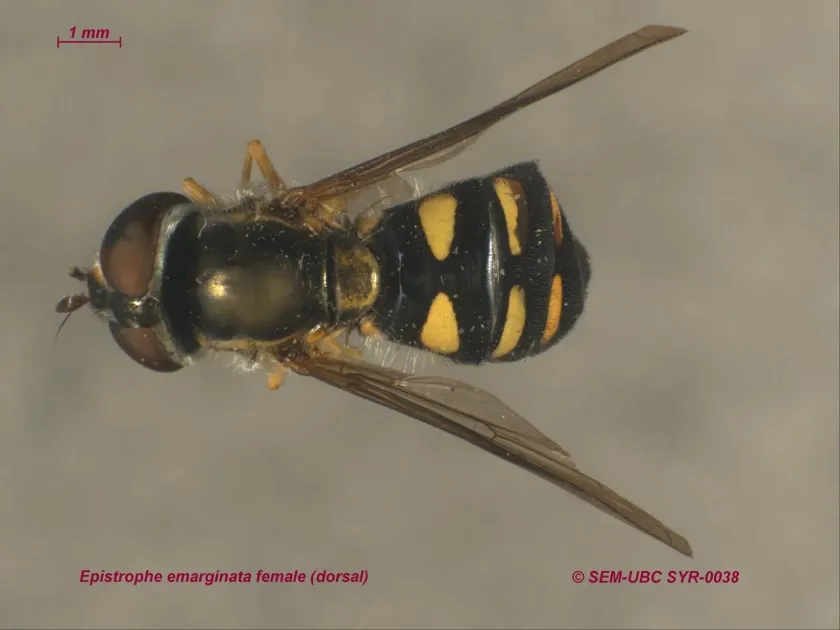
Adults possess a characteristic wasp-like appearance with yellow and black markings on the abdomen, which is a common mimicry strategy among hoverflies to deter predators.
The larvae are typically soft-bodied and slug-like, specifically adapted to navigate leaves and stems while searching for prey within aphid colonies.
The life cycle encompasses four distinct stages: egg, larva, pupa, and adult, with the larval stage being the most critical for agricultural pest management.
They are frequently observed hovering near flowers or plants infested with aphids, where they search for suitable locations to deposit their eggs.
What it damages
It is crucial for agronomists to recognize that Epistrophe emarginata is not a plant pest. It causes no physical or physiological damage to agricultural crops.
Instead, its larvae are voracious predators of aphids, which are significant pests that transmit plant viruses and weaken crops by extracting sap.
By effectively reducing aphid populations through predation, these hoverflies act as a natural biological control agent, enhancing crop health and productivity.
There are no recorded instances of this insect consuming or destroying plant tissues, meaning it poses absolutely no threat to the harvest.
Therefore, farmers should identify this insect as an ally and distinguish it from harmful pests to avoid unnecessary and harmful insecticide applications.
Control measures
Since the species is beneficial, no control measures to eliminate it are needed. On the contrary, conservation and habitat management are recommended to support their population.
Reducing the use of broad-spectrum insecticides is the most effective way to protect these predators, as chemicals often kill beneficial insects along with pests.
Planting flower strips or margins with nectar-rich plants like coriander, dill, and wildflowers provides essential carbohydrates for the adult hoverflies to survive and reproduce.
Implementing integrated pest management (IPM) strategies allows for the coexistence of hoverflies and crops, ensuring that the natural balance is maintained.
Maintaining hedgerows and uncultivated field edges provides necessary overwintering sites, ensuring the presence of Epistrophe emarginata in the coming season.
Taxonomy
- Latin name
- Epistrophe emarginata
- Order
- Diptera (flies)
- Family
- Syrphidae
- EPPO code
- METYEM
Discussion
No discussions yet — be the first.