
28-spotted potato ladybird
Epilachna vigintioctomaculata
Description
How to identify
The 28-spotted potato ladybird is a plant-eating beetle belonging to the Coccinellidae family. Unlike its predatory relatives, this species causes significant damage to agricultural crops.
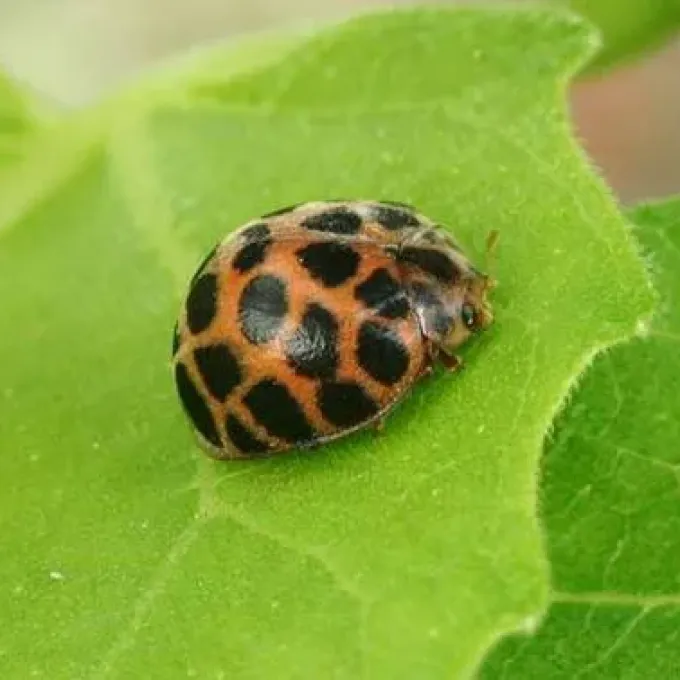
The adult beetle is oval-shaped, measuring about 6-8 mm in length. Its elytra are orange-brown and covered with 28 distinct black spots, which is the primary identifying feature.
The larvae have a yellow body and are covered with branched, spine-like structures. These spines provide defense and make them easily distinguishable on the foliage.
The eggs are elongated, yellow, and laid in clusters on the underside of leaves. Each cluster typically contains 20 to 30 eggs, indicating a localized infestation.
The pupae are also yellowish-orange and are found attached to leaves or stems. They are the transitional stage before the adult beetles emerge to continue the lifecycle.
What it damages
This pest mainly targets Solanaceae crops, with potatoes being the most susceptible. It feeds extensively on leaves, reducing the plant's photosynthetic capacity.
Tomatoes, eggplants, and peppers are also common hosts. In cases of severe infestation, the pests can cause complete defoliation of these plants.
Both adults and larvae feed by scraping the leaf tissue, leaving behind only the veins. This skeletonization process prevents the plant from producing a healthy yield.
Besides leaf damage, the beetles can scar fruits. These wounds often lead to secondary infections by pathogens, causing the fruit to rot prematurely.
Economic losses are severe as the damage directly impacts the quality and quantity of the harvest, forcing farmers to seek urgent intervention.
When it appears
Adult beetles overwinter in the soil under debris, leaf litter, or sheltered areas. They emerge in the spring once temperatures become consistently warm.
The peak activity occurs during the summer, particularly during the flowering and fruit-setting stages of the host plants. Two generations per year are possible in warmer regions.
The developmental cycle from egg to adult takes about a month, depending on environmental conditions. Fast development allows populations to surge in a short time.
Most damage occurs in the late summer months. Monitoring programs should focus on these periods to identify and manage larvae before they reach maturity.
As autumn approaches, the new generation of adults searches for overwintering sites, making crop rotation and field sanitation essential for preventing future outbreaks.
Signs of infestation
The most visible sign of infestation is the skeletonized appearance of leaves, where only the vascular tissue remains. This looks like a fine lace or web.
Finding clusters of yellow eggs on the undersides of leaves is a clear indicator that the population is expanding and requires immediate attention.
The presence of yellow, spiny larvae on the foliage is a definite sign that the pest is actively feeding and destroying the crop's vegetative parts.
Wilting of the plant despite adequate watering can sometimes be a sign that the root system or the overall plant health has been compromised by extreme foliage loss.
Marks or surface pitting on the fruits indicate that the ladybirds have switched from leaf consumption to attacking the produce, requiring rapid pest management.
Control measures
Field sanitation is a primary control method. Removing plant residues and weeds prevents the beetles from finding suitable sites for overwintering.
Manual removal of beetles and larvae is highly effective for small gardens. This method is environmentally friendly and helps maintain low population levels.
Crop rotation is crucial; avoiding planting Solanaceae crops in the same spot for several consecutive years disrupts the pest's lifecycle and reduces buildup.
Chemical control using systemic insecticides is recommended during high-infestation years to protect the crop during its most vulnerable growth stages.
- Use of bio-insecticides targeting larvae.
- Proper weed control to remove alternative hosts.
- Monitoring using yellow sticky traps in greenhouses.
Taxonomy
- Latin name
- Epilachna vigintioctomaculata
- Order
- Coleoptera (beetles)
- Family
- Coccinellidae
- EPPO code
- EPILVI
Discussion
No discussions yet — be the first.