
Leaf katydid
Ephippitytha
Description
How to identify
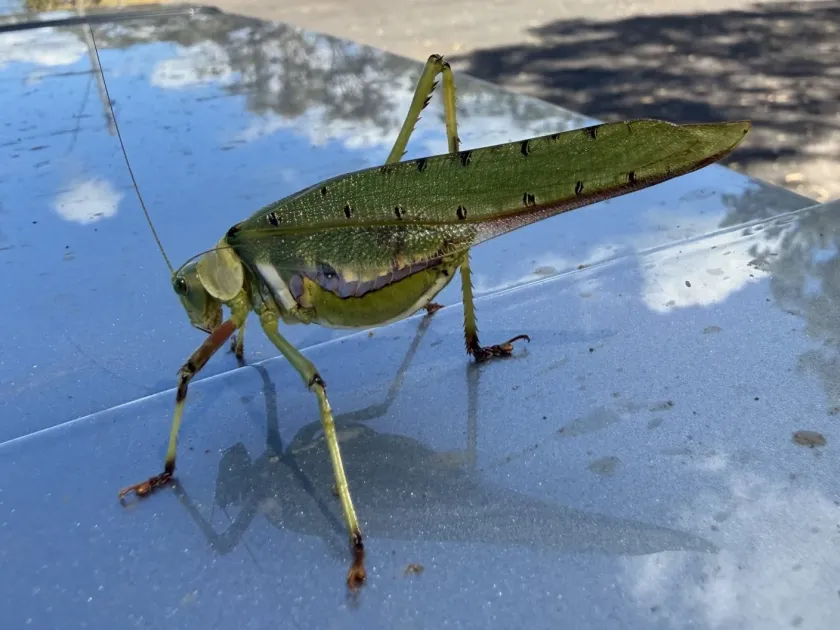
The leaf katydid Ephippitytha belongs to the order Orthoptera and the family Tettigoniidae. This insect is a master of camouflage, with body morphology that perfectly mimics leaves.
Adult insects have well-developed wings with venation patterns that look exactly like the veins of a real leaf. Their color is typically vibrant green, which helps them blend into the foliage of trees and shrubs.
Females possess a distinctive, sabre-like ovipositor used to deposit eggs into plant tissues. Adults usually measure between 30 and 50 millimeters in length, and males are known for their loud nocturnal stridulation.
Nymphs resemble smaller versions of adults but lack fully formed wings. They undergo several molting stages, growing progressively larger until they reach maturity.
They have excellent sensory organs, including large compound eyes and long, sensitive antennae. Their powerful hind legs allow them to jump great distances, making them difficult to catch or monitor.
What it damages
This pest is a polyphage, meaning it feeds on a wide variety of trees and shrubs. It is particularly problematic in fruit orchards, ornamental nurseries, and forestry plantations.
Both nymphs and adults feed on soft leaf tissue, creating irregular, ragged holes. In cases of high infestation, they can cause significant defoliation, which hampers photosynthesis and plant vigor.
In addition to foliage, they frequently feed on young, succulent shoots and fruit sets. This causes stunted growth, physical deformation of branches, and reduced yield quality.
Feeding wounds often serve as entry points for pathogens, leading to secondary bacterial or fungal infections. Weakened plants are more susceptible to environmental stress and further pest attacks.
In nurseries, the leaf katydid is a severe threat to young seedlings. Feeding on terminal buds distorts the plant structure, leading to asymmetrical growth that renders the plants unfit for sale.
When it appears
The activity of the leaf katydid is closely tied to local climate conditions and seasonal temperature fluctuations. Typically, nymph emergence occurs in mid-spring, coinciding with initial plant growth.
Adult activity peaks during the summer months, from June to August. This is the period when they are most actively feeding, reproducing, and preparing for the next generation.
The life cycle is generally univoltine, meaning one generation per year. They overwinter in the egg stage, with females inserting eggs into bark or plant stems for protection against winter conditions.
The optimal temperature range for development is between 22 and 30 degrees Celsius. Hot and humid summers create ideal conditions for population explosions of these insects.
Activity gradually declines as temperatures drop in autumn. Adults die off with the first significant frosts, leaving the eggs to survive the winter safely in the plant tissue.
Signs of infestation
The first sign of infestation is the presence of uneven, jagged holes along the edges of leaves. Unlike caterpillars, katydids often leave a more distinct, rough-edged bite pattern.
Auditory evidence, such as the loud, rhythmic chirping of males during the night, is a strong indicator of their presence within the orchard or garden canopy.
Careful inspection of stems and young branches may reveal small punctures or slits in the bark, which are the sites where females have laid their eggs.
Fecal pellets, appearing as small, dark granules on the leaves or the ground beneath the plant, are a reliable sign of recent feeding activity.
- Distorted terminal shoots.
- Jagged holes in leaves.
- Bark slits from oviposition.
- Loud nocturnal chirping.
Control measures
Cultural control involves systematic pruning and destruction of infested branches to remove overwintering eggs. This is an effective way to lower population density for the following season.
Biological control includes the use of entomopathogenic fungi or bacteria that target young nymphs without harming beneficial insect populations in the garden.
Chemical control should be reserved for cases where the economic threshold is exceeded. Insecticides from the pyrethroid or organophosphate groups are commonly used to mitigate large outbreaks.
Promoting a healthy environment for natural predators, such as birds, lizards, mantids, and ground beetles, helps maintain the population at a manageable level naturally.
On a small scale, manual removal in the early morning when the insects are less active is highly effective. Additionally, light traps can be used for both population monitoring and physical control.
Taxonomy
- Latin name
- Ephippitytha
- Order
- Orthoptera (locusts)
- Family
- Tettigoniidae
- EPPO code
- EPPISP
Discussion
No discussions yet — be the first.