
Provençal saddle-backed bush-cricket
Ephippiger provincialis
Description
How to identify
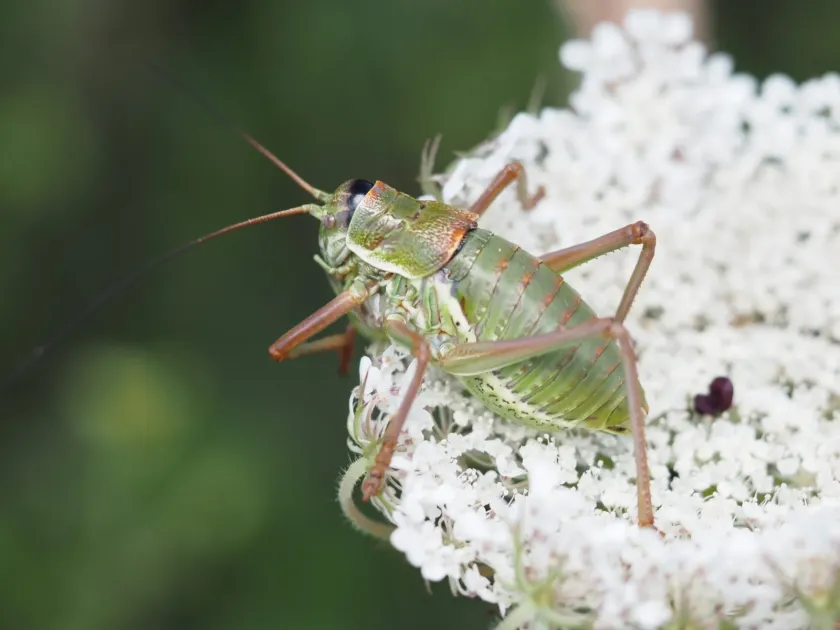
The Provençal saddle-backed bush-cricket Ephippiger provincialis is a large insect belonging to the Tettigoniidae family. It is easily identified by its robust body and the saddle-like shape of its pronotum, which gives the species its common name.
These insects exhibit a camouflage coloration ranging from vibrant green to various shades of brown, blending perfectly into their natural environment. Their wings are significantly reduced, rendering them flightless and forcing them to rely on jumping as their primary mode of movement.
Equipped with powerful mandibles, these bush-crickets are specialized for consuming tough plant fibers. Females possess a long, slightly curved ovipositor, which they use to insert eggs into the soil or plant debris, ensuring their survival through the winter.
The species prefers arid landscapes and open fields, where they are often found in high numbers. They tend to remain in stable populations within specific habitats, which makes them a constant threat to localized agricultural areas.
The nymphs look like miniature versions of the adults, developing through a series of stages known as instars. During this development, they are highly active feeders, constantly moving from one plant to another to satisfy their nutritional requirements.
What it damages
As a polyphagous insect, the Provençal saddle-backed bush-cricket feeds on a wide variety of flora, causing significant damage to commercial crops. Grapes, orchards, and decorative hedges are among their most frequent targets.
Adults consume leaf tissue, creating irregular, ragged holes in the foliage. When the population density is high, they can cause extensive defoliation, which severely restricts the plant's ability to perform photosynthesis and reduces overall yield.
During food scarcity, they often switch to reproductive parts of the plant, such as flower buds, developing ovaries, and young fruit. These feeding habits lead to direct financial losses and reduce the aesthetic value of ornamental plants.
Vineyards are particularly vulnerable to these bush-crickets. Beyond direct physical destruction of the grapes, the damage they cause allows pathogens to enter the fruit, triggering premature rotting and attracting other secondary pests.
Repeated feeding on shoots can cause plant deformities and stunted growth. The cumulative stress from constant pest pressure makes the vegetation susceptible to secondary infections and abiotic environmental stressors.
When it appears
The life cycle is univoltine, meaning there is only one generation per year. The winter is spent in the egg stage, with eggs buried in the soil where they remain dormant and resilient until the environmental conditions become favorable.
In spring, as temperatures rise, the nymphs emerge from the soil. They start feeding almost immediately on the emerging green shoots, rapidly increasing in size and moving through their developmental stages as the season progresses.
Summer marks the period of adult activity, where they reach maturity and focus on mating. This is the time when their feeding activity reaches its peak, resulting in the most severe damage observed by farmers.
As the season shifts toward autumn, the population begins to decline after the females lay their eggs in the soil. The adults die off as temperatures fall, leaving the next generation secured in the ground until the following spring.
Environmental conditions play a crucial role in the timing of their cycle. Dry and warm weather patterns often accelerate the development of nymphs, leading to population explosions that can catch growers by surprise.
Signs of infestation
One of the most obvious signs of a bush-cricket infestation is the presence of ragged, notched leaves. This distinct feeding pattern looks like large chunks have been removed from the leaf edges, often accompanied by dry, brownish margins.
Acoustic monitoring is highly effective; the loud, shrill chirping of the males during evening and early morning hours is a reliable indicator of their presence. The intensity of the sound often correlates with the population size.
Excrement, appearing as dark, elongated pellets, is often found underneath the plant canopy or on the leaves where the insects have been feeding. Detecting these droppings is an excellent way to map the specific areas of high activity.
Deformed or partially eaten fruit and buds are clear indicators of late-stage infestation. Growers should inspect the underside of leaves during the early hours of the day when the insects are less mobile and easier to spot.
In cases of severe infestation, partial or total defoliation of specific branches can occur. Early detection through regular field scouting allows for quick intervention before the population causes irreparable damage to the crop.
Control measures
Management of the Provençal saddle-backed bush-cricket requires an integrated pest management approach that combines mechanical and chemical strategies for the best possible protection of the crop.
Cultivation practices such as deep autumn plowing are essential. By turning over the soil, the eggs are exposed to harsher elements, significantly reducing the survival rate for the next season's population.
Mechanical control via hand-picking is viable for smaller plots or home gardens. Since these insects are less active at dawn and dusk, these are the optimal times for manual removal and destruction of the pests.
If population thresholds exceed economic damage levels, contact insecticides should be applied. The application should target the nymph stages to eliminate the pests before they can develop into breeding adults.
- Mowing surrounding weeds and grass reduces harborages for the insects.
- Encouraging natural predators like birds and predatory beetles to keep numbers down.
- Installing sticky barriers on young tree trunks to prevent nymphs from climbing.
- Avoiding over-spraying to preserve beneficial insects that act as natural biological controls.
Taxonomy
- Latin name
- Ephippiger provincialis
- Order
- Orthoptera (locusts)
- Family
- Tettigoniidae
- EPPO code
- EPHPPR
Discussion
No discussions yet — be the first.