
Ephippiger cavannai
Ephippiger cavannai
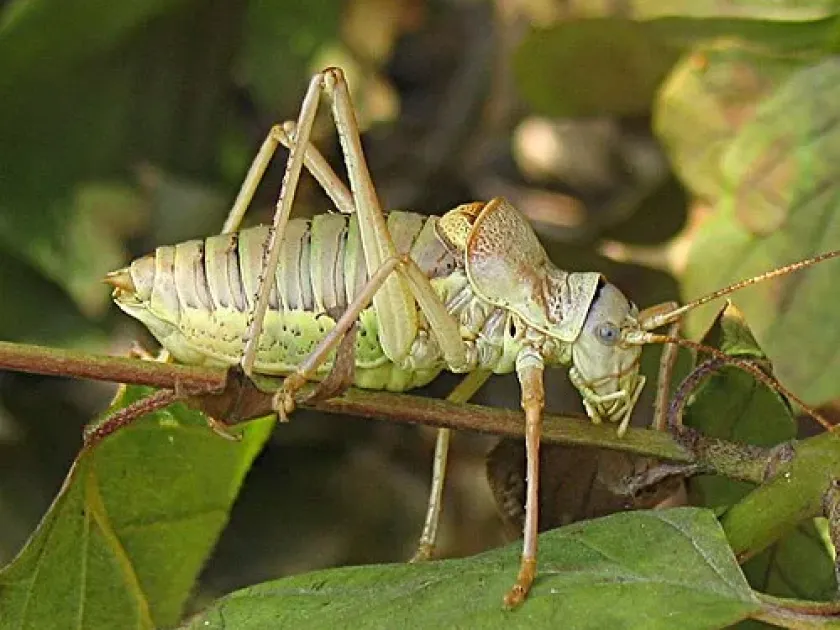
Description
How to identify
Ephippiger cavannai belongs to the order Orthoptera and the family Tettigoniidae (true bush-crickets). This insect has a robust body characteristic of the Ephippiger genus and possesses heavily reduced elytra (wing covers), rendering it incapable of sustained flight.
The species is distinguished by a specific coloration that allows it to perfectly camouflage among dry grass and plant stems. The color varies from light green to brownish, serving as a defensive mechanism against predators in its natural habitat.
Females of this species have a long, slightly curved ovipositor, which enables them to deposit eggs deep into plant tissues or the soil. The insect's head is large, featuring powerful chewing mouthparts adapted for grinding tough plant fibers.
Adult individuals possess strongly developed hind jumping legs, allowing them to move rapidly across an area when sensing danger. The overall size of the adults can vary depending on feeding conditions and regional climatic factors.
A distinctive feature is the presence of specialized sound-producing organs on the elytra of males, which emit characteristic stridulating sounds during the mating season, often helping agronomists detect the presence of the population.
What it damages
This grasshopper species is a polyphagous insect, meaning it is capable of feeding on a wide range of plant crops. It causes the most significant damage to vegetable, grain, and fruit crops by actively chewing their aerial parts.
During periods of mass reproduction, Ephippiger cavannai can cause severe damage to leaves, young shoots, and even fruit ovaries, leading to significant yield losses and weakening the overall health of the plants.
The pest poses a particular threat to young seedlings in nurseries, where damage to the growing point can lead to the complete death of the plant. It also frequently infests and damages cultivated pastures and grasses.
Beyond direct mechanical tissue damage, the pest's presence creates conditions for secondary infections. Pathogenic fungi and bacteria often settle in the bite marks, penetrating deep into the plant through these wounds.
Economic damage increases in years with dry summers when natural food sources in the wild dwindle, prompting grasshoppers to mass-migrate into irrigated or more succulent agroecosystems.
When it appears
The life cycle of the insect is closely tied to seasonal rhythms. They overwinter as eggs laid in the soil or plant debris, which ensures high offspring survival even under harsh winter conditions.
Nymphs emerge in the spring, usually in late April or May, when average daily air temperatures become consistently positive. Nymphal development involves several molting stages, accompanied by intensive feeding.
The peak activity of adults occurs in the second half of the summer, specifically July and August. It is during this time that damage to plantings is most pronounced, as the insects reach their physiological peak.
Reproduction takes place at the end of the summer season. Males actively attract females with sound signals, followed by mating and egg deposition into the substrate to prepare for the winter period of dormancy.
The full developmental cycle takes one year. Thus, the presence of the pest on a site is seasonal, though the high fecundity of females allows the population to recover rapidly from year to year.
Signs of infestation
The first sign of the pest's presence is the occurrence of characteristic jagged edges on the leaves of cultivated plants. Unlike caterpillars, grasshoppers often leave marks with uneven, rough cuts.
Observing the pest's activity is facilitated visually: the insects are relatively large and clearly visible on plant stems during morning and evening hours when their activity reaches its peak.
The evening stridulation, audible within a radius of several dozen meters from the infestation site, is a reliable indicator of a significant population of male Ephippiger cavannai in a field or orchard.
The presence of excrement in the form of small granules beneath damaged leaves is also a characteristic indicator of orthopteran activity, allowing for differentiation from other types of pests.
In cases of mass infestation, stripping of plant stems is observed, with lower tiers sometimes being completely eaten, leading to a rapid loss of marketability for the produce.
Control measures
Control of Ephippiger begins with agrotechnical measures, including deep autumn plowing of the soil. This effectively destroys overwintering egg sites and drastically reduces the density of the future population in the next season.
The use of contact-stomach insecticides is effective during the nymph emergence period. It is crucial to perform treatments early, before the insects reach sexual maturity and begin active reproduction.
Biological control methods include maintaining the population of natural enemies, such as birds, insectivorous mammals, and predatory insects, which actively regulate grasshopper numbers in natural conditions.
On small plots and in greenhouses, it is advisable to use mechanical barriers and perform regular plant inspections, followed by manual collection of individuals if the pest population does not exceed the critical threshold.
To prevent the migration of pests from adjacent areas, it is recommended to mow weeds along the field edges and remove dry debris, which serves as an ideal shelter for adults during hot periods of the day.
Taxonomy
- Latin name
- Ephippiger cavannai
- Order
- Orthoptera (locusts)
- Family
- Tettigoniidae
- EPPO code
- EPHPCA
Discussion
No discussions yet — be the first.