
Parsnip moth
Epermenia chaerophyllella
Description
How to identify
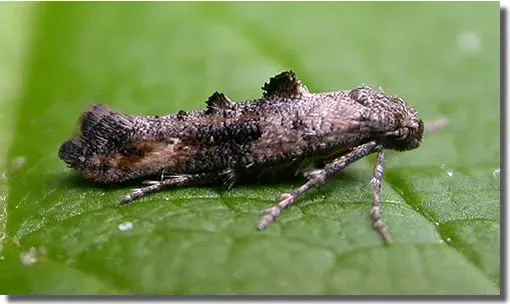
The Parsnip moth Epermenia chaerophyllella belongs to the order Lepidoptera and the family Epermeniidae. The adult moth is small, with a wingspan ranging from 12 to 15 millimeters.
The forewings have a distinctive brownish-grey appearance with dark spots and light flecks. The hindwings are narrow, fringed with long hairs, which is a diagnostic feature for this family.
The larvae, or caterpillars, grow up to 12 mm long and have a yellowish-green body with dark spots on each segment. Their heads are usually dark brown, making them recognizable.
The pupae are typically encased in a loose, net-like cocoon. The moth prefers to spin these cocoons on the underside of leaves or within folded leaf edges for better protection.
The species undergoes a complete metamorphosis. The life cycle consists of egg, larva, pupa, and adult stages, with the number of generations per year depending on the climate.
What it damages
This pest mainly attacks plants of the Apiaceae (Umbelliferae) family. Major crops affected include carrots, parsnips, celery, parsley, and dill.
The moth also thrives on wild umbelliferous plants such as hogweed and angelica. These wild hosts serve as a reservoir for the pest, allowing it to move to cultivated areas easily.
Larvae are the primary cause of damage. They feed on the leaves, creating irregular mines or translucent patches as they consume the inner tissues, severely limiting the plant's photosynthetic capacity.
During heavy infestations, caterpillars may also attack stems and flower heads. This feeding behavior can stunt growth and significantly reduce the yield of root crops and seed production.
Secondary infections, particularly fungal pathogens, often enter the plant through the wounds created by the caterpillars. This causes decay, wilting, and a general decline in the quality of the vegetables.
When it appears
Adult moths typically overwinter in sheltered locations, such as leaf litter, under tree bark, or in plant debris. They become active as soon as temperatures rise in the spring.
Oviposition occurs throughout the spring and summer months. Females lay eggs individually or in small batches on the undersides of leaves, prioritizing the most succulent plant parts.
The first generation of caterpillars is active in late spring and early summer. A second generation often emerges later in the season, extending the risk period into July and August.
Environmental factors like temperature and humidity play a significant role in the moth's development speed. Warmer, wetter conditions typically lead to more rapid population growth.
As autumn approaches, the adults begin to prepare for hibernation. Cleaning up garden debris after harvesting is a critical step to remove potential overwintering sites for the next year.
Signs of infestation
Early symptoms include tiny light-colored spots on the foliage that develop into larger, pale mines. These areas appear transparent where the internal leaf tissue has been consumed.
Fine silk webbing on the leaves is a strong indicator of larval activity. The caterpillars use this silk to anchor themselves and build protective structures for feeding.
Deformed shoots and wilting flower buds are common signs of infestation. In seed crops, the destruction of developing buds directly impacts the success of the harvest.
The presence of frass (larval excrement) inside the mines confirms that the pest is still actively feeding. This distinguishes mining damage from simple environmental leaf spots.
Premature yellowing or browning of foliage, particularly on otherwise healthy plants, often suggests that caterpillars are hidden within the leaf stalks or central growing point.
Control measures
Cultural control is the most effective approach. Removing wild Apiaceae weeds from the vicinity of the garden significantly reduces the initial population of moths in the spring.
Implementing a proper crop rotation plan is essential. Avoid planting Apiaceae crops in the same area for at least three consecutive years to disrupt the moth's life cycle.
Tilling the soil deeply in the autumn can destroy pupae hidden in the ground, preventing them from emerging as adults in the following growing season.
Chemical control may be necessary if thresholds are exceeded. Insecticides should be applied during the early stage of larval emergence before extensive mining damage occurs.
Monitoring the moth population with pheromone or light traps helps in determining the precise timing for intervention, ensuring that control measures are both timely and effective.
Taxonomy
- Latin name
- Epermenia chaerophyllella
- Order
- Lepidoptera (butterflies)
- Family
- Epermeniidae
- EPPO code
- EPRMCH
Discussion
No discussions yet — be the first.