
Ennearthron
Ennearthron
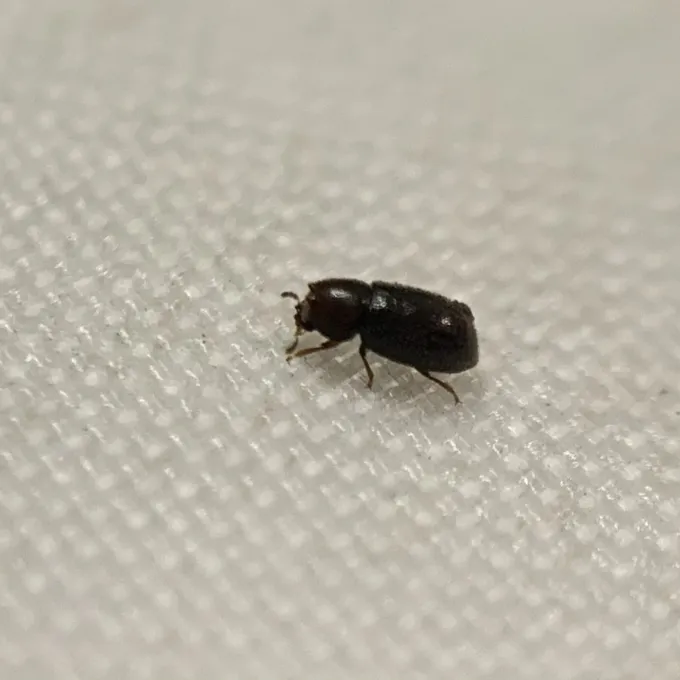
Description
How to identify
Ennearthron is a genus of beetles belonging to the family Bostrichidae (or the subfamily Ciidae, depending on the taxonomy). These are tiny insects, typically measuring between 2 and 3 millimeters in length.
Adult beetles are characterized by a cylindrical body shape, typical for many wood-boring species. Their coloration is usually dark brown or black, providing excellent camouflage on the bark or wood surface.
The head is often tucked under the pronotum when viewed from above, which is a diagnostic feature for this family. Their mouthparts are strong and adapted for gnawing through firm plant tissues.
Larvae are C-shaped, creamy-white in color, and lead a cryptic life inside the woody substrate. Because they hide deep within their food source, they are rarely seen without opening the wood.
Proper identification requires careful observation of the specific exit holes and, in many cases, examination of the beetles under a microscope to distinguish them from other closely related wood borers.
What it damages
The primary food source for Ennearthron is the mycelium of wood-decay fungi found on dead or weakened trees. Unlike many other wood borers, they are specialists in consuming fungal growth within the wood.
These beetles infest various hardwood and softwood species that are in a state of decay. They are frequently found in fallen logs, standing dead trees (snags), and old stumps where fungal colonization has occurred.
In a commercial context, Ennearthron can become a problem in timber yards if wood is stored under damp conditions. Excess moisture encourages the growth of fungi, which in turn attracts these beetles.
While they are not typically primary pests of healthy living trees, their activity accelerates the degradation process of wood. They play a significant role in forest ecology by breaking down organic matter.
In rare instances, if building timber is exposed to prolonged moisture and fungal decay, these beetles may colonize structural elements, necessitating remediation and moisture control.
When it appears
Adult activity of Ennearthron is highly dependent on ambient temperature, with peak movement usually occurring during the warm spring and summer months.
The duration of the life cycle varies based on climate and wood moisture content. In optimal conditions, multiple generations can occur within a single growing season.
Overwintering takes place inside the wood substrate, where both larvae and adults can survive cold temperatures. The depth of the wood provides thermal protection against freezing.
In spring, as wood temperatures rise, the beetles emerge to mate. Females deposit eggs in bark crevices or fungal entry points, ensuring the offspring have immediate access to their fungal food source.
Monitoring programs, utilizing light traps or visual inspection, are most effective from May to August to assess population levels and prevent potential outbreaks in timber stores.
Signs of infestation
The most visible sign of an Ennearthron infestation is the presence of small, perfectly round exit holes on the surface of the timber, created as adults emerge.
Fine frass, consisting of wood dust mixed with larval excrement, is often found piled near these exit holes. The color of the frass usually matches the color of the infested wood.
When the wood is split, a network of galleries can be observed. These tunnels are often packed with fungal mycelium, confirming the beetle's reliance on these fungi as a primary nutrient source.
The presence of fungal fruiting bodies (mushrooms/brackets) on the surface of the wood serves as a strong indicator that the internal environment is suitable for Ennearthron.
Finding the insects themselves or their larvae within the fungal-laden tunnels is the final diagnostic proof of active infestation within the wood substrate.
Control measures
The most effective strategy for preventing Ennearthron infestations is the maintenance of dry storage conditions. Reducing wood moisture content below 20% effectively halts fungal growth.
Sanitation is crucial; forest managers should remove slash, fallen logs, and diseased trees from the vicinity of timber yards to eliminate natural breeding reservoirs.
Applying antiseptic wood preservatives to stored timber can prevent the establishment of decay fungi. Without the fungi, the beetles cannot survive, thus protecting the structural integrity of the material.
If wooden structures are infested, they should be thoroughly dried and, if necessary, replaced. Targeted deep-penetrating insecticides can be used to reach larvae within the wood galleries.
- Regular inspection of stored timber for signs of new bore holes.
- Proper stacking of lumber to facilitate air circulation and drying.
- Removal of all sources of fungal infection from the storage area.
Taxonomy
- Latin name
- Ennearthron
- Order
- Coleoptera (beetles)
- Family
- Ciidae
- EPPO code
- ENNRSP
Discussion
No discussions yet — be the first.