
Fungus beetle
Cis boleti
Description
How to identify
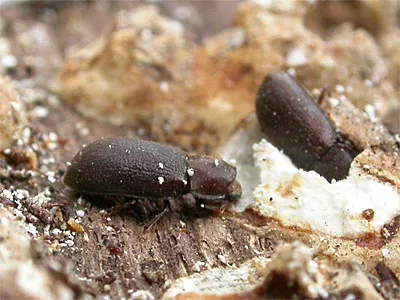
The fungus beetle (Cis boleti) is a member of the Ciidae family within the order Coleoptera. These are tiny insects, typically measuring between 2 and 3 mm in length, characterized by a cylindrical, elongated body shape.
Their coloration ranges from dark brown to black. They possess dense, often hair-covered wing cases (elytra) that provide protection while they move through the tough tissues of fungal fruiting bodies.
The larvae of this beetle are small, white, and curved in shape, with a well-developed head capsule. They lead a cryptic, internal lifestyle, burrowing deep inside the mushroom flesh, which makes them difficult to spot.
The lifecycle of Cis boleti is intrinsically linked to the presence of decaying or cultivated fungi. Both adults and larvae occupy the same space, feeding on the fungal substrate continuously.
Females lay their eggs either directly into the pores of the fungus or within its tissue, ensuring that larvae have an immediate food source upon hatching, which facilitates rapid colonization.
What it damages
This beetle primarily feeds on wood-decaying fungi (polypores) and is known to infest cultivated mushrooms, including oyster mushrooms (Pleurotus ostreatus). In indoor cultivation, they can cause significant yield loss.
Larvae consume the interior tissue of the fruiting body, creating extensive tunnel networks. This physical damage destroys the structural integrity of the mushroom, rendering it soft and unmarketable.
Severe infestations turn the internal mushroom structure into a dusty, crumbly mess filled with larval frass. Such mushrooms are completely unsuitable for human consumption or processing.
Beyond the direct physical destruction, the beetles act as vectors for various pathogens, including molds and bacteria, which enter through the tunnels and cause secondary rot of the mycelium.
The economic impact is high because these beetles can quickly spread throughout a mushroom house if proper hygiene protocols are not maintained during the production cycle.
When it appears
In natural forest environments, the fungus beetle is active throughout the growing season of mushrooms, from spring to late autumn. However, in controlled indoor environments, they can breed year-round.
The optimal temperature range for their development is between +15°C and +25°C, which perfectly overlaps with the conditions required for commercial mushroom cultivation.
Beetles overwinter primarily as adults, finding shelter inside dried-out mushroom fruiting bodies or under tree bark, where they remain protected from extreme cold and desiccation.
As temperatures rise in the spring, the beetles emerge to seek out fresh fungal hosts. Their activity peaks during periods of high fungal fruiting in both wild and cultivated settings.
Multiple generations can occur in a single year within climate-controlled mushroom farms, meaning that constant monitoring is essential to prevent large-scale outbreaks.
Signs of infestation
The most visible sign of infestation is the presence of minute circular holes (less than 1 mm in diameter) on the surface of the mushroom cap or stem, created by emerging adults.
Upon breaking open an affected mushroom, one can see internal tunnels and a buildup of "mushroom flour," which is essentially the larval waste and chewed-up fungal tissue.
Affected mushrooms often show signs of stunted growth or premature wilting. In some cases, the mushroom may develop a faint, musty odor due to the secondary presence of mold spores.
If the infection is heavy, beetles can often be observed on the surface of the substrate blocks or the walls of the cultivation chamber during the evening or night.
Finding fine dust or debris accumulating underneath the growing mushrooms is a major warning sign that requires an immediate inspection and control intervention.
Control measures
The cornerstone of fungus beetle management is rigorous hygiene. This includes the complete removal of all spent mushroom substrate and cleaning of equipment between production cycles.
- Thorough heat treatment (pasteurization) of the growth substrate to kill all life stages of the beetle.
- Regular inspections of fruiting bodies to remove any signs of infestation before beetles can emerge.
- Installing fine-mesh screens on ventilation systems to prevent adult beetles from entering from outside.
- Maintaining proper climate control to prevent conditions that favor explosive insect reproduction.
Due to the sensitivity of mushrooms to chemical treatments, biological control agents and strict cultural practices are the preferred methods for long-term pest management.
Taxonomy
- Latin name
- Cis boleti
- Order
- Coleoptera (beetles)
- Family
- Ciidae
- EPPO code
- CISXBO
Discussion
No discussions yet — be the first.