
Chinese fungus beetle
Cis chinensis
Description
How to identify
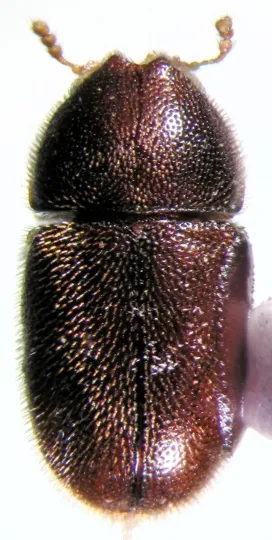
The Chinese fungus beetle (Cis chinensis) belongs to the Ciidae family, a group of small beetles that live within the fruiting bodies of various fungi.
These insects are typically cylindrical in shape, measuring approximately 2–3 mm in length, with coloration ranging from reddish-brown to black.
Larvae are characterized by a soft, white, curved body and are perfectly adapted for burrowing and consuming the dense tissue of fungal sporocarps.
Identification is often difficult without professional entomological equipment, as many species within the Cis genus share similar morphological traits.
The presence of specific features on the pronotum in males is one of the most reliable diagnostic markers used by researchers to identify this particular species.
What it damages
The primary impact of these beetles is the degradation of polypore fungi, which grow on both living and dead wood in forest environments.
By consuming the internal tissues and the hymenium (spore-bearing layer), the beetles significantly impede the reproductive capability of the host fungus.
While the beetle itself does not consume the wood, its activity promotes the rapid disintegration of fungal fruiting bodies, which may otherwise provide habitat for other beneficial insects.
In forestry contexts, a high density of these beetles can be a signal that a specific area of the forest is suffering from widespread wood-decay fungal infections.
The damage to the fungus is cumulative, meaning that over time, the entire internal structure of the polypore can be transformed into a mass of frass.
When it appears
The life cycle of the Chinese fungus beetle is closely linked to the seasonal development of its host fungi during the warmer months of the year.
Adult beetles become active in early spring, emerging from overwintering sites within old fungi or woody debris to locate fresh fruiting bodies for egg-laying.
Multiple generations can occur throughout the summer, provided that environmental moisture levels remain high enough to support fungal growth.
As autumn temperatures drop, the metabolic activity of the beetles slows down, and they enter diapause, often staying within the fungal tissues throughout the winter.
The peak infestation period usually coincides with the height of the fungal sporulation season, when mushrooms are most abundant and nutritionally suitable for the larvae.
Signs of infestation
The most visible sign of an infestation is the presence of numerous minute, circular holes on the surface of the fungal cap, representing exit holes of adults.
Fine, dusty frass, which consists of wood fibers and fungal remains, is often found scattered beneath the affected fungal fruiting body.
Internal examination of a suspected mushroom will reveal a labyrinth of narrow tunnels packed with larval stages and adult beetles feeding on the tissue.
Affected fruiting bodies often lose their structural integrity, becoming fragile or collapsing prematurely compared to healthy, non-infested specimens.
Surface discoloration or premature darkening of the fungal cap may also occur as a result of internal colonization by the beetle larvae.
Control measures
Control of Cis chinensis is primarily achieved through sanitation practices rather than chemical applications, which are largely impractical.
Removing and destroying infected fungal fruiting bodies from trees and stumps can drastically reduce local populations of the beetle.
Maintaining a healthy forest ecosystem by clearing out overly decayed wood helps limit the spread of wood-rotting fungi, thereby eliminating the host source for the beetles.
Encouraging natural predators such as parasitoid wasps or predaceous beetles can provide effective biological control against these wood-inhabiting pests.
Proper management of plantation forests should focus on reducing the conditions that favor excessive fungal growth on the stems of valuable trees.
Taxonomy
- Latin name
- Cis chinensis
- Order
- Coleoptera (beetles)
- Family
- Ciidae
- EPPO code
- CISXCH
Discussion
No discussions yet — be the first.