
Endoxyla wood moth
Endoxyla
Description
How to identify
The Endoxyla genus belongs to the Cossidae family within the order Lepidoptera. These insects are commonly known as wood moths, and their larvae live inside tree trunks and branches, making them a serious hidden threat.
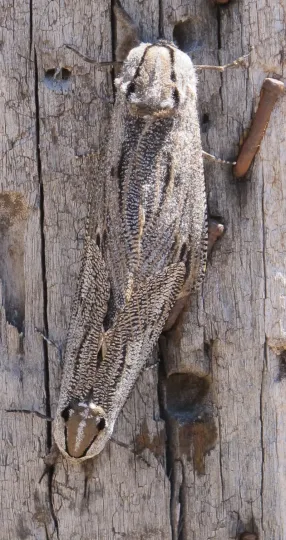
Adult moths are heavy-bodied with grey or brown cryptic coloration, allowing them to blend perfectly with tree bark. Some species in this genus have a significant wingspan, marking them as some of the largest Lepidoptera in their respective regions.
The larvae possess powerful mandibles adapted for boring through solid wood. They generally have pale, yellowish or pinkish bodies, typical of many wood-boring moth species.
Pupation occurs entirely within the gallery (tunnel) carved by the larva. Before the adult emerges, the pupa pushes itself partially out of the exit hole, allowing the moth to escape the tree trunk safely.
Identifying the exact species is often difficult due to their nocturnal and wood-dwelling habits. Identification typically relies on examining the damage patterns and the morphology of adult specimens.
What it damages
These pests primarily target various Eucalyptus species and other hardwood trees. In agroforestry or urban landscapes, they can infest both wild and cultivated tree species.
Larvae excavate extensive galleries within the wood, which disrupt nutrient and water flow, severely weakening the tree's physiological state and leaving it vulnerable to secondary fungal pathogens.
Heavy infestations often lead to premature branch dieback and, in some cases, the total collapse of younger trees. In timber plantations, this leads to significant economic loss due to degraded wood quality.
The structural integrity of the trunk can be compromised by the extensive network of tunnels. In high-wind conditions, infested trees are significantly more prone to stem snapping at the site of larval activity.
While the moth often prefers already stressed or damaged trees, high-density populations allow them to successfully attack healthy, vigorous specimens as well.
When it appears
The life cycle of the Endoxyla genus is prolonged and may span several years, depending on the environmental conditions. Larvae remain active and continue feeding throughout the warmer months.
Adult emergence typically occurs during the warm season, when environmental conditions are optimal for mating and egg-laying within bark crevices.
Overwintering occurs within the larval tunnels inside the tree, providing protection from harsh winter temperatures and external predators. Feeding resumes once spring temperatures rise.
Pupation is also climate-dependent, generally occurring in late spring or early summer when tree sap flow is active and provides necessary resources for the maturing larvae.
Monitoring adult flight periods using light traps or pheromone lures (where available) is crucial for timing effective management interventions.
Signs of infestation
The most visible sign of infestation is the accumulation of frass (larval excrement mixed with wood shavings) at the base of the tree or within branch forks.
Small, round, or oval-shaped exit holes on the bark indicate where the larvae have been active and are the primary points from which waste is expelled.
In some cases, gum or resin exuding from entry points is a clear sign that the tree is reacting defensively to the larval boring activities.
A thinning crown, yellowing leaves, or premature leaf drop are indirect signs that the tree's internal transport system has been damaged by wood-boring larvae.
Careful inspection of the trunk may reveal patches of dead bark, which often conceal active entry points or galleries bored into the cambium layer.
Control measures
Cultural control, including proper tree maintenance and the removal and destruction of heavily infested branches or trees, is the first line of defense.
Systemic insecticides, applied via trunk injections, are currently the most effective method for targeting and killing the hidden larvae inside the wood.
Biological control methods include the application of entomopathogenic nematodes or specialized fungal sprays directed into the galleries to infect and eliminate the larvae.
Regular surveillance and mechanical cleaning of loose bark can help disrupt the moth's egg-laying process and improve tree health.
- Enforce quarantine measures to prevent the spread via nursery stock.
- Encourage the presence of natural predators like birds and parasitic wasps.
- Select resistant tree species or varieties for new landscape or forest plantings.
Taxonomy
- Latin name
- Endoxyla
- Order
- Lepidoptera (butterflies)
- Family
- Cossidae
- EPPO code
- EDXLSP
Discussion
No discussions yet — be the first.