
Favier's Paussid Beetle
Edaphopaussus favieri
Description
How to identify
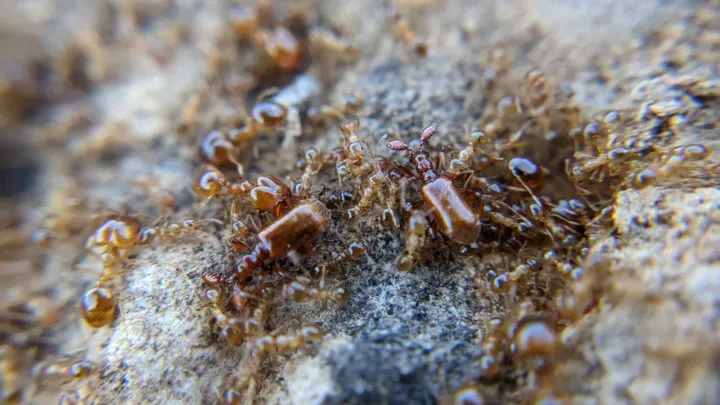
The Favier's Paussid beetle (Edaphopaussus favieri) is a member of the ground beetle family (Carabidae), specifically the subfamily Paussinae. These insects have evolved highly specialized traits for myrmecophily.
The most distinctive morphological feature of this species is its heavily modified, thickened antennae, which serve as an important diagnostic character for identifying the subfamily.
Their bodies are typically smooth and polished, exhibiting a reddish-brown coloration that allows them to blend into their environment within ant colonies.
Adult beetles measure between 6 and 9 millimeters. Their anatomy is a result of a long evolutionary process of adaptation to living within the high-pressure environment of ant nests.
Precise identification of Edaphopaussus favieri usually requires an expert analysis of genital morphology to distinguish it from related species within the Paussinae group.
What it damages
The Edaphopaussus favieri does not inflict direct mechanical damage on agricultural crops, as it does not feed on plant tissues or foliage during its lifecycle.
However, its presence is significant from an agronomic standpoint because it serves as an indicator of dense ant populations residing within the crop area.
Ants, which host these beetles, are known to farm and protect aphids, which in turn cause severe damage to crops by sucking sap and spreading viral diseases.
Therefore, while the beetle itself is not a primary pest, its ecological role as an ant-nest inhabitant means it contributes to conditions that favor secondary crop damage.
Managing the ant colonies is the only necessary intervention, as the beetle's impact on agricultural productivity is purely indirect and linked to its host insects.
When it appears
The seasonal activity of the Favier's Paussid beetle is strictly synchronized with the life cycle and activity levels of the ant species it inhabits.
They are most active during the spring and summer months when ground temperatures are high and ant colony activity is at its maximum peak.
The development of the beetle, including its pupal stage, occurs within the secure environment provided by the ant colony, which shields the insects from external predators.
As temperatures decline in late autumn, both the ants and their associated beetles retreat deeper into the soil profile to overwinter in a state of diapause.
The population density is highest during the hottest months, reflecting the metabolic requirements of both the beetles and their ant hosts.
Control measures
There are no specific pesticide protocols established for the control of Edaphopaussus favieri, as it is not considered a direct threat to commercial crops.
Control strategies should focus on the integrated pest management of ants, as removing the host colony eliminates the ecological niche required by these beetles.
Recommended interventions involve the use of registered insecticides targeted at ant mounds and common pathways to reduce overall colony pressure.
- Utilizing sticky barriers on tree trunks to prevent ant movement.
- Applying soil-based treatments to nesting sites to disrupt colony structure.
- Regular cultivation and soil aeration to disturb subterranean ant chambers.
By effectively managing the ant population, farmers will naturally suppress the presence of Paussid beetles, ensuring better overall crop health.
Taxonomy
- Latin name
- Edaphopaussus favieri
- Order
- Coleoptera (beetles)
- Family
- Carabidae
- EPPO code
- EDAPFA
Discussion
No discussions yet — be the first.