
Edaphopaussus
Edaphopaussus
Description
How to identify
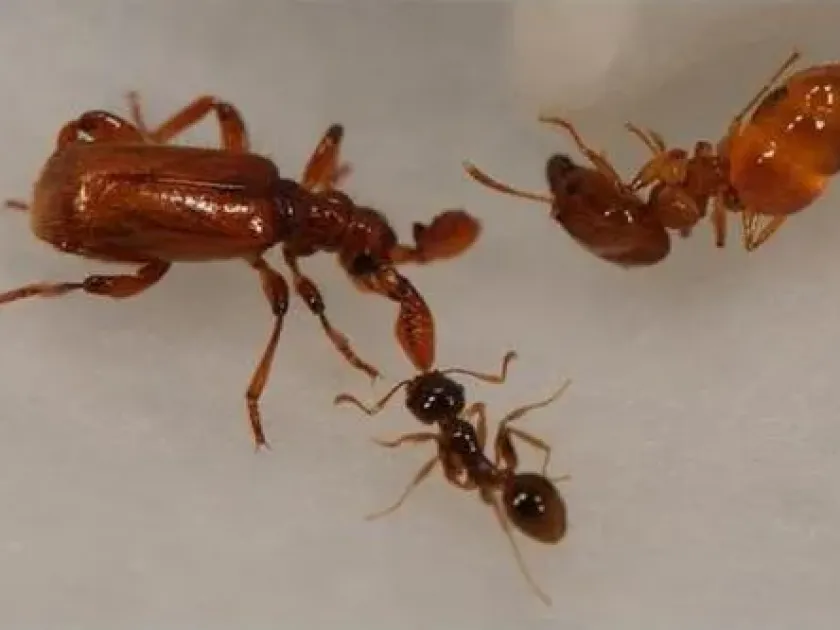
Edaphopaussus is a genus of ground beetles (Carabidae) belonging to the subfamily Paussinae. These insects are well-known for their unique evolutionary relationship with ants.
The morphology of these beetles is highly specialized, characterized by flattened bodies and uniquely developed antennae used to interact with their host ant colonies.
Adult beetles are relatively small, typically measuring just a few millimeters, making them difficult to spot in dense agricultural soils.
Their exoskeleton is often hard and may possess specialized trichomes or glandular structures that secrete chemicals to appease the ants.
Identification often requires careful microscopic examination of adult morphology, as many species within the tribe Paussini appear quite similar.
What it damages
Edaphopaussus beetles are not primarily phytophagous and do not usually consume plant tissues directly, thus causing little mechanical damage to crops.
The main impact is indirect: these beetles act as parasites or guests in ant nests, which can disrupt the ants' role in protecting honeydew-secreting insects.
By interfering with ant behavior, Edaphopaussus may inadvertently promote the proliferation of aphids or mealybugs in certain crop systems.
The presence of these beetles serves as an indicator of significant soil arthropod activity, which is an important consideration in integrated pest management.
Economic damage is typically non-existent unless the population density becomes unusually high, influencing the balance of beneficial vs. harmful insects.
Control measures
There are no specific pesticide protocols for Edaphopaussus, as their role in the agricultural environment is subtle and usually beneficial to soil health.
If population control is required, cultural practices like crop rotation and soil tillage effectively disrupt their habitat and the associated ant colonies.
Maintaining healthy soil biodiversity helps suppress population spikes, ensuring that no single species becomes overly dominant in the field.
Integrated Pest Management (IPM) programs focus on controlling the primary pests, such as aphids, rather than targeting these commensal beetles.
Monitoring using pitfall traps is recommended to gather data on the presence and activity of various ground-dwelling coleoptera within the crop rotation cycle.
Taxonomy
- Latin name
- Edaphopaussus
- Order
- Coleoptera (beetles)
- Family
- Carabidae
- EPPO code
- EDAPSP
Discussion
No discussions yet — be the first.